Athletic halls of fame represent powerful tools for school administrators seeking to honor athletic excellence, preserve program history, and inspire current student-athletes. These recognition systems celebrate championship teams, individual achievement milestones, coaching legacies, and the competitive excellence that defines successful athletic programs.
School administrators face distinct challenges when establishing athletic halls of fame. How do you create fair selection criteria that honor diverse accomplishments? What infrastructure investments ensure sustainable recognition that grows with your program? How can you balance honoring historical achievements while maintaining space for future inductees? Where do traditional physical displays meet modern digital solutions?
This comprehensive guide provides school administrators with practical frameworks for creating, implementing, and managing athletic halls of fame that appropriately honor competitive excellence, preserve institutional athletic heritage, and inspire current student-athletes through meaningful recognition of those who came before.
Athletic recognition serves multiple institutional objectives beyond simply honoring past achievements. Well-designed halls of fame strengthen school pride, provide tangible goals motivating current athletes, preserve program history that might otherwise fade from memory, and demonstrate institutional commitment to athletic excellence that resonates throughout the broader school community.

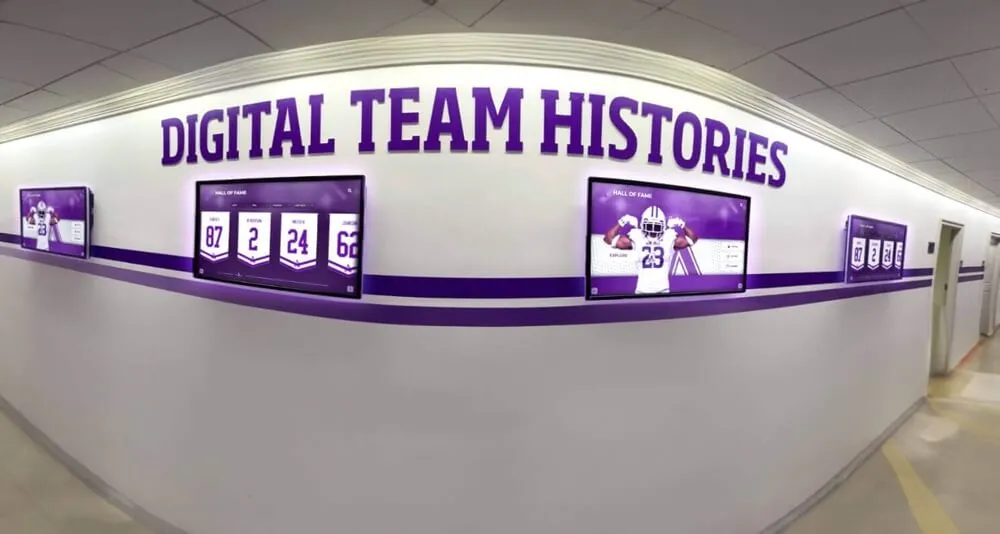
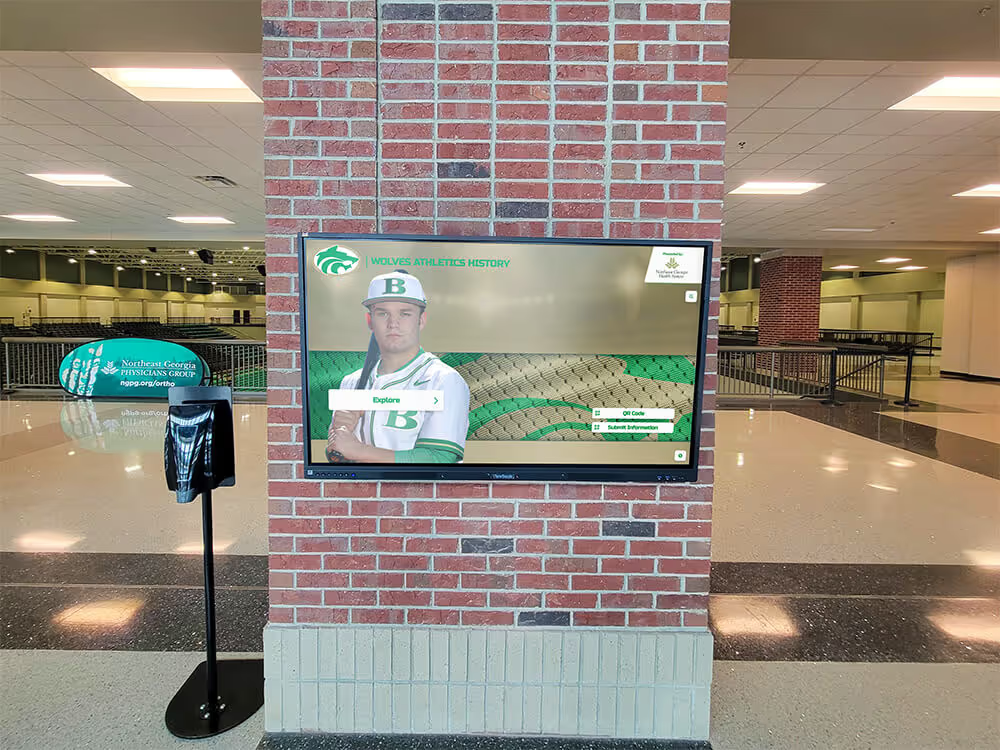
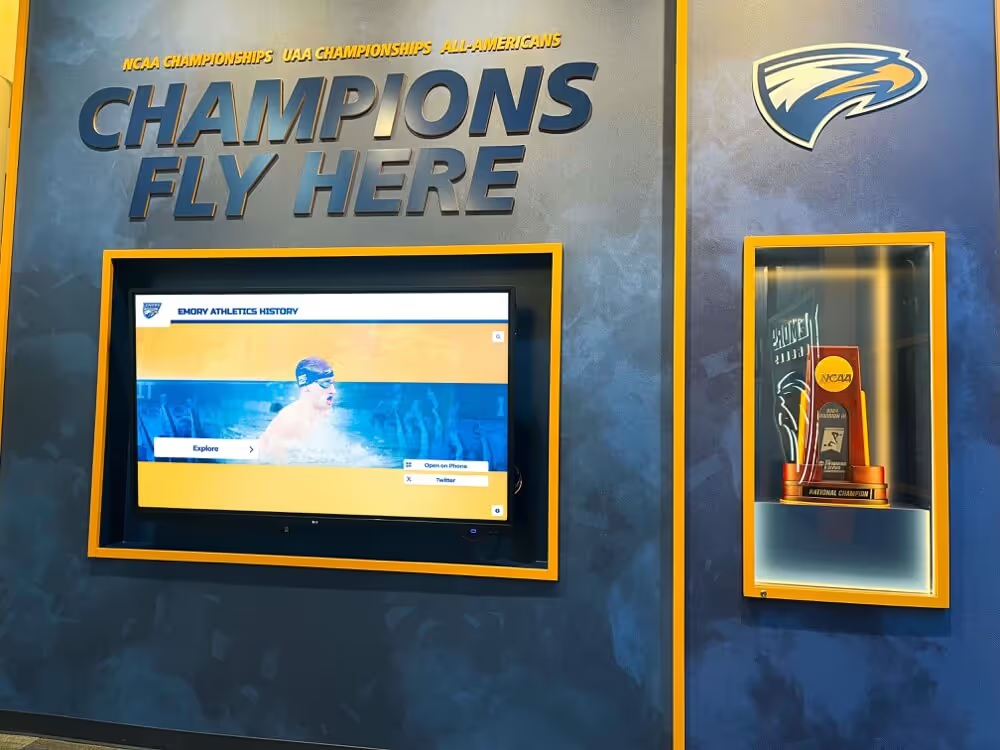
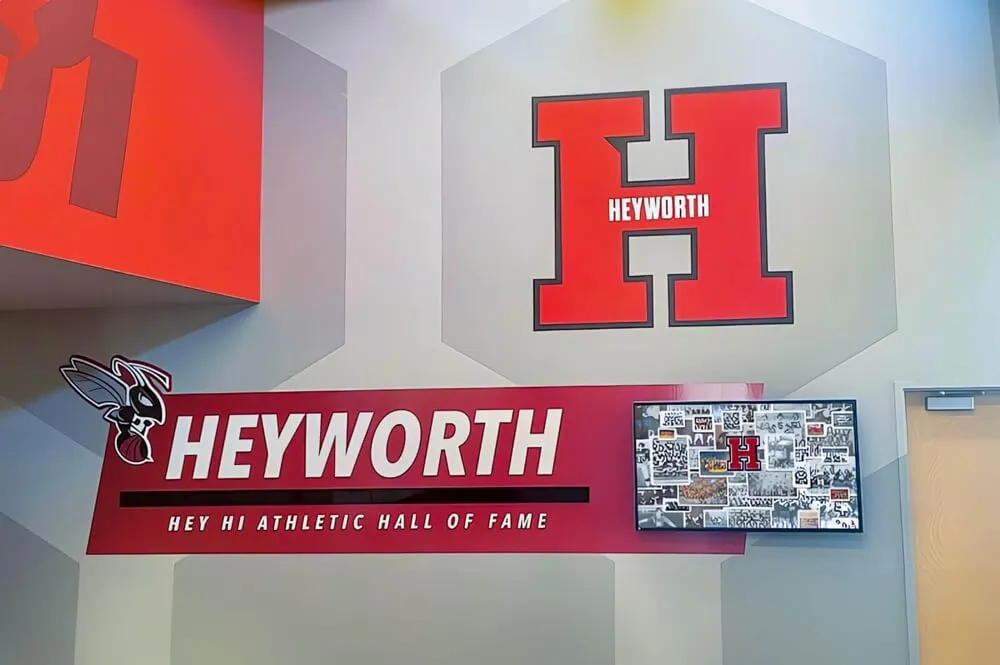
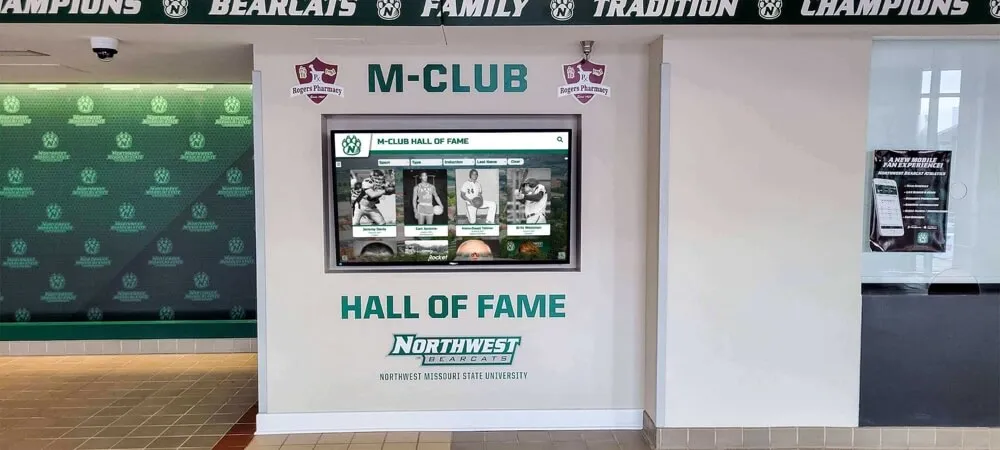
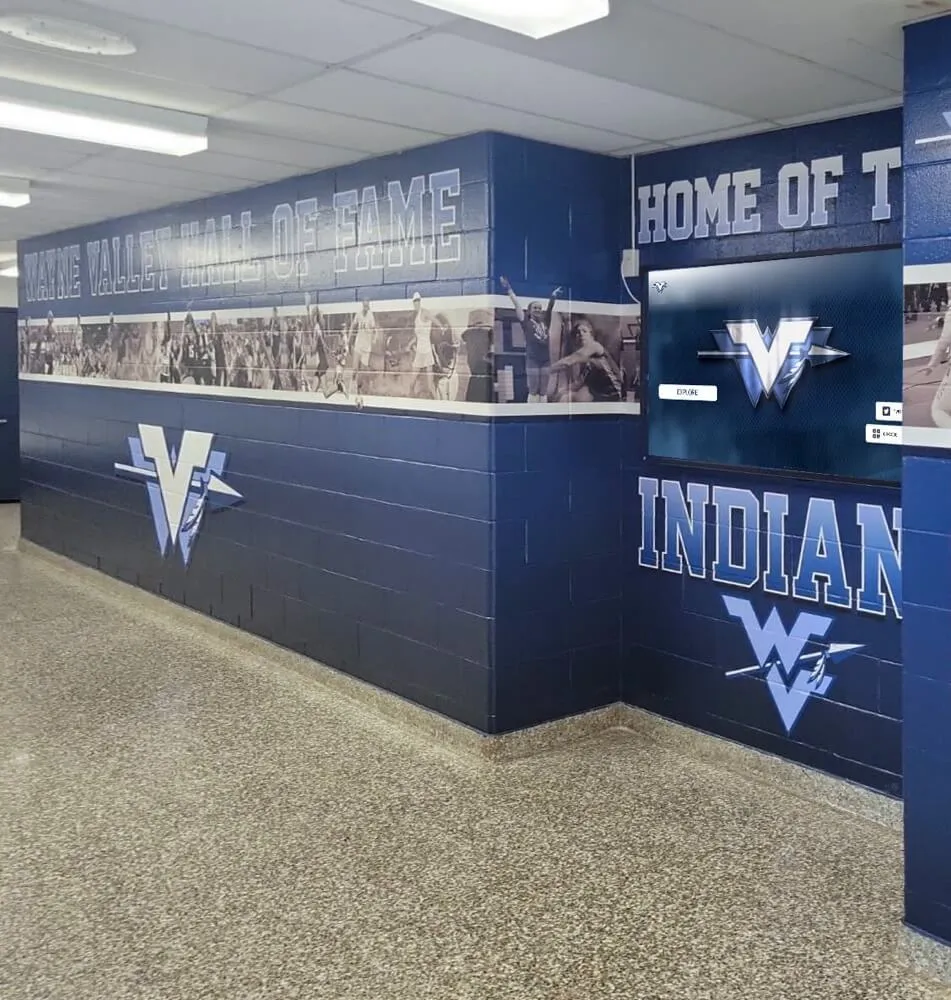
Modern athletic halls of fame combine institutional branding with engaging displays that celebrate competitive excellence and inspire current student-athletes
Understanding Athletic Hall of Fame Purpose and Benefits
Before implementing athletic recognition systems, administrators need clarity about what halls of fame achieve and how they support broader institutional goals.
Core Functions of Athletic Halls of Fame
Successful athletic recognition serves multiple interconnected purposes within educational institutions.
Honoring Individual and Team Excellence
Athletic halls of fame provide systematic recognition for competitive achievement across diverse accomplishments through individual athlete inductee profiles celebrating statistical excellence and championship contributions, championship team recognition documenting winning seasons and tournament success, coaching legacy preservation honoring program builders and leaders, milestone achievement celebration for records and statistical thresholds, and special contributor acknowledgment recognizing supporters enabling program success.
This comprehensive recognition ensures that diverse forms of athletic excellence receive appropriate permanent acknowledgment rather than being forgotten as years pass and memories fade.
Preserving Athletic Program History
Beyond individual recognition, halls of fame create institutional archives documenting program evolution through chronological team histories showing season-by-season results, facility development documentation illustrating infrastructure investment, rivalry preservation maintaining competitive tradition narratives, program milestone documentation capturing significant achievements, and statistical record preservation providing comprehensive performance data.
These historical archives serve educational purposes while helping current athletes understand traditions they’re continuing and excellence standards they’re maintaining or surpassing.
Inspiring Current Student-Athletes
Athletic recognition creates aspirational targets motivating current competitors through visible examples of achievable excellence within their program, clear standards defining what achievement levels merit permanent recognition, connection to program tradition linking current athletes to institutional heritage, tangible recognition goals providing motivation beyond seasonal competition, and role model visibility showing life trajectories of honored alumni.
Schools report that well-implemented halls of fame significantly increase current athlete awareness of program standards and achievement expectations, creating positive peer pressure toward excellence.
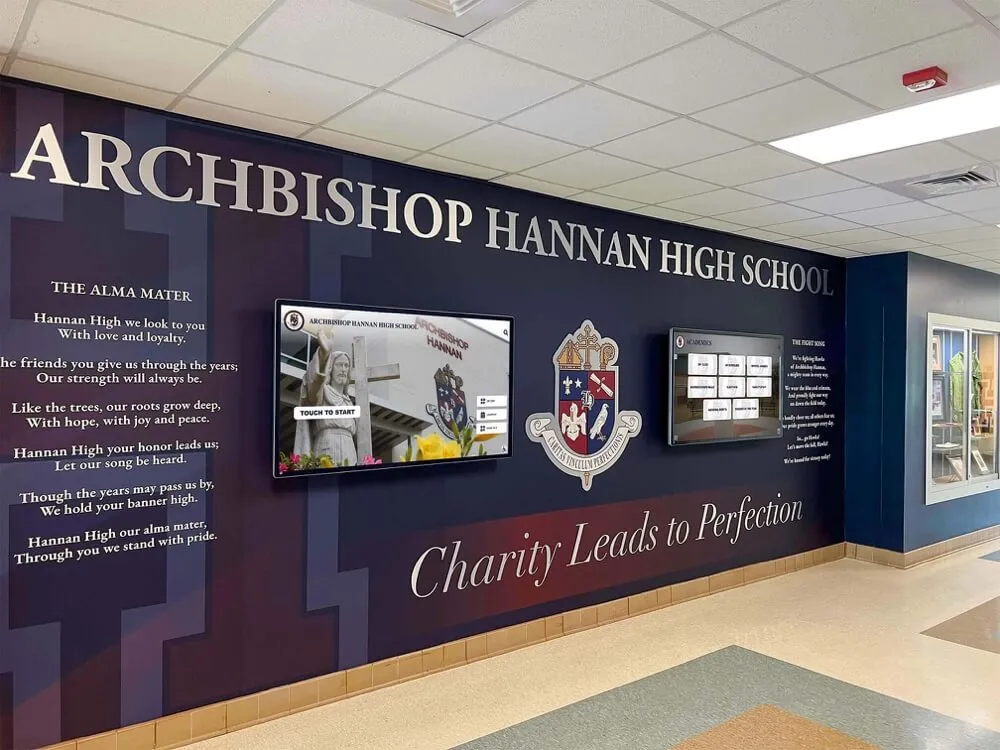
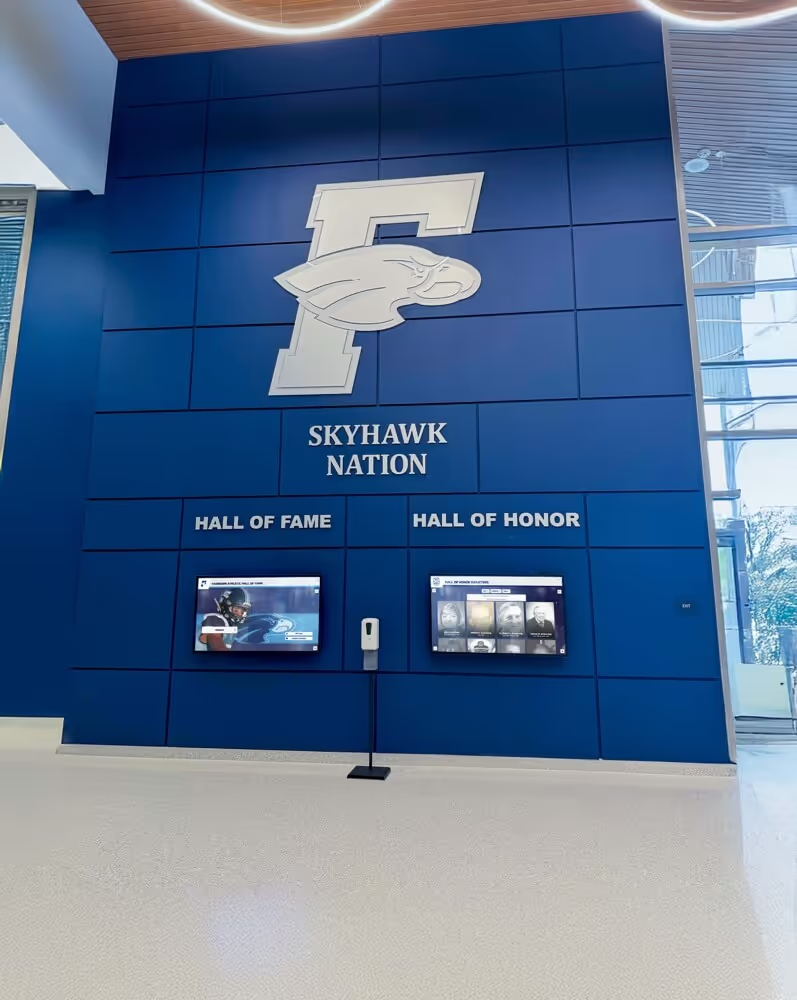
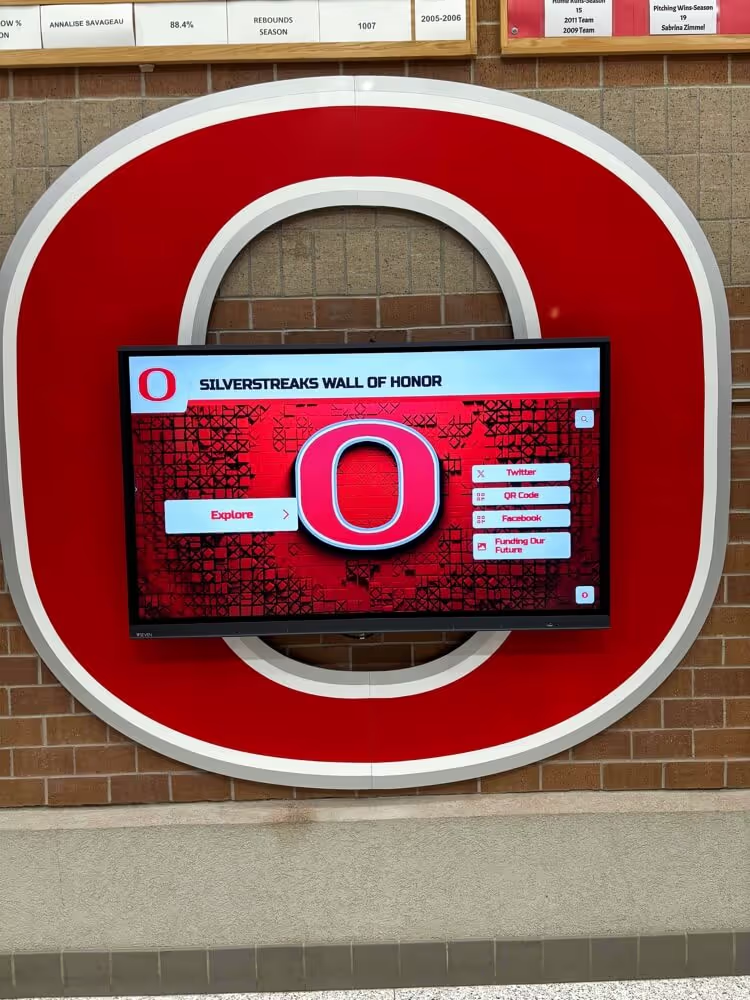
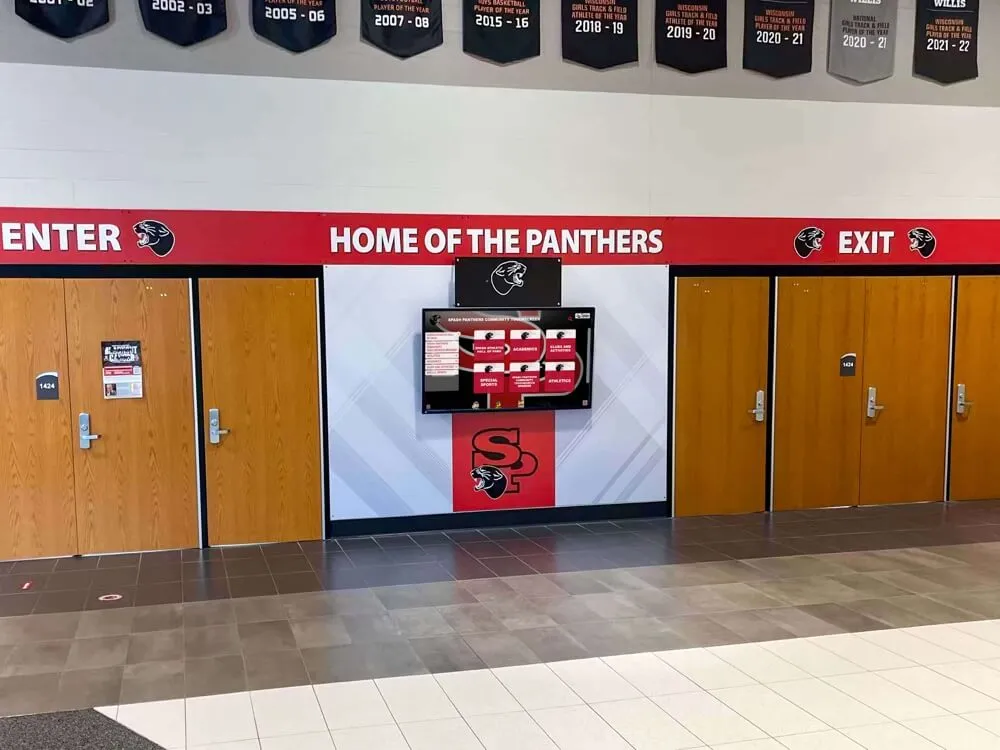
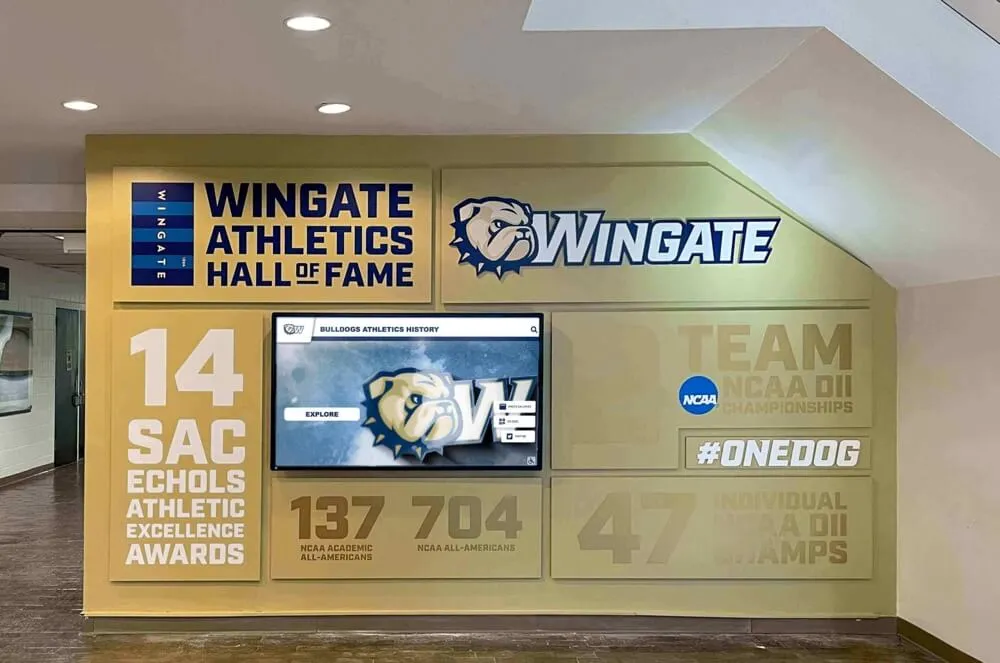
Branded recognition displays integrate institutional identity while creating spaces that celebrate athletic tradition and competitive excellence
Strengthening School Pride and Community Connection
Athletic achievement resonates beyond participants to strengthen broader community identity through shared celebration of competitive success, community gathering spaces created around recognition displays, alumni engagement opportunities connecting former athletes to current programs, local media visibility when inductees are announced and honored, and donor engagement as recognition demonstrates institutional commitment to athletic excellence.
These community benefits extend recognition value beyond direct participants to support broader institutional goals including alumni relations, community engagement, and development initiatives.
Quantifying Hall of Fame Impact
While some benefits remain qualitative, schools implementing comprehensive athletic recognition report measurable outcomes worth considering during planning.
Student Athlete Engagement Metrics
Schools with established halls of fame typically observe participation increases in voluntary team activities and off-season training, higher athlete retention rates across seasons, increased interest in team leadership positions, stronger performance in academic eligibility maintenance, and greater alumni athlete engagement with current programs.
These engagement indicators suggest that visible recognition of athletic excellence creates cultural effects motivating current participants beyond simple awareness of past achievement.
Alumni and Community Connection Indicators
Recognition systems strengthen alumni relationships through increased athletic alumni event attendance, higher response rates to athletic department communications, enhanced willingness to serve as mentors or speakers, greater financial support for athletic programs and facilities, and stronger social media engagement with program content.
For administrators seeking to strengthen alumni networks and develop fundraising capacity, athletic halls of fame provide tangible infrastructure supporting these broader institutional objectives.
Establishing Selection Criteria and Induction Frameworks
Fair, clear selection processes ensure halls of fame maintain credibility while honoring deserving athletes, teams, coaches, and contributors.
Individual Athlete Selection Criteria
Clear standards define what level of achievement merits permanent hall of fame recognition.
Statistical and Performance Thresholds
Most halls of fame establish objective achievement standards including minimum statistical accomplishments like points scored, yards gained, or wins accumulated, state-level recognition such as all-state selections or state championship participation, conference or league-level honors accumulated across careers, record-breaking performances exceeding previous program standards, and national recognition for exceptional achievements extending beyond local or state competition.
These objective criteria provide clear pathways to recognition while ensuring consistency across different sports and eras. For comprehensive athletic recognition approaches, explore best ways to showcase athletic achievement awards digitally.

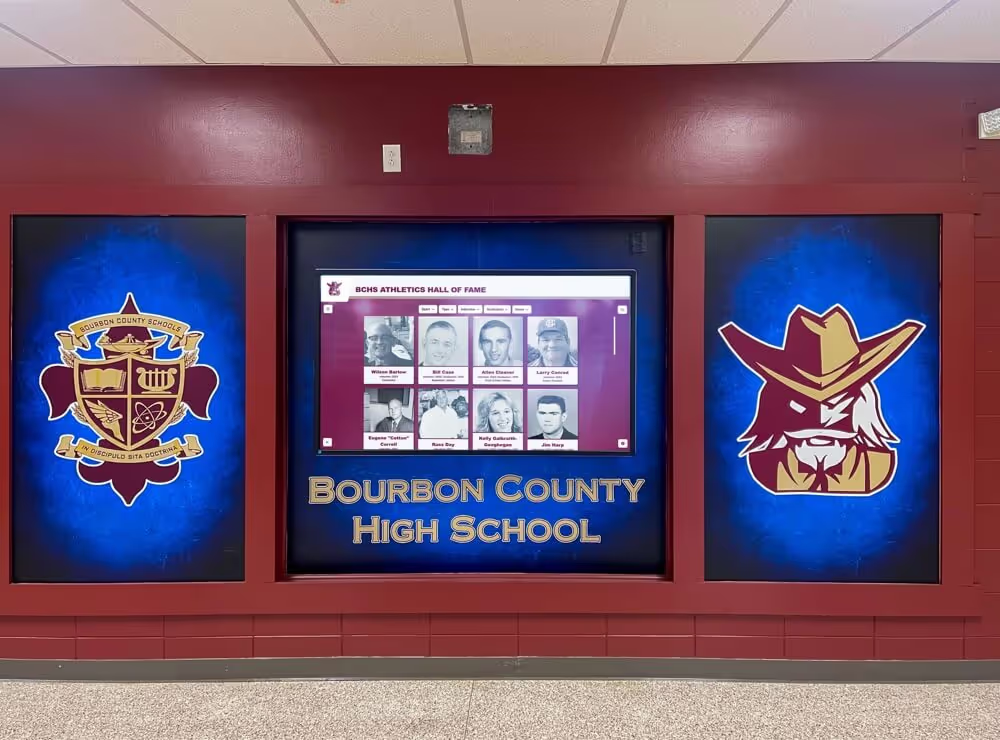
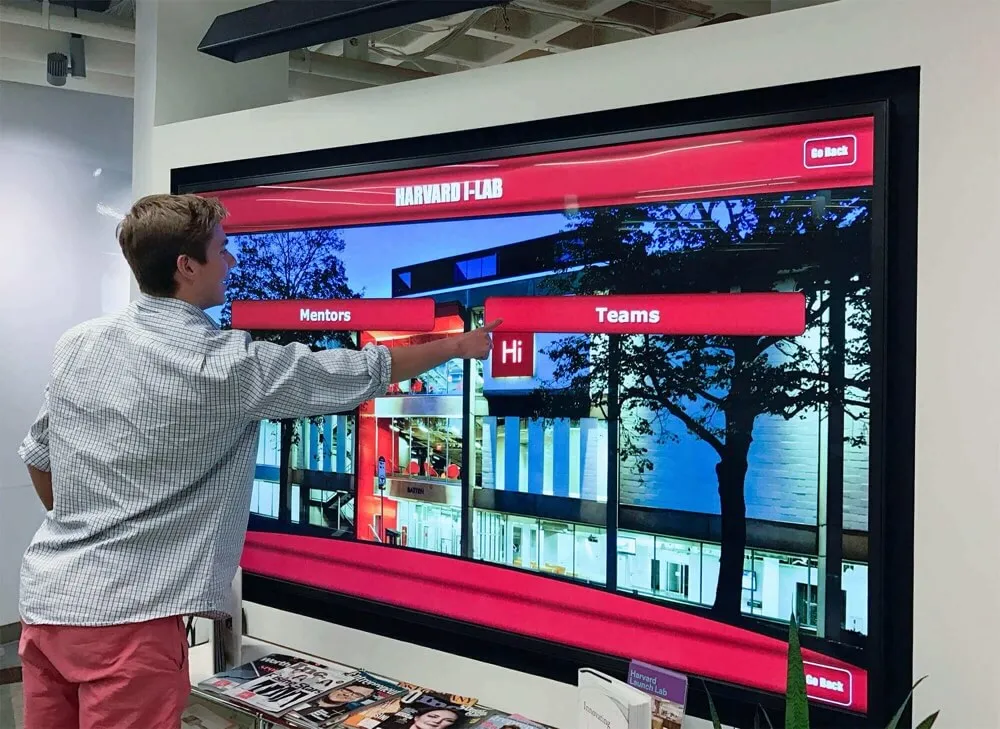
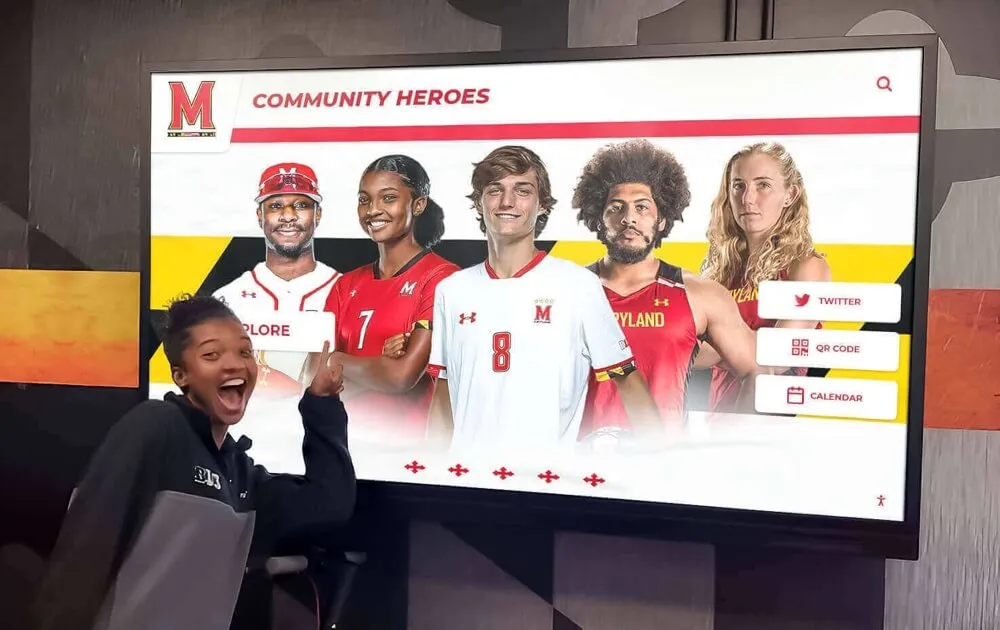
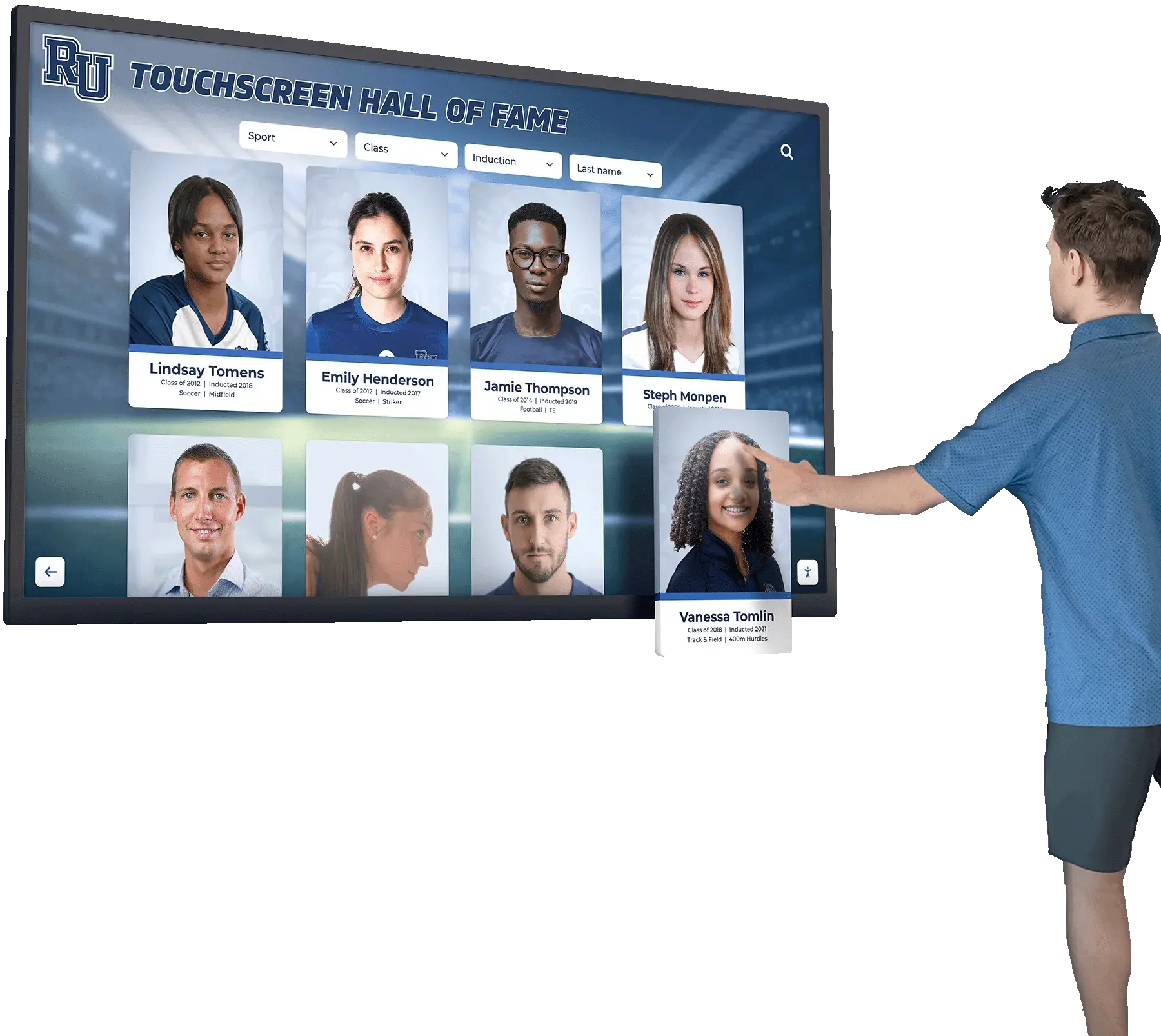
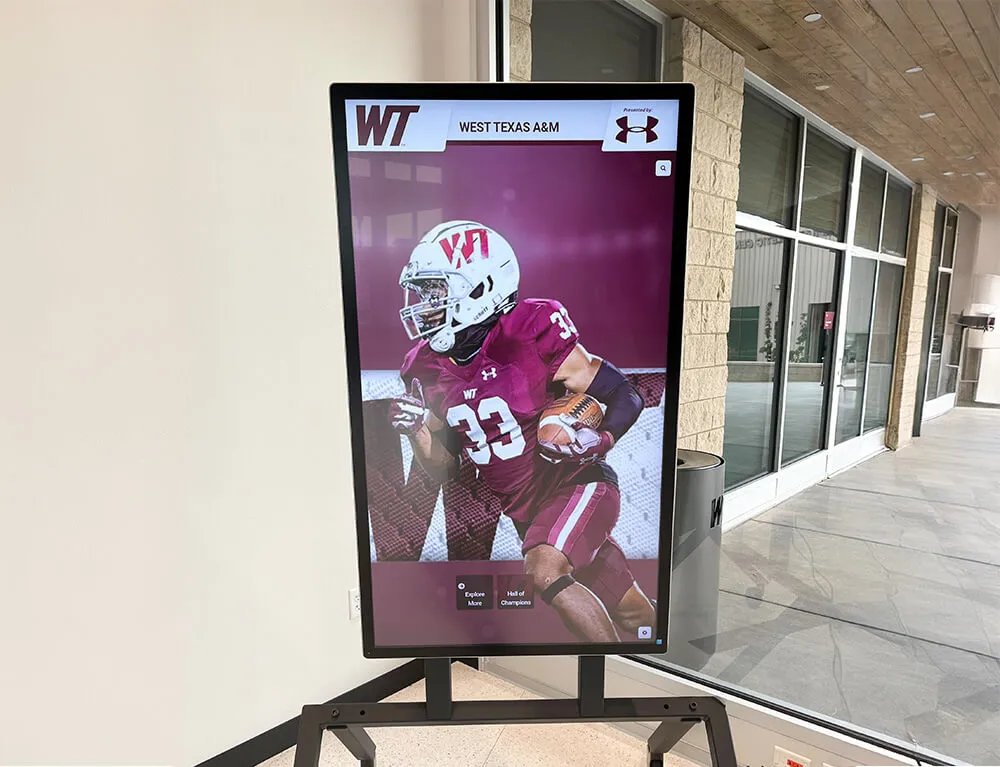
Interactive touchscreen systems enable visitors to explore athlete profiles, statistics, and achievements through simple, user-friendly digital interfaces
Character and Citizenship Requirements
Beyond competitive achievement, most halls of fame incorporate character criteria ensuring inductees exemplify institutional values through academic eligibility maintenance throughout athletic careers, sportsmanship recognition and absence of significant disciplinary issues, team leadership and positive influence on program culture, community service and citizenship demonstration, and post-graduation trajectory reflecting positively on institutional values.
These character requirements ensure halls of fame honor complete student-athletes rather than simply rewarding athletic skill regardless of other behaviors or values.
Waiting Period Policies
Most established halls of fame require time between athletic career completion and eligibility consideration through minimum waiting periods of 5-10 years after graduation, exceptions for truly extraordinary immediate impact achievements, opportunity for post-athletic accomplishments to inform selection, perspective enabling comparison across different eras, and cooling-off periods preventing emotion-driven selections immediately following competitive careers.
Waiting periods allow selection committees to evaluate complete legacies while ensuring contemporary bias doesn’t distort historical perspective or create inconsistent selection standards across different periods.
Team Recognition Standards
Championship teams deserve systematic recognition alongside individual honorees.
Team Achievement Thresholds
Clear criteria define which team accomplishments merit permanent hall of fame recognition including state championship victories and finals appearances, undefeated seasons or historically exceptional win-loss records, conference or league championship achievements, significant tournament advancement and national recognition, and historically significant victories or competitive achievements representing program milestones.
Team recognition ensures collaborative success receives acknowledgment alongside individual excellence while documenting the complete competitive history schools want preserved.
Team Profile Content Requirements
Comprehensive team recognition includes roster listings identifying all team members, coaching staff acknowledgment, season records and key game results, championship game recaps and highlight descriptions, team photo documentation, and individual standout performer recognition within team context.
This complete documentation ensures championship achievements receive thorough historical preservation rather than simple acknowledgment without supporting context.
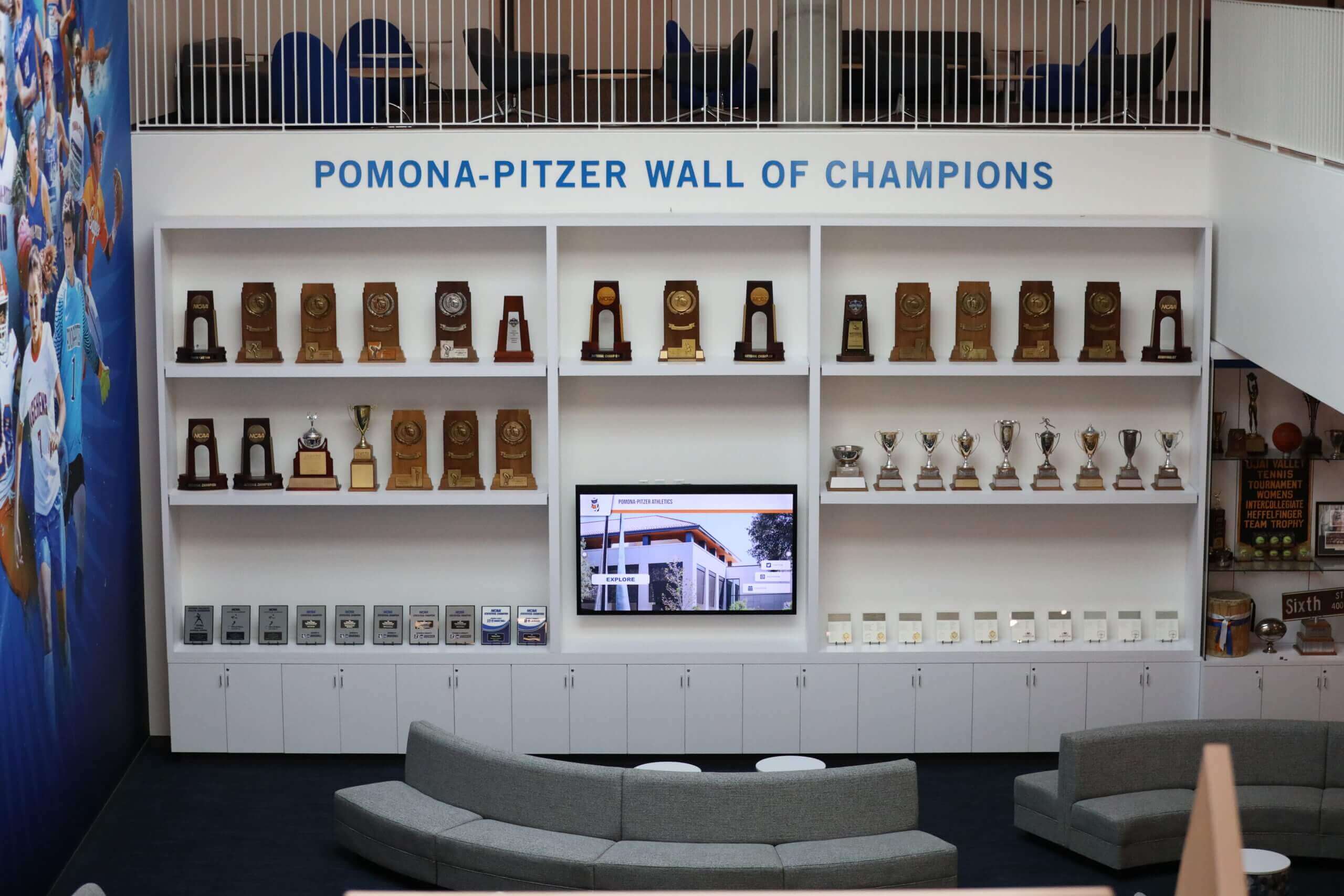
Recognition spaces combine trophy displays with comfortable areas creating destinations where students explore athletic heritage
Coaching and Contributor Recognition
Athletic success depends on leadership and support beyond direct competitors.
Coaching Legacy Criteria
Systematic coaching recognition honors program builders through career longevity and tenure milestones, championship achievement and tournament advancement, overall win-loss record achievement and winning percentage, program development and facility improvement leadership, and athlete mentorship producing college athletes or professional competitors.
Coaching recognition acknowledges that competitive success requires leadership, and those developing programs deserve permanent acknowledgment alongside the athletes they coached.
Special Contributor Recognition Categories
Beyond coaches and athletes, halls of fame may honor athletic trainers and medical staff supporting athlete health, longtime officials and game administration supporters, booster club leaders and financial contributors, facility donors enabling program infrastructure, and volunteer coaches and assistant staff providing essential support.
These contributor categories ensure recognition extends to the full community enabling athletic success rather than narrowly focusing on competitive participants alone. Learn more about donor recognition for booster clubs.
Selection Process and Committee Structure
Fair, credible selection requires systematic processes and appropriate committee composition.
Selection Committee Formation
Committee structure affects both selection quality and community confidence in decisions.
Committee Composition Principles
Effective selection committees typically include athletic director or designee providing institutional perspective, current head coaches representing active programs, alumni athletes from diverse sports and eras, school administrators ensuring alignment with institutional values, and community representatives providing external perspective.
Committee size of 7-11 members provides adequate diversity while remaining manageable for productive deliberation and decision-making.
Term Limits and Rotation Policies
Sustainable committees incorporate staggered terms ensuring continuity while enabling fresh perspective, term limits preventing permanent control by small groups, rotation schedules balancing experience with new viewpoints, and conflict of interest policies addressing situations where committee members have direct relationships with candidates under consideration.
These structural elements maintain committee credibility across leadership transitions and evolving institutional contexts.

Strategic lobby placement ensures athletic recognition reaches diverse audiences including visitors, students, families, and community members
Nomination and Selection Procedures
Clear processes ensure fair evaluation and systematic decision-making.
Nomination Process Design
Accessible nomination procedures encourage community participation through online nomination forms available to all stakeholders, coaching staff nomination authority, alumni self-nomination or peer nomination pathways, committee-initiated nominations for overlooked candidates, and nomination deadline schedules aligned with induction ceremony timing.
Open nomination processes prevent deserving candidates from being overlooked while ensuring selection committees have complete candidate pools for evaluation.
Evaluation and Voting Protocols
Systematic evaluation ensures consistent application of criteria through standardized candidate information packets, committee discussion protocols and deliberation guidelines, voting procedures and threshold requirements for selection, tie-breaking protocols when needed, and documentation requirements creating permanent records of selection rationale.
Formal procedures maintain process integrity while creating accountability ensuring selections align with established criteria rather than reflecting arbitrary committee preferences.
Communication and Transparency Standards
Process credibility depends on appropriate transparency through published selection criteria and eligibility requirements, annual announcement of selection timeline and procedures, notification protocols informing candidates of selection decisions, public announcement processes celebrating new inductees, and appeals or reconsideration procedures for disputed decisions.
Balance transparency supporting public confidence with discretion protecting privacy of non-selected nominees and enabling frank committee deliberations.
Physical and Digital Display Implementation
Hall of fame effectiveness depends significantly on how recognition appears and where displays are positioned within school facilities.
Traditional Physical Display Options
Conventional recognition approaches remain relevant for many schools.
Wall-Mounted Plaque Systems
Traditional donor wall-style displays utilize individual plaques for each inductee, organized chronologically or by sport, mounted on dedicated hallway or lobby walls, incorporating school branding and visual design, and updating annually with new inductee additions.
Physical plaques provide permanent, maintenance-free recognition but face inherent space limitations forcing difficult prioritization as programs mature and inductee numbers grow.
Trophy Case Integration
Many schools incorporate hall of fame recognition within existing trophy display infrastructure through dedicated sections within trophy cases, combination of physical plaques with achievement documentation, integration with championship trophies and team photos, and coordinated visual design connecting all athletic recognition.
Trophy case approaches leverage existing infrastructure but typically provide limited space for detailed athlete profiles or comprehensive historical documentation.
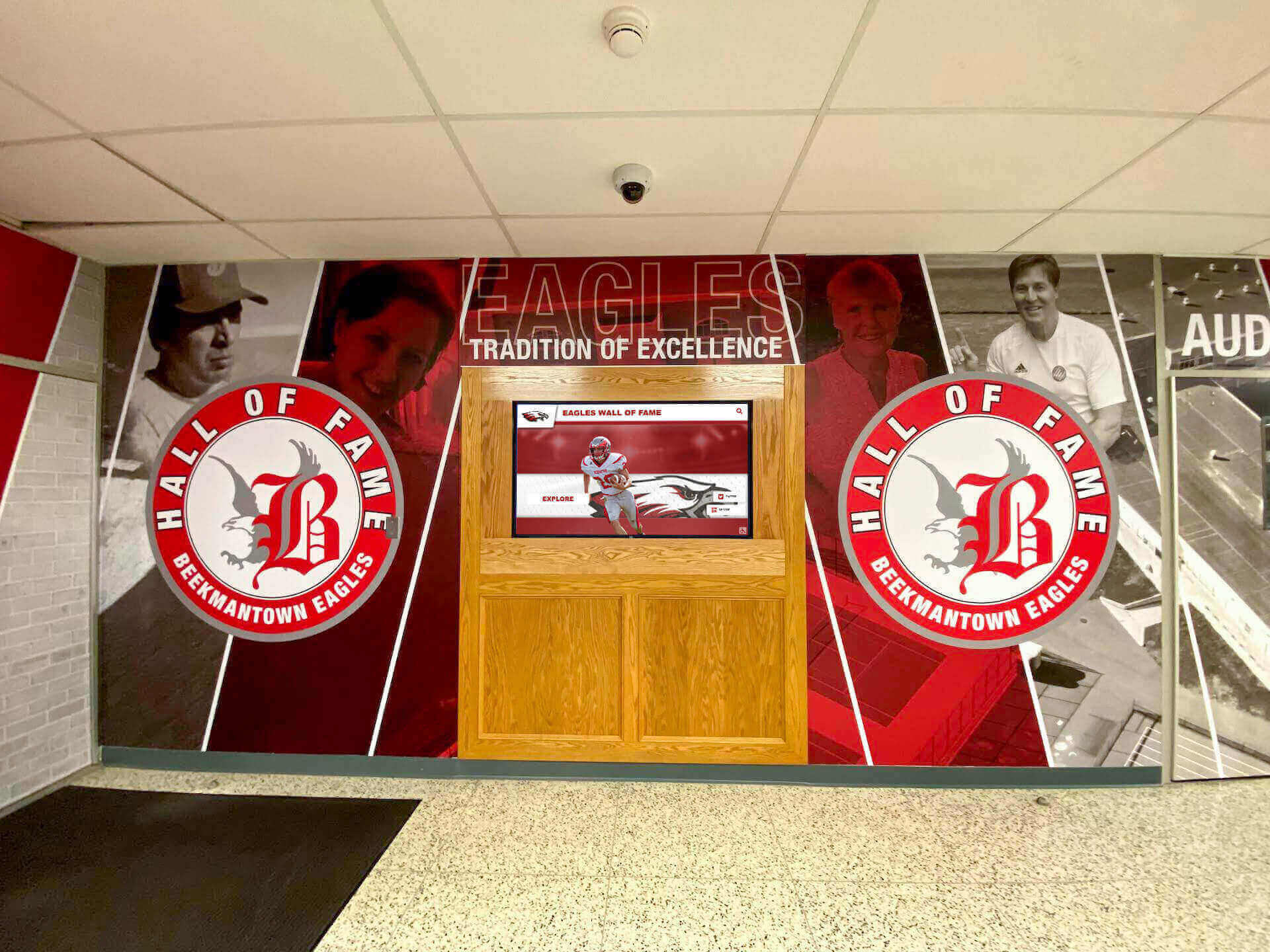
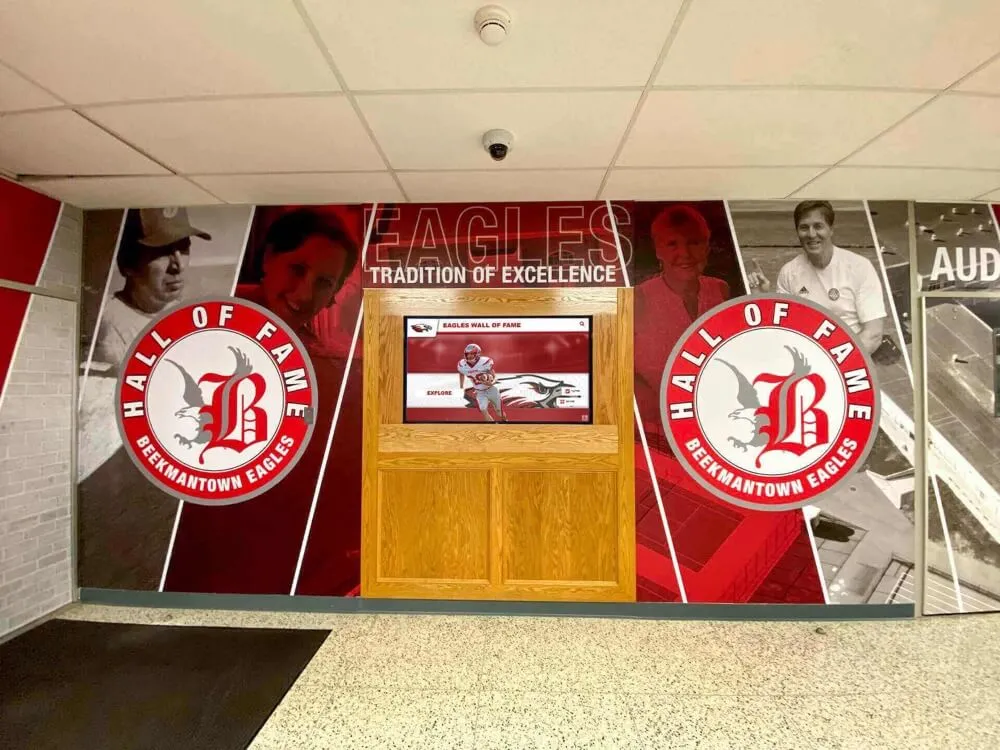
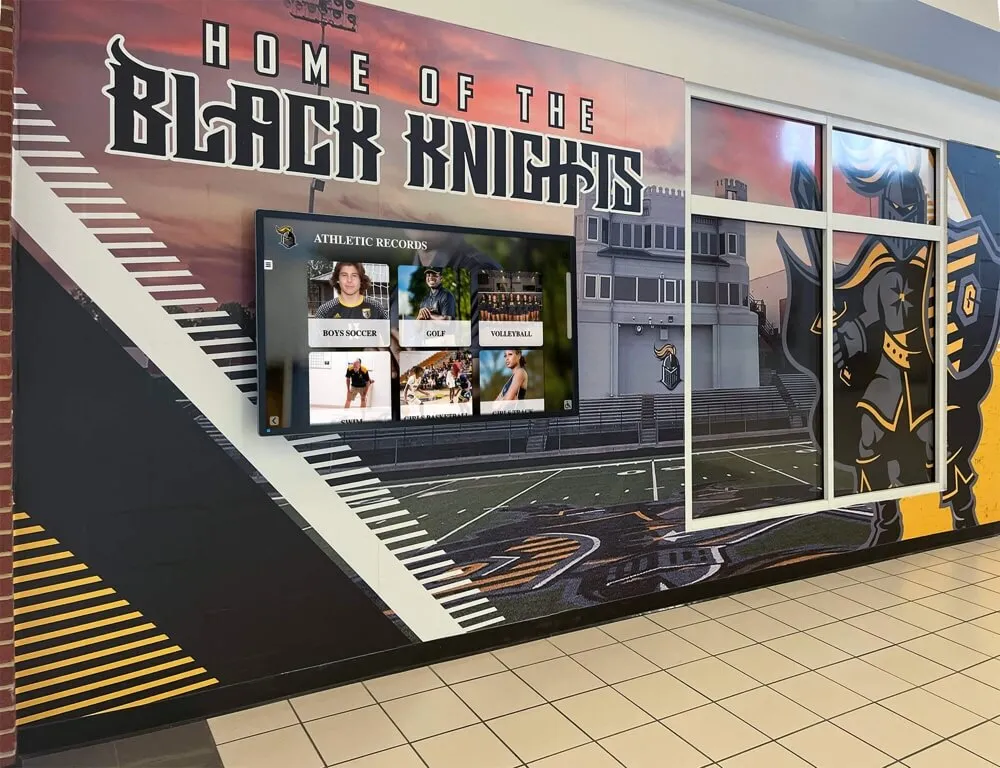
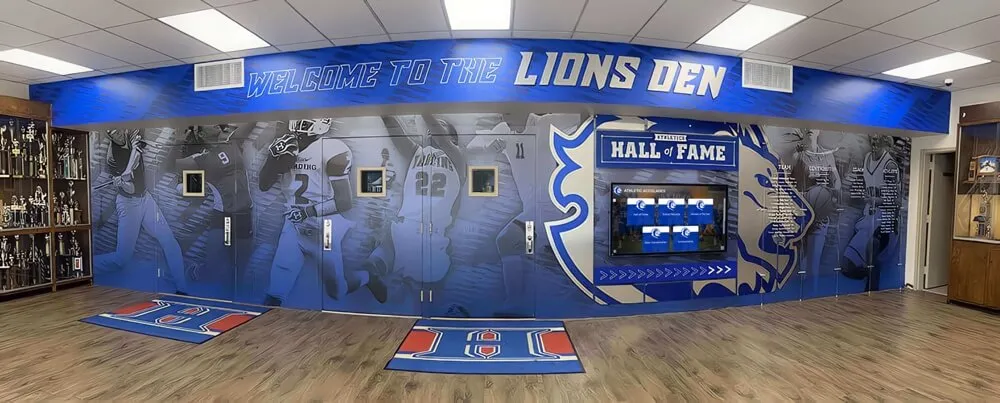
Comprehensive recognition environments integrate branded murals, digital displays, and physical elements creating memorable impression points for visitors
Dedicated Hall of Fame Spaces
Larger schools may designate complete rooms or corridor sections as dedicated athletic halls of fame through custom millwork and branded environmental design, combination of multiple display types and media, comfortable seating creating destination spaces, integration of historical photos, uniforms, and memorabilia, and coordinated lighting and architectural elements.
Dedicated spaces provide maximum impact and visitor engagement but require significant facility space and construction investment.
Digital Display Solutions and Advantages
Modern digital recognition platforms address traditional display limitations while providing enhanced capabilities.
Unlimited Recognition Capacity
Digital systems eliminate space constraints forcing impossible prioritization decisions through unlimited athlete profiles without physical expansion requirements, comprehensive team histories spanning entire program existence, detailed statistical documentation and achievement records, video highlight integration bringing achievements to life, and historical photo galleries preserving program evolution.
A single digital display can showcase recognition requiring dozens of traditional plaque walls, making comprehensive historical preservation achievable regardless of program age or inductee volume.
Interactive Exploration and Search Features
Unlike static plaques, digital halls of fame enable active visitor engagement through athlete name search enabling quick profile location, filtering by sport, era, or achievement type, statistical database exploration and record comparison, video content viewing showing competitive highlights, and social sharing features enabling alumni to distribute their recognition.
These interactive capabilities transform passive viewing into engaging experiences particularly appealing to younger visitors accustomed to digital media interaction.
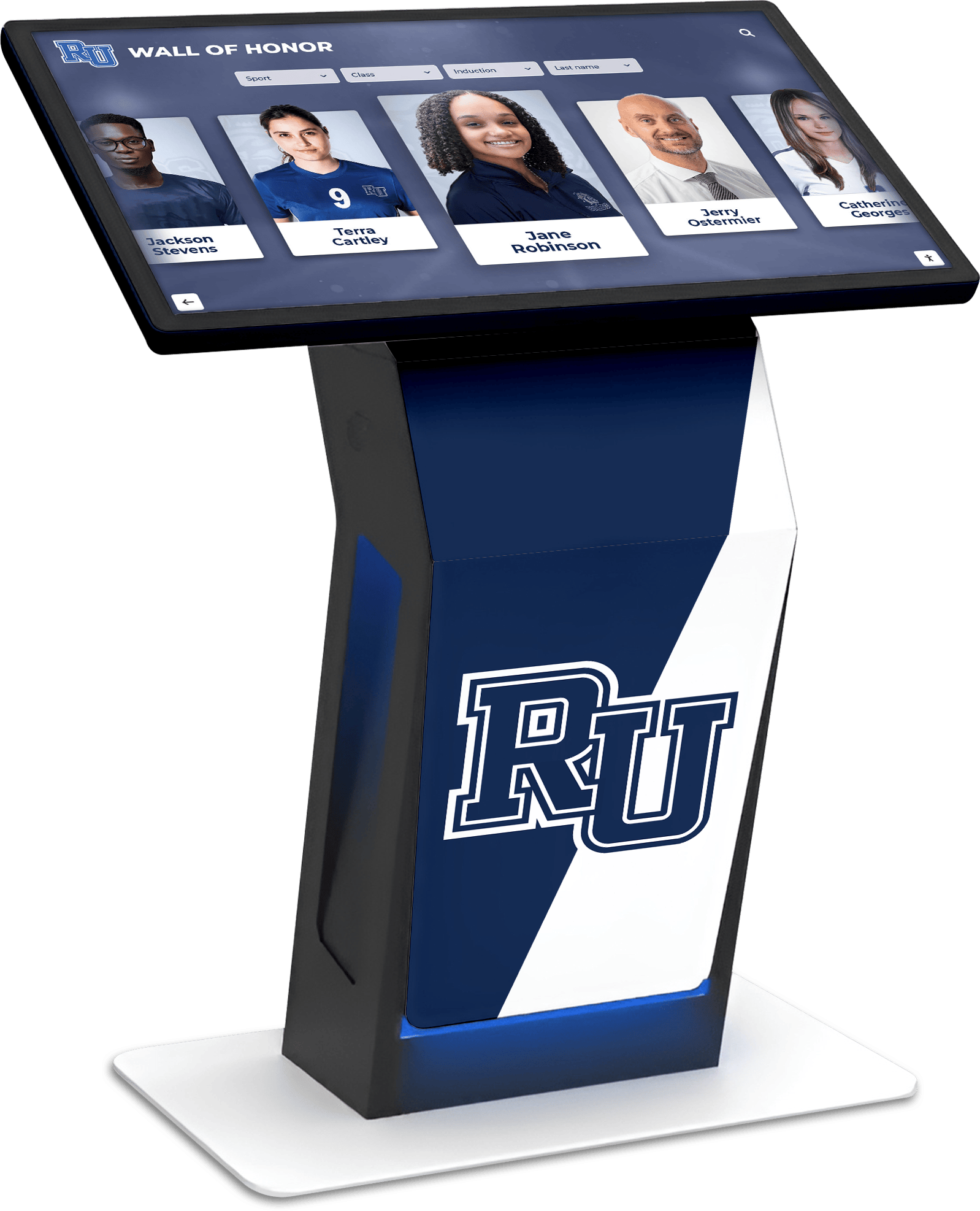
Freestanding kiosks provide self-contained recognition stations suitable for lobbies, athletic facilities, and high-traffic areas without wall mounting requirements
Simple Content Management and Updates
Digital platforms dramatically simplify administrative maintenance through cloud-based content management requiring no specialized software, remote updates from any internet-connected device, scheduled publishing automation for induction ceremony coordination, bulk import capabilities for historical data entry, and role-based permissions enabling appropriate staff access without technical training requirements.
Schools report 80-90% reduction in administrative time maintaining athletic recognition after implementing digital systems compared to traditional physical displays requiring manual updates.
Web Accessibility and Extended Reach
Digital recognition extends beyond physical campus through mobile-responsive web displays accessible globally, shareable individual athlete profile URLs, integration with school websites and athletic department pages, social media connectivity amplifying recognition, and alumni access regardless of physical campus proximity.
This extended accessibility proves particularly valuable for geographically dispersed alumni communities and families unable to regularly visit campus physical displays. Solutions like Rocket Alumni Solutions provide purpose-built platforms designed specifically for educational athletic recognition.
Content Development and Profile Creation
Compelling athletic recognition requires thoughtful content creation telling complete achievement stories.
Individual Athlete Profile Components
Comprehensive inductee recognition includes essential information and engaging narrative.
Core Profile Information
Every athlete profile should include full name and graduation year, sport(s) participated in, position(s) played, years of varsity participation, and major statistical achievements and records.
This baseline data provides factual foundation while enabling statistical comparison across athletes and eras.
Achievement Documentation and Honors
Detailed accomplishment records list all-conference, all-state, and all-American selections, championship participation and contributions, individual records set or held, awards and special recognition received, and post-high school athletic career (college athletics, professional opportunities).
Comprehensive documentation ensures recognition captures complete achievement rather than simply highlighting isolated accomplishments.
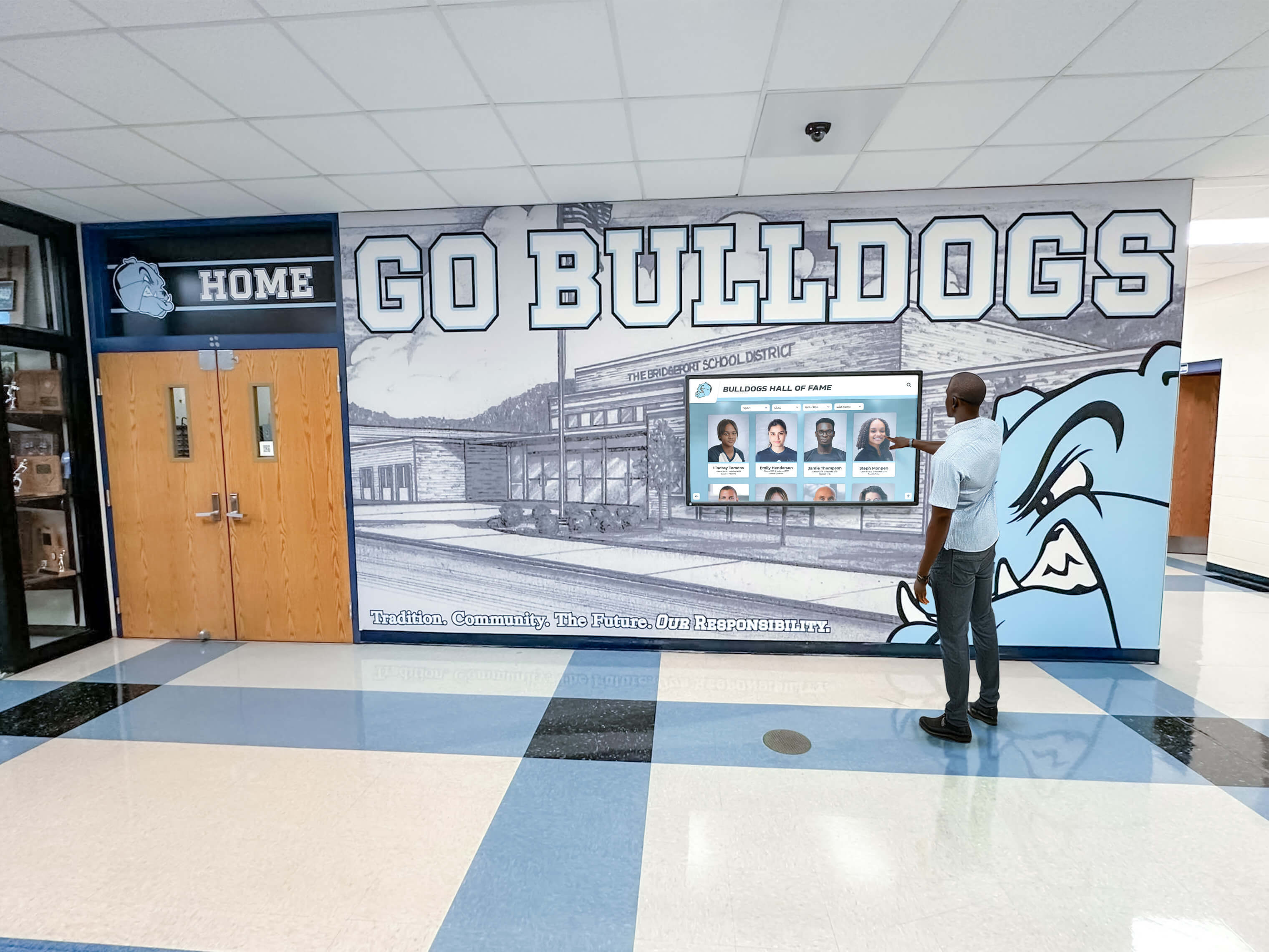
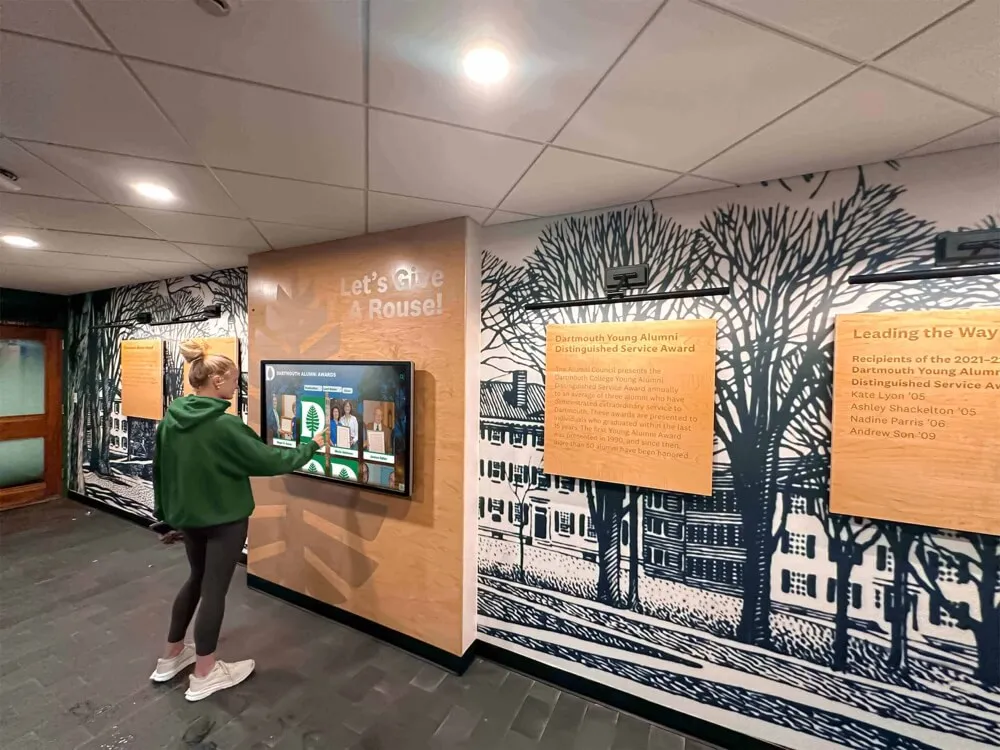
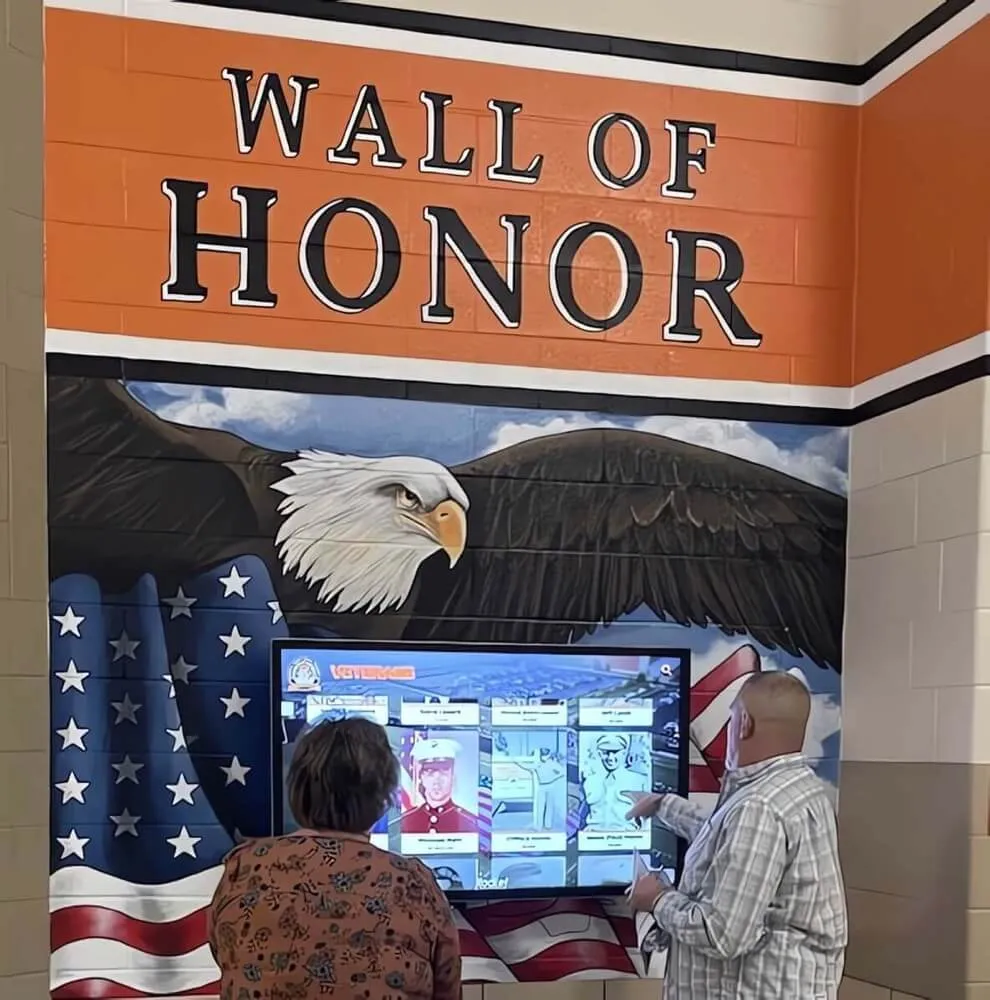
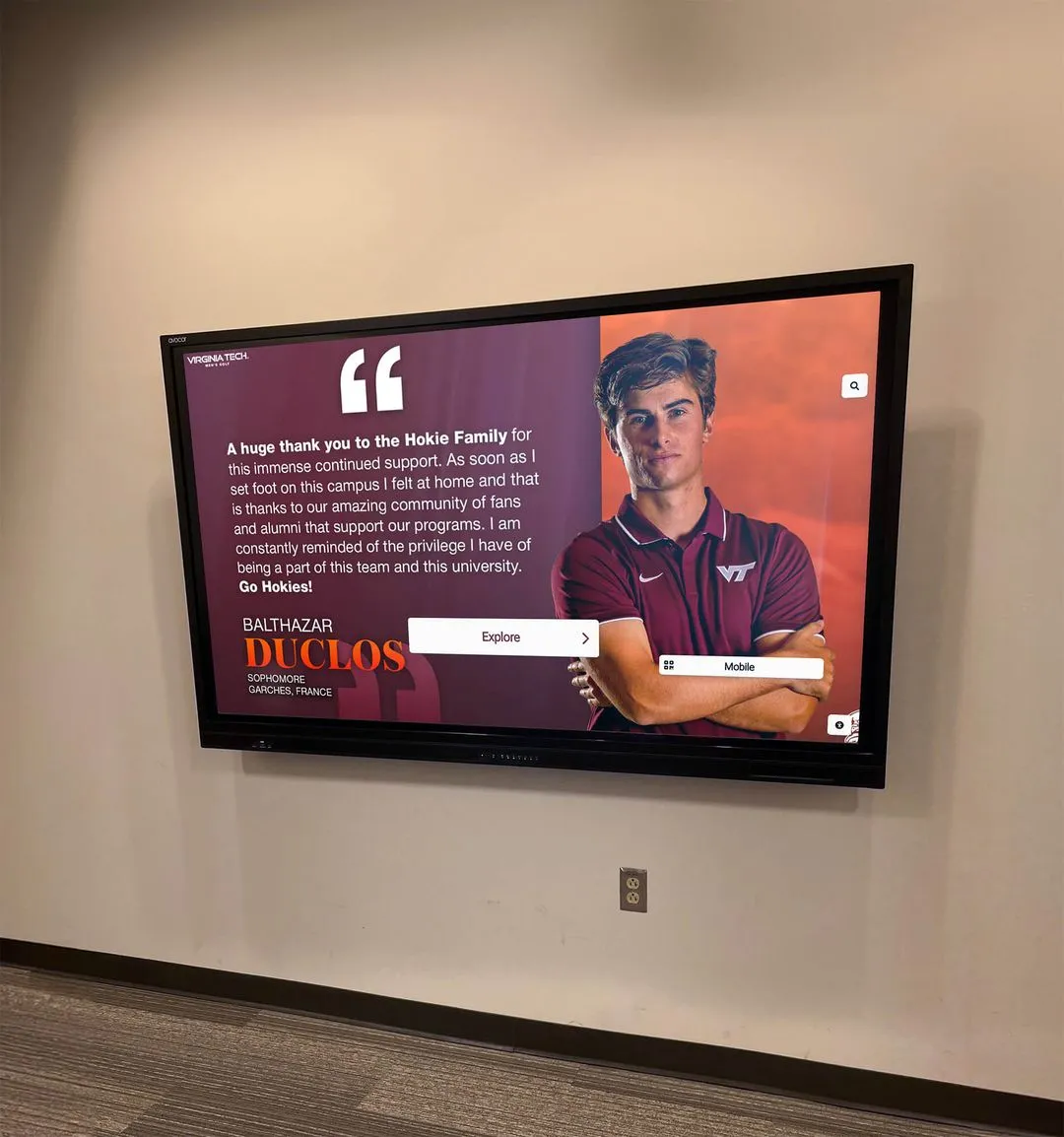
User-friendly touchscreen interfaces enable visitors of all ages to independently explore athletic history and discover individual athlete stories
Narrative Context and Personal Story
Move beyond statistics to tell complete human stories through personal reflections about athletic experience and program impact, coaching testimonials providing context for achievements, memorable game or season descriptions, post-athletic career information showing life trajectories, and family legacy connections for multi-generational athletes.
These narrative elements transform recognition from dry statistics into engaging stories that inspire current athletes while honoring complete individuals rather than simply athletic performance.
Visual Content Requirements
Quality recognition includes professional photography through action shots from competitive career, team photo placement showing broader context, current photos connecting past athletes to present, historical documentation showing uniforms and facilities of era, and video highlights when available bringing achievements to life.
Visual content significantly increases engagement and makes recognition more memorable and personally meaningful for inductees and visitors.
Team Recognition Profile Elements
Championship team documentation preserves collective achievement and season narratives.
Essential Team Information
Complete team recognition includes season year and final record, championship achievement description, tournament progression and key victories, complete roster listing all team members, coaching staff identification, and team photo documentation.
This baseline documentation ensures championship seasons receive permanent preservation rather than fading from institutional memory as participants graduate and years pass.
Season Narrative and Context
Compelling team recognition tells complete season stories through pre-season expectations and team development, key games defining the season trajectory, tournament or playoff progression descriptions, championship game detailed recap, and historical significance within program context.
Narrative context helps future generations understand not just that teams won championships, but how seasons unfolded and what made specific achievements historically significant.
Individual Standout Recognition Within Team Context
While team recognition celebrates collective achievement, acknowledge individual excellence through statistical leaders in key categories, all-league and all-state selections from team, special award recipients, and individual game performances defining season success.
This balanced approach honors both collaborative success and individual excellence within team frameworks.
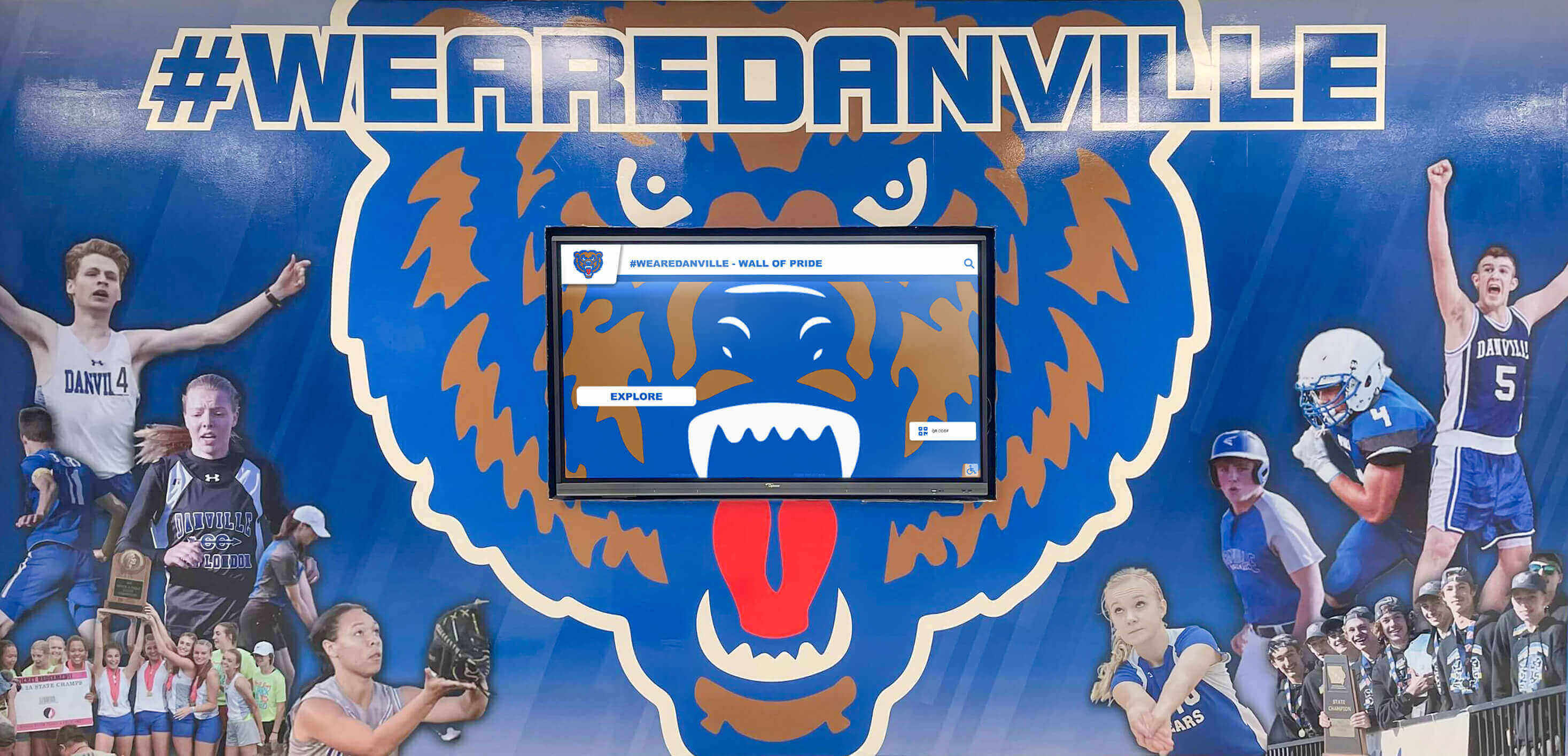
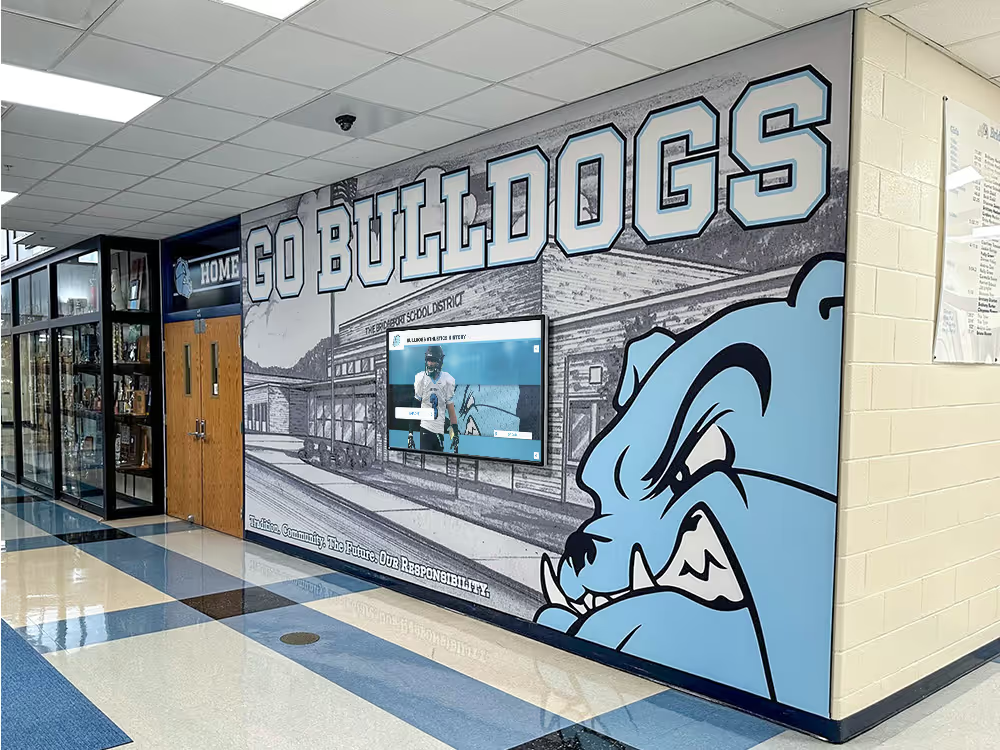
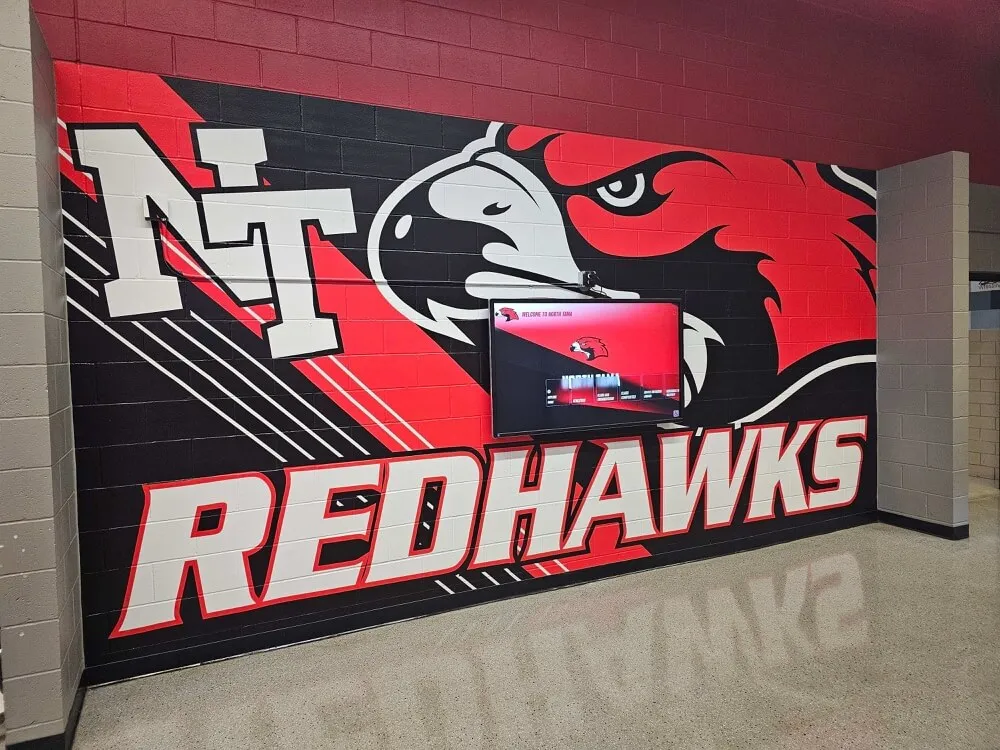
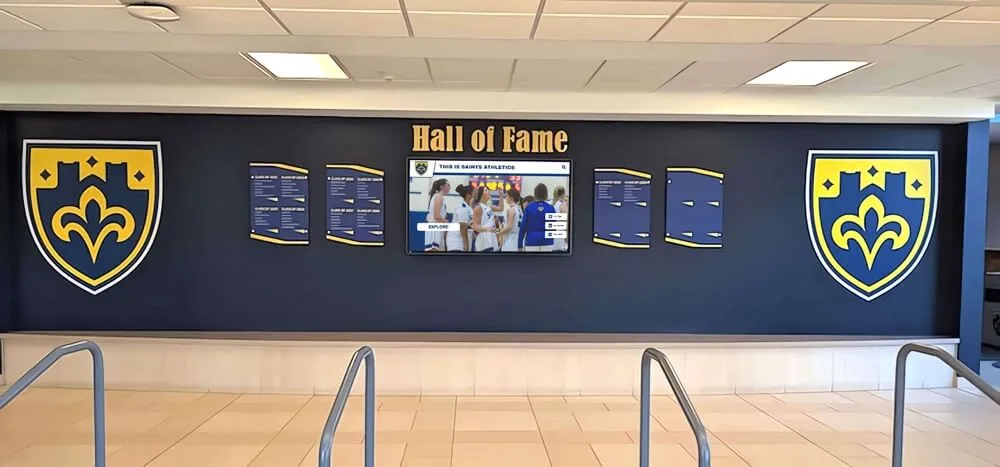
Combined recognition designs bring together branded murals with digital displays creating cohesive athletic celebration environments
Coaching and Contributor Profiles
Recognition extends beyond athletes to honor those enabling program success.
Coaching Legacy Documentation
Comprehensive coaching recognition includes career tenure and years served, overall record and winning percentage, championship achievements and tournament advancement, program development initiatives and facility improvements, notable athletes coached and their achievements, and coaching philosophy and program values.
These complete profiles honor coaching contributions while preserving institutional knowledge about program development and leadership approaches that created sustained success.
Special Contributor Recognition Content
When honoring non-coaching contributors, include specific contributions to athletic program success, duration of involvement and support, tangible impacts on program development, and personal connection to institution and athletic department.
Thoughtful contributor recognition demonstrates that athletic success requires community support and acknowledges those who enabled achievement beyond direct coaching and competition.
Induction Ceremony Planning and Management
Formal induction creates memorable recognition experiences while celebrating new inductees publicly.
Ceremony Format and Program Design
Successful induction events balance formality with celebration and accessibility.
Event Timing and Scheduling
Consider multiple timing options including homecoming weekend incorporating recognition into existing alumni gathering, dedicated spring induction event, senior night coordination during final home competitions, or standalone ceremony focused exclusively on hall of fame.
Event timing affects attendance patterns and integration with other institutional traditions. For related recognition event approaches, explore high school end of year awards guides.
Program Structure and Elements
Effective ceremonies typically include welcome and program overview, brief history of athletic hall of fame, introduction of selection committee, individual inductee recognition with profile summaries, opportunity for inductee remarks, unveiling of new display or digital recognition, and reception enabling social connection.
Balance formality appropriate to recognition significance with accessibility ensuring broad attendance and comfortable atmosphere for diverse community members.
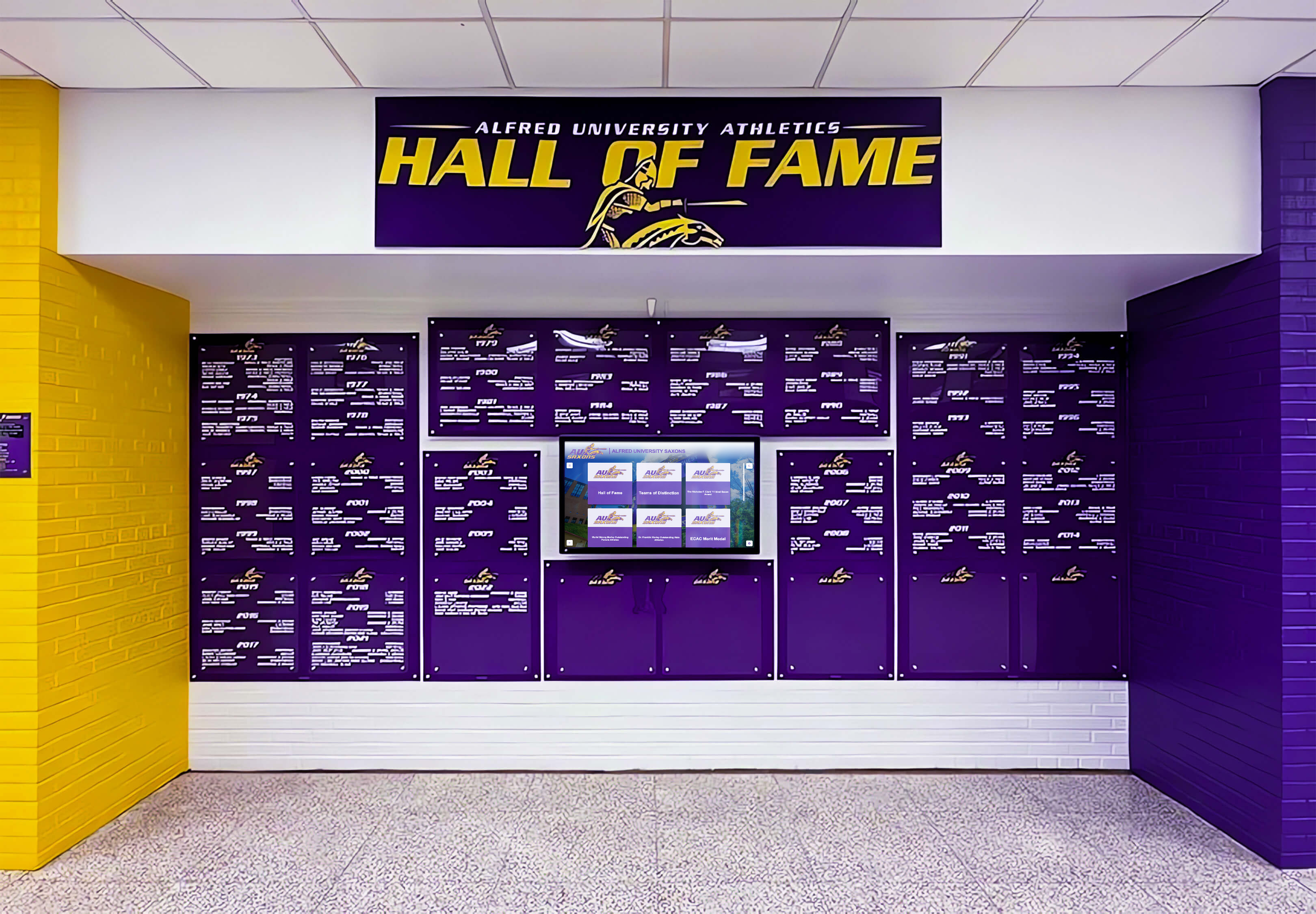
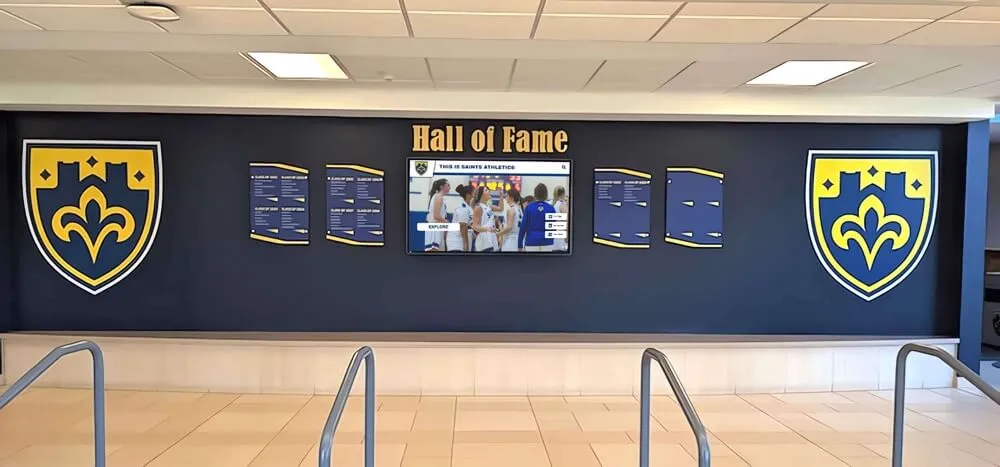
Professional recognition displays incorporate institutional branding and school colors creating branded environments celebrating athletic tradition
Inductee Recognition Procedures
Individual recognition typically includes introductory video or presentation showing achievements, speaker introduction (coach, teammate, family member), formal presentation of hall of fame certificate or plaque, opportunity for inductee acceptance remarks, and photo opportunity with family and program representatives.
These structured elements ensure each inductee receives appropriate individual recognition while maintaining reasonable ceremony length when multiple inductees are honored simultaneously.
Attendance Building and Community Engagement
Successful ceremonies require strategic promotion and attendance building.
Invitation and Communication Strategy
Maximize attendance through personalized invitations to inductees and families, outreach to former coaches and teammates, communication with all athletic alumni, school community notification through multiple channels, and local media coverage building awareness.
Early communication and personal outreach significantly increase attendance while demonstrating that recognition represents significant institutional honor.
Venue Selection and Logistics
Choose spaces matching expected attendance through gymnasium or auditorium for large public ceremonies, intimate spaces for smaller selective recognition, consideration of accessible parking and facility access, audio-visual capabilities supporting presentations, and reception space for post-ceremony social gathering.
Venue selection affects ceremony tone and attendance patterns—larger public spaces communicate broad community significance while smaller settings create intimate celebration focused on inductees and close supporters.
Sustainable Program Management and Administration
Long-term hall of fame success requires administrative systems ensuring consistent operation through leadership transitions.
Administrative Structure and Responsibilities
Clear accountability prevents recognition programs from becoming inconsistent or dormant.
Staff Assignment and Role Definition
Designate specific responsibilities including athletic director oversight and strategic direction, selection committee coordination and meeting facilitation, nomination process administration, content development for athlete and team profiles, display maintenance (physical or digital), and ceremony planning and execution.
Written role descriptions prevent confusion while ensuring critical tasks have assigned ownership regardless of staff changes or departures.
Budget Planning and Resource Allocation
Sustainable programs require adequate funding through initial display installation (physical or digital infrastructure), annual induction ceremony expenses, ongoing content development and photography, display maintenance and updates, marketing and communication materials, and recognition awards or plaques for inductees.
Multi-year budget planning ensures programs remain funded through leadership transitions and competing budget priorities.
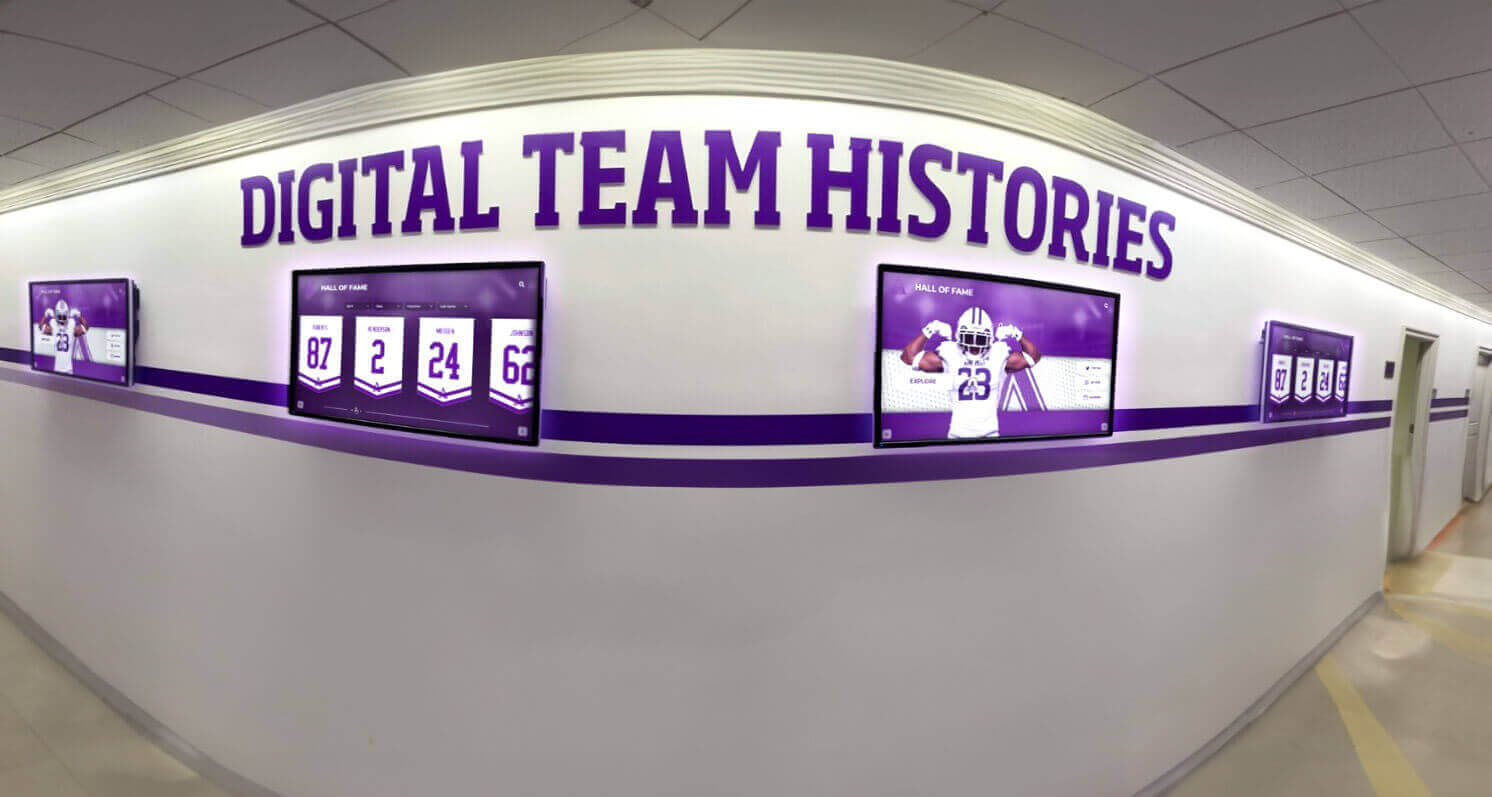
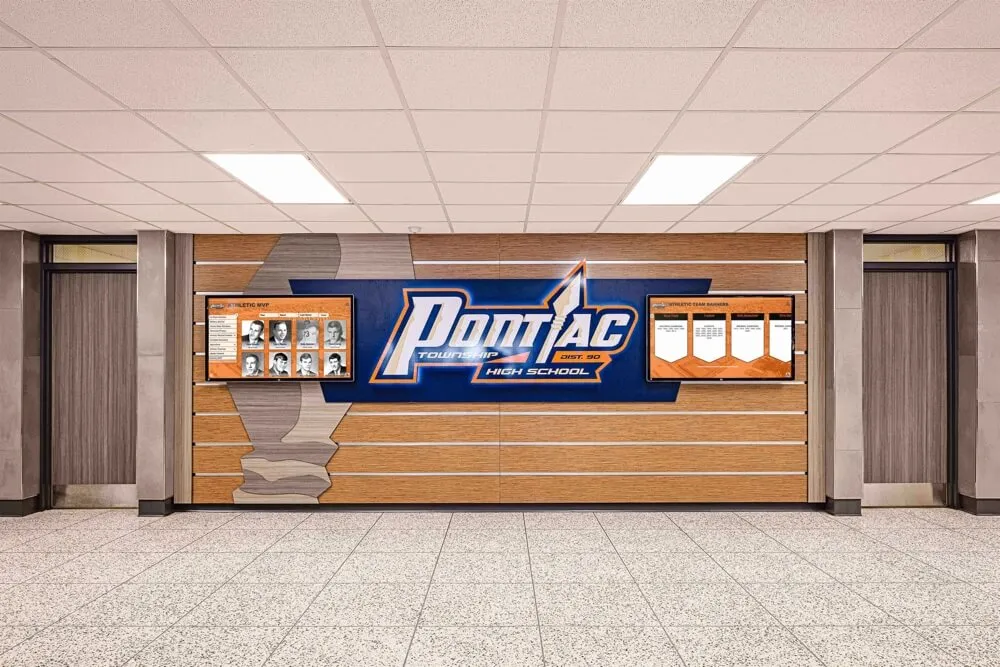
Coordinated multiple-display installations create comprehensive recognition corridors celebrating athletic history throughout high-traffic areas
Technology Management and Support
For digital recognition systems, plan for software licensing and cloud platform fees, content management training for designated staff, technical support arrangements for troubleshooting, hardware maintenance and eventual replacement, and data backup ensuring content preservation.
Unlike physical plaques requiring minimal maintenance, digital systems need ongoing technical support—factor these requirements into long-term planning. Consider platforms like digital hall of fame solutions designed for educational institutions.
Content Development Workflows
Systematic processes ensure timely, quality profile creation.
Historical Data Collection Procedures
Building comprehensive historical recognition requires research protocols including yearbook review and athletic record compilation, newspaper archive research for achievement documentation, interview outreach to coaches and teammates, statistical verification through official records, and photo acquisition from multiple sources.
Historical research proves time-intensive but creates foundational content ensuring halls of fame honor complete program history rather than only recent achievement.
Annual Induction Content Creation
Establish timeline-driven workflows for new inductee profiles including nominee information collection during selection process, inductee notification and information request, profile writing and editing procedures, photography scheduling and completion, content review and approval processes, and publication coordination with ceremony timing.
Standard workflows with clear deadlines ensure quality profiles are completed before induction ceremonies rather than creating last-minute content development pressure.
Ongoing Content Maintenance
Plan for profile updates and corrections when errors are identified, new photo or video acquisition improving existing profiles, obituary information and memorial designation when inductees pass away, post-induction achievement updates for younger alumni, and historical expansion as research uncovers additional documentation.
Living recognition programs continuously improve rather than treating initial publication as final content requiring no future enhancement.
Measuring Program Success and Impact
Systematic assessment demonstrates value while identifying improvement opportunities.
Engagement and Awareness Metrics
Track indicators revealing how community interacts with athletic recognition.
Physical Display Interaction Data
For digital systems, monitor daily interaction counts and session frequency, average session duration indicating engagement depth, search term analysis revealing what visitors seek, profile view patterns showing whose recognition receives attention, and time-of-day usage patterns informing content strategy.
These metrics help administrators understand whether recognition displays achieve intended engagement goals while identifying opportunities to enhance content or improve placement based on actual visitor behavior.
Web-Based Access Analytics
Beyond physical displays, track online recognition engagement through web platform visits and unique visitor counts, geographic distribution showing where online visitors originate, device analytics revealing mobile versus desktop access patterns, social share frequency indicating recognition amplification, and referral sources showing how visitors discover recognition.
Web analytics demonstrate recognition reach beyond physical campus while revealing whether alumni engage with recognition remotely as digital platforms enable.
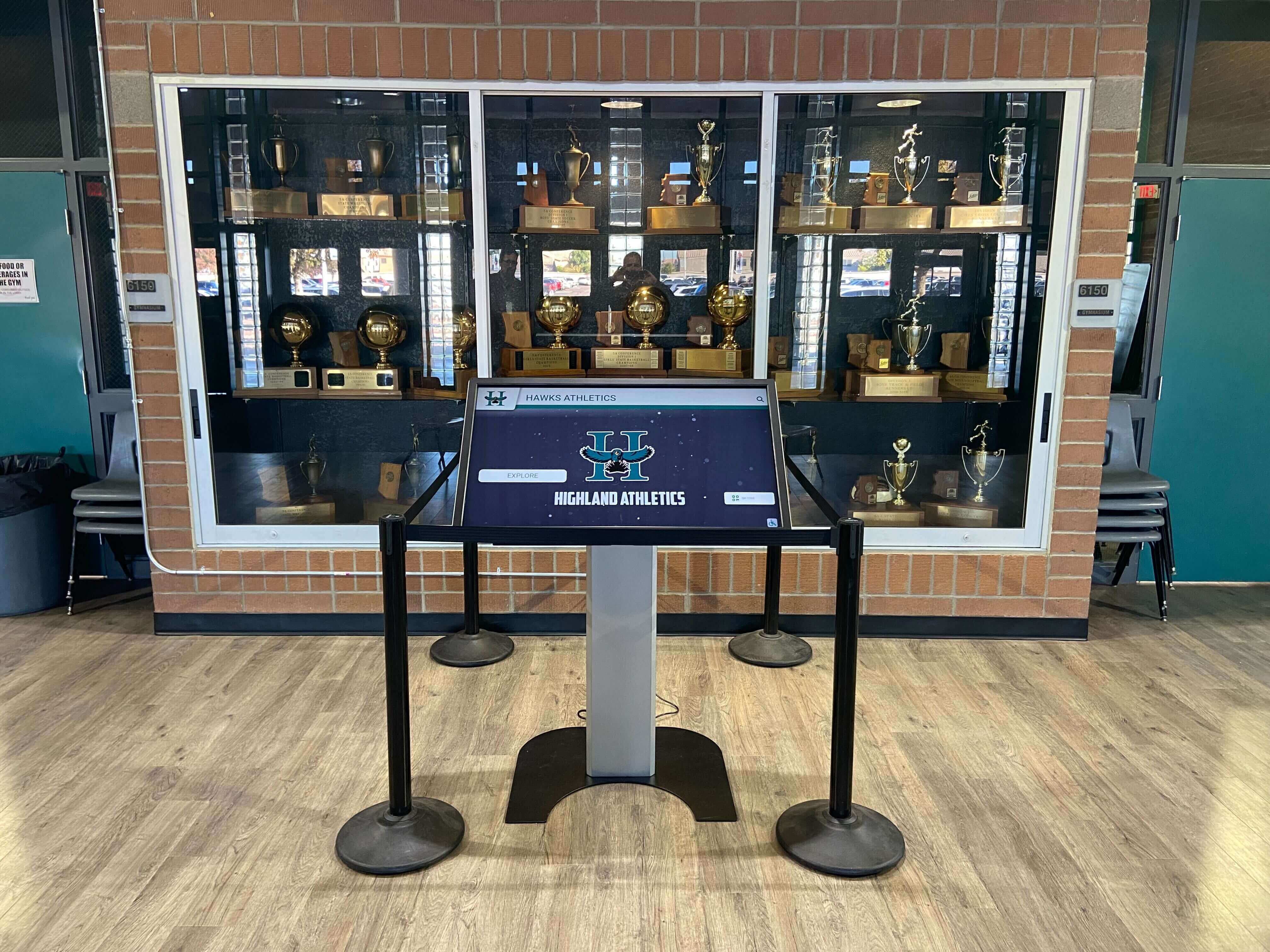
Strategic kiosk placement within existing trophy case areas integrates digital recognition with traditional physical athletic displays
Ceremony Attendance Tracking
Monitor induction event participation through total attendance year-over-year trends, inductee family attendance rates, alumni athlete participation beyond immediate inductees, community member engagement, and media coverage reach and quality.
Attendance patterns indicate whether recognition maintains community significance and informs decisions about ceremony timing, format, and promotion strategies.
Qualitative Assessment and Feedback
Beyond quantitative metrics, gather stakeholder perceptions about program effectiveness.
Stakeholder Satisfaction Surveys
Systematically collect feedback from inductees about recognition experience and ceremony quality, families regarding communication and event planning, current athletes about awareness and motivational impact, coaches concerning selection process fairness and recognition comprehensiveness, and alumni reflecting on whether recognition appropriately honors achievement.
Regular feedback enables continuous improvement ensuring programs evolve based on stakeholder input rather than administrative assumptions about effectiveness.
Cultural Impact Indicators
Monitor less tangible but meaningful program effects including current athlete awareness of program tradition and standards, alumni engagement with current athletic programs, community pride and institutional athletic identity, media coverage quality and recognition significance, and parent perception of institutional commitment to athletic excellence.
These cultural indicators reveal whether halls of fame achieve broader institutional objectives beyond simply creating recognition displays.
Special Considerations and Advanced Topics
Several specific situations require tailored approaches beyond standard hall of fame frameworks.
Multi-Sport and Multi-Level Recognition
Complex athletic programs need coordinated approaches ensuring fair recognition across all sports.
Sport-Specific vs. Unified Recognition
Schools face decisions about creating separate halls of fame for major sports versus unified programs honoring all athletics equally. Unified approaches ensure smaller sports receive equal recognition opportunity, prevent prestige hierarchies between sports, simplify administration through single selection process, and communicate institutional value for all athletic participation.
However, sport-specific recognition allows specialized criteria reflecting unique achievement standards, creates manageable selection committee sizes, and may reflect historical institutional practice or facility configuration.
Varsity, Junior Varsity, and Youth Program Recognition
Most halls of fame focus on varsity achievement, but some programs incorporate sub-varsity recognition through separate categories or display areas, modified selection criteria reflecting appropriate achievement levels, feeder program acknowledgment connecting youth athletics to high school, or all-participant recognition beyond selective hall of fame induction.
These decisions affect recognition inclusivity while maintaining distinction between varying achievement levels.

Stadium and arena installations bring recognition directly to competitive venues where current athletes train and compete daily
Title IX Compliance and Gender Equity
Athletic recognition must reflect commitment to equal opportunity across all programs.
Balanced Recognition Standards
Ensure selection criteria apply equitably across male and female sports through parallel achievement thresholds regardless of sport, proportional representation reflecting participation rates, equal prominence in physical or digital displays, balanced ceremony recognition across genders, and regular equity analysis ensuring fair recognition distribution.
Title IX compliance extends beyond participation opportunities to encompass recognition and celebration of achievement across all athletic programs.
Historical Context and Evolving Standards
Many schools have longer male athletic program histories due to historical participation barriers for female athletes. Address these legacy effects through intentional outreach identifying deserving female athletes from earlier eras, adjusted criteria recognizing achievement within historical context, supplemental recognition categories celebrating program pioneers, and historical documentation acknowledging how athletic opportunities evolved.
These approaches honor complete institutional athletic history while acknowledging that equal recognition standards must account for historical participation barriers that affected opportunity.
Consolidation and Multi-School Legacy Recognition
School consolidations create unique challenges when multiple institutional athletic traditions merge.
Honoring Multiple Institutional Legacies
When schools merge, halls of fame should acknowledge all predecessor institutions through separate recognition sections for each historical school, unified selection applying same standards across all institutional eras, comprehensive historical documentation explaining consolidation context, and celebration of combined tradition creating new unified identity while honoring distinct histories.
Inclusive approaches demonstrate respect for all communities contributing to consolidated institutions while building unified identity honoring complete athletic heritage. Explore consolidated school history approaches for comprehensive strategies.
Memorial and Posthumous Recognition
Special sensitivity applies when honoring deceased athletes, coaches, or contributors.
Memorial Designation Standards
Establish clear policies for posthumous recognition including waiting period requirements ensuring perspective, family consultation and consent processes, appropriate memorial designation in profiles, ceremony protocol recognizing family presence, and permanent memorial elements within displays.
Thoughtful memorial recognition honors those who have passed while providing appropriate acknowledgment for families grieving loss. Learn more about honoring deceased faculty and community members.
Technology Selection and Implementation Guide
For schools pursuing digital recognition, systematic technology evaluation ensures appropriate platform selection.
Digital Platform Evaluation Criteria
Compare solutions across dimensions affecting long-term satisfaction and program success.
Content Management Capabilities
Assess platforms based on ease of profile creation without technical skills required, bulk import for historical data entry, scheduled publishing and content calendar features, revision history and version control, role-based permissions for multi-user access, and mobile accessibility for content management.
Complex, technical systems create ongoing frustration and may prevent regular updates maintaining recognition currency.
Display Hardware and Integration
Evaluate touchscreen display quality and commercial-grade durability, mounting options (freestanding kiosks vs. wall-mounted), ADA-compliant accessibility features, integration with existing athletic facility infrastructure, and remote management capabilities.
Hardware quality significantly affects long-term reliability and visitor experience—consumer-grade equipment proves inadequate for high-traffic educational environments.
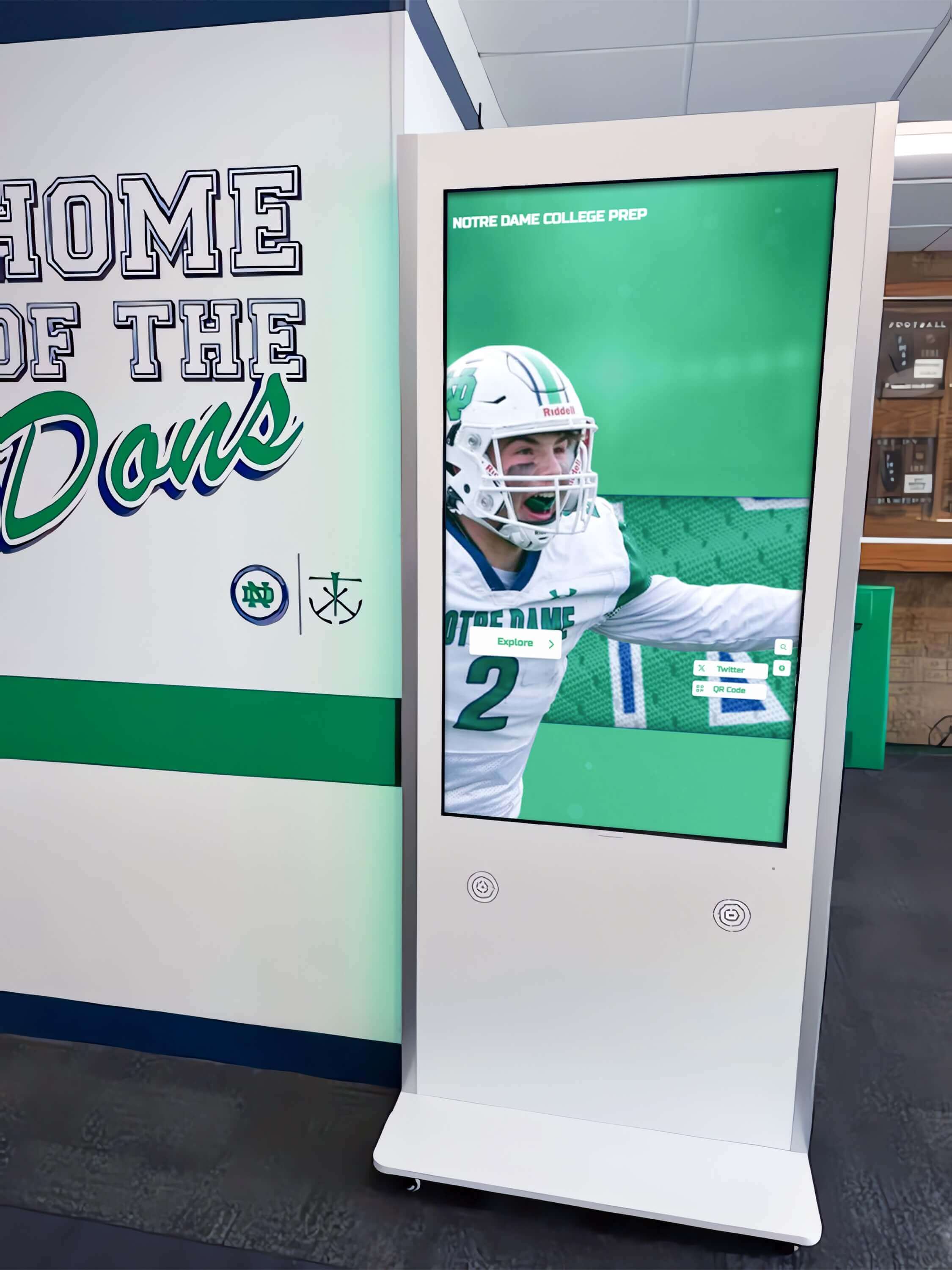
Professional kiosk installations provide durable, attractive recognition stations withstanding heavy daily use in educational environments
Web and Mobile Extensions
Consider solutions providing responsive web displays accessible across devices, individual profile URLs for sharing, social media integration enabling recognition amplification, website embedding capabilities, and mobile app integration when applicable.
Recognition extending beyond physical displays maximizes visibility and alumni engagement regardless of geographic location.
Support and Training Resources
Evaluate vendor-provided onboarding and training for staff, ongoing technical support availability and responsiveness, documentation and help resources, software update frequency and enhancement roadmap, and user community or peer networking opportunities.
Long-term program success depends on sustainable management—inadequate support creates ongoing frustration regardless of platform capabilities.
Implementation Planning and Timeline
Systematic deployment ensures successful launch and stakeholder satisfaction.
Pre-Implementation Planning Phase (8-12 weeks)
Begin with goal definition and program requirements documentation, selection committee formation and criteria establishment, historical data collection and organization, budget finalization and approval, and technology evaluation and vendor selection.
Thorough planning prevents costly mistakes and ensures recognition programs launch with clear direction and adequate resources.
Content Development Phase (12-20 weeks)
After planning, focus on historical inductee profile creation, photography acquisition and digitization, coaching and contributor recognition development, team achievement documentation, and content review and quality assurance.
Content development typically requires most time investment during implementation—the depth of historical recognition desired determines timeline length more than technical installation.
Technology Deployment Phase (4-8 weeks)
With content ready, proceed to hardware installation and configuration, software setup and branding customization, content migration and publishing, staff training on management systems, and system testing and quality assurance.
Coordinate technical deployment with content readiness ensuring complete recognition is available at launch rather than partial implementation requiring future expansion.
Launch and Initial Operation (4-6 weeks)
Complete implementation with soft launch and internal testing period, stakeholder communication and promotion, formal unveiling and inaugural ceremony, initial usage monitoring and feedback collection, and refinement based on early experience.
Phased launch enables issue resolution before high-profile public unveiling while building anticipation through progressive stakeholder communication.
Conclusion: Building Lasting Athletic Recognition Programs
Athletic halls of fame represent significant opportunities for school administrators to honor competitive excellence, preserve institutional athletic heritage, and inspire current student-athletes through meaningful recognition of those who came before. Successful programs balance traditional values of athletic achievement recognition with modern approaches ensuring sustainable administration, comprehensive inclusivity, and engaging presentation formats resonating with contemporary audiences.
The frameworks explored in this guide provide administrators with systematic approaches to creating athletic recognition programs that serve institutional mission while remaining manageable through leadership transitions and program evolution. From transparent selection criteria and committee structures to modern digital display solutions and sustainable content management workflows, these evidence-based strategies ensure halls of fame achieve intended goals while avoiding common pitfalls undermining recognition program effectiveness and credibility.
Transform Your Athletic Recognition Program
Discover how modern digital recognition solutions can help you honor athletic excellence while preserving your complete program history through engaging displays designed specifically for educational athletics.
Explore Recognition SolutionsWhether implementing first athletic halls of fame for programs seeking to formalize recognition, enhancing existing physical displays with modern digital capabilities, or addressing equity concerns ensuring all sports receive appropriate acknowledgment, the strategies in this guide provide practical pathways forward. Begin with clear goal definition understanding what recognition programs must achieve, comprehensive needs assessment evaluating current approaches and improvement opportunities, realistic budget development accounting for initial implementation and ongoing management, and stakeholder engagement ensuring recognition programs reflect community values and athletic department priorities.
With thoughtful planning, appropriate technology selection when pursuing digital approaches, and commitment to sustainable content management, athletic halls of fame provide recognition platforms serving institutional missions while adapting to changing needs and expanding as programs grow. The investment in recognition infrastructure pays dividends through enhanced school pride, inspired current athletes, preserved athletic heritage, and strengthened alumni connections supporting broader institutional goals.
Ready to begin? Explore digital athletic recognition systems, discover comprehensive approaches to sports awards, learn about state championship recognition displays, or schedule a consultation to discuss how digital recognition platforms can support your athletic hall of fame goals and celebrate the athletes, coaches, and community members advancing your athletic programs.