School advancement offices run on two currencies: money and trust. Capital campaigns close, gala tables sell out, and annual fund mailers produce solid returns—yet many development teams watch their donor retention rates hover around 40 to 50 percent, quietly bleeding relationships that took years to build. The culprit is rarely a failed solicitation strategy. It is what happens (or doesn’t happen) between the gift receipt and the next ask.
Donor relations best practices provide the systematic framework that transforms transactional giving into genuine partnership. When advancement offices treat stewardship as a year-round discipline rather than an afterthought following each campaign, they create the conditions where major givers deepen their investment, mid-level donors upgrade into leadership circles, and first-time contributors return the following year. This guide delivers that framework—practical, school-specific, and built around what your donors actually need to feel valued.
The distinction between donor recognition and donor relations is worth clarifying upfront. Recognition is what you do visibly: the plaque in the corridor, the listing in the annual report, the name on the scholarship. Relations is the ongoing relational infrastructure that surrounds recognition—the personal calls, the impact reports, the coffee meeting with the head of school, the thoughtful card on a donor’s retirement. Both matter. Neither works well without the other.

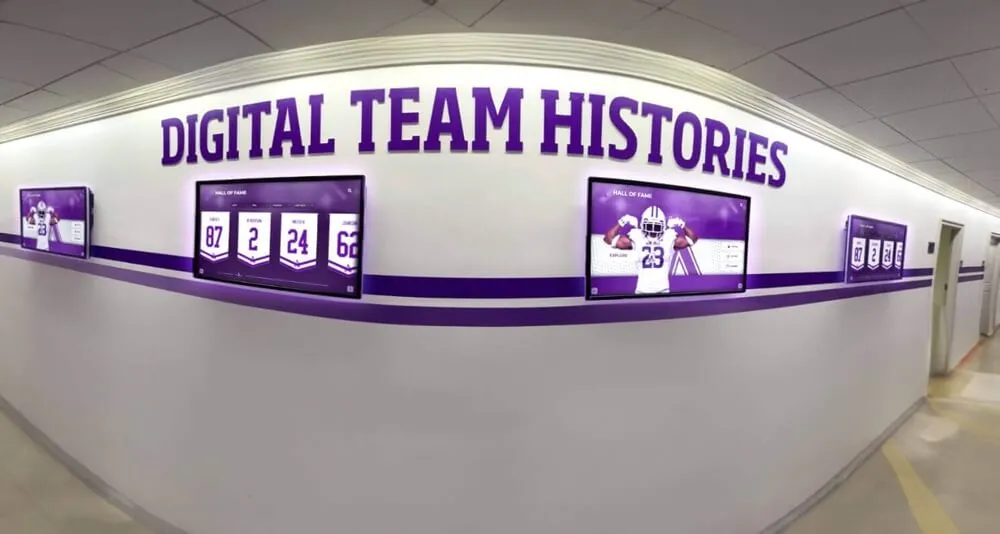
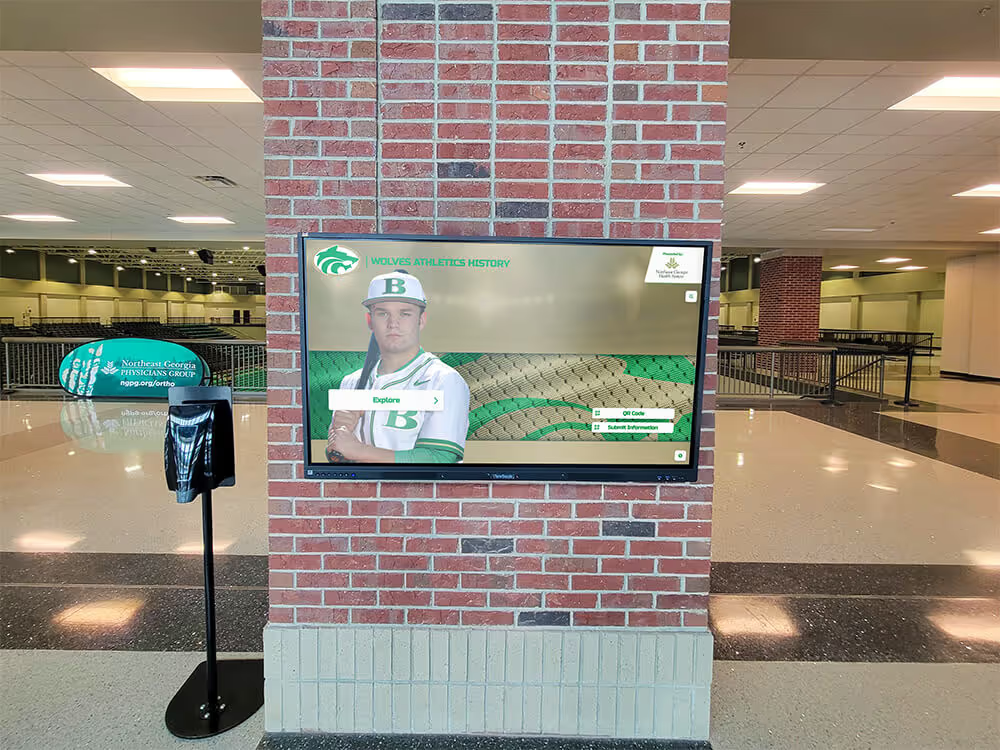
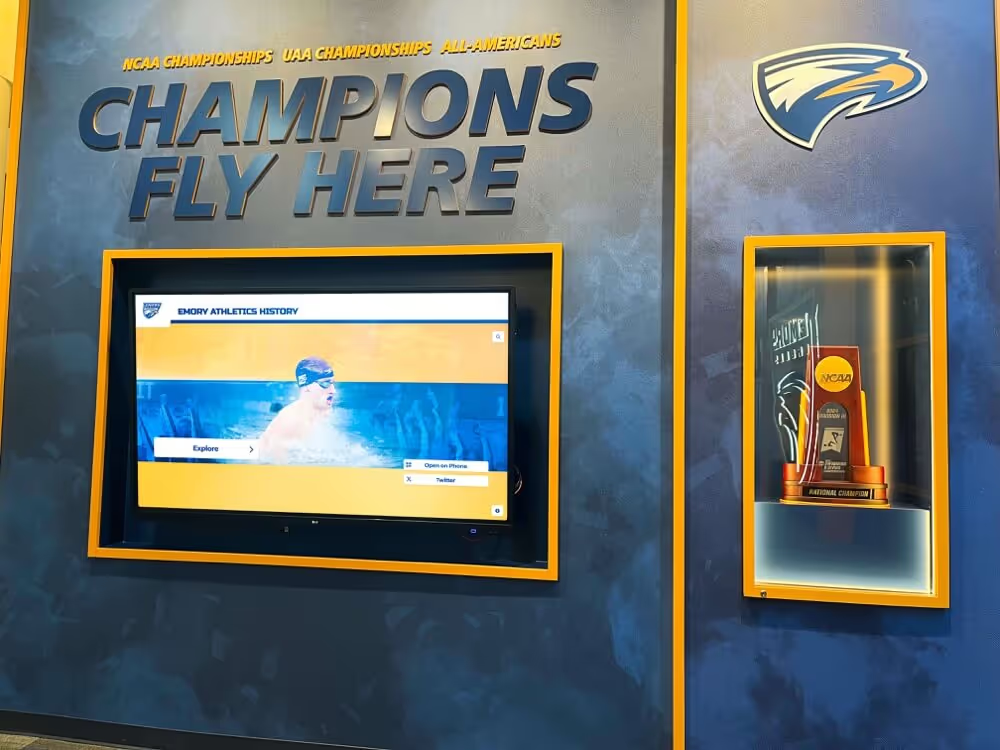
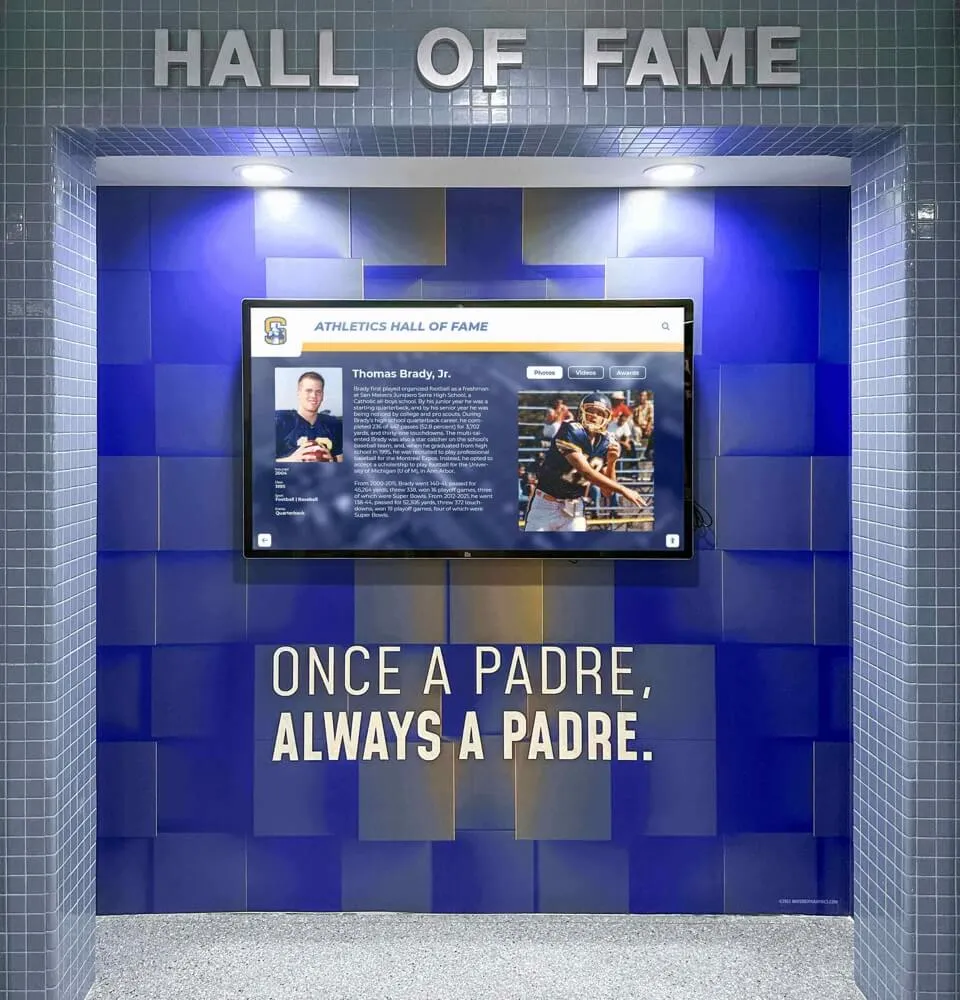
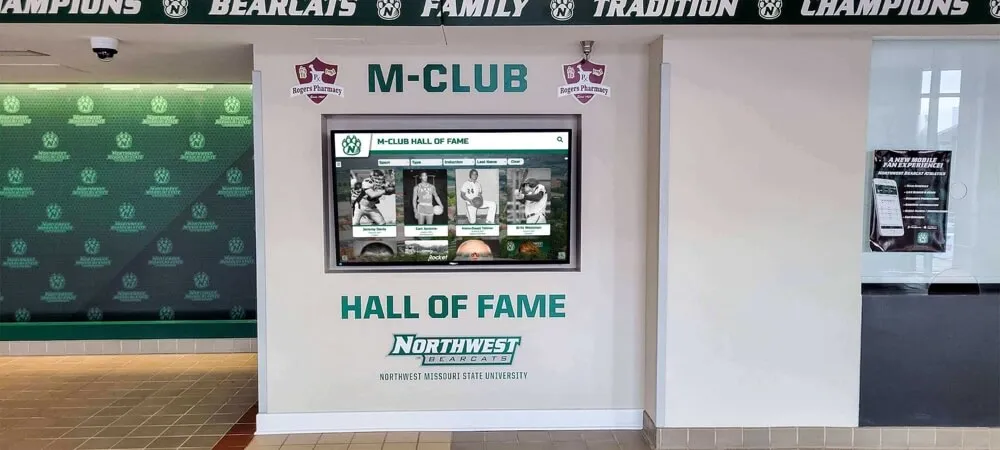
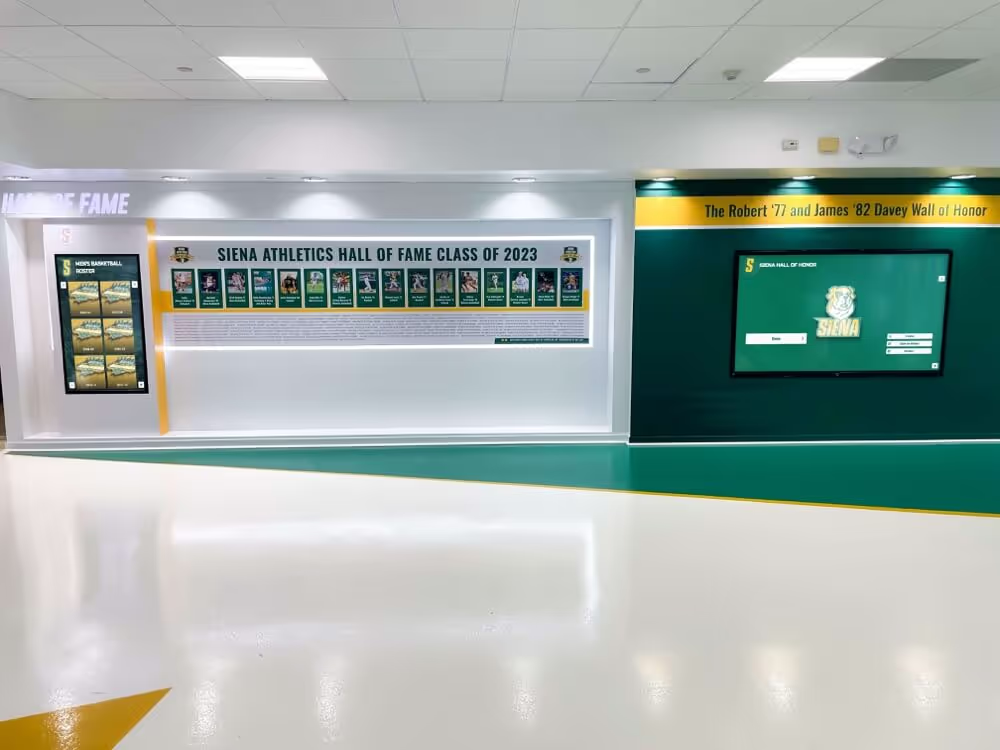
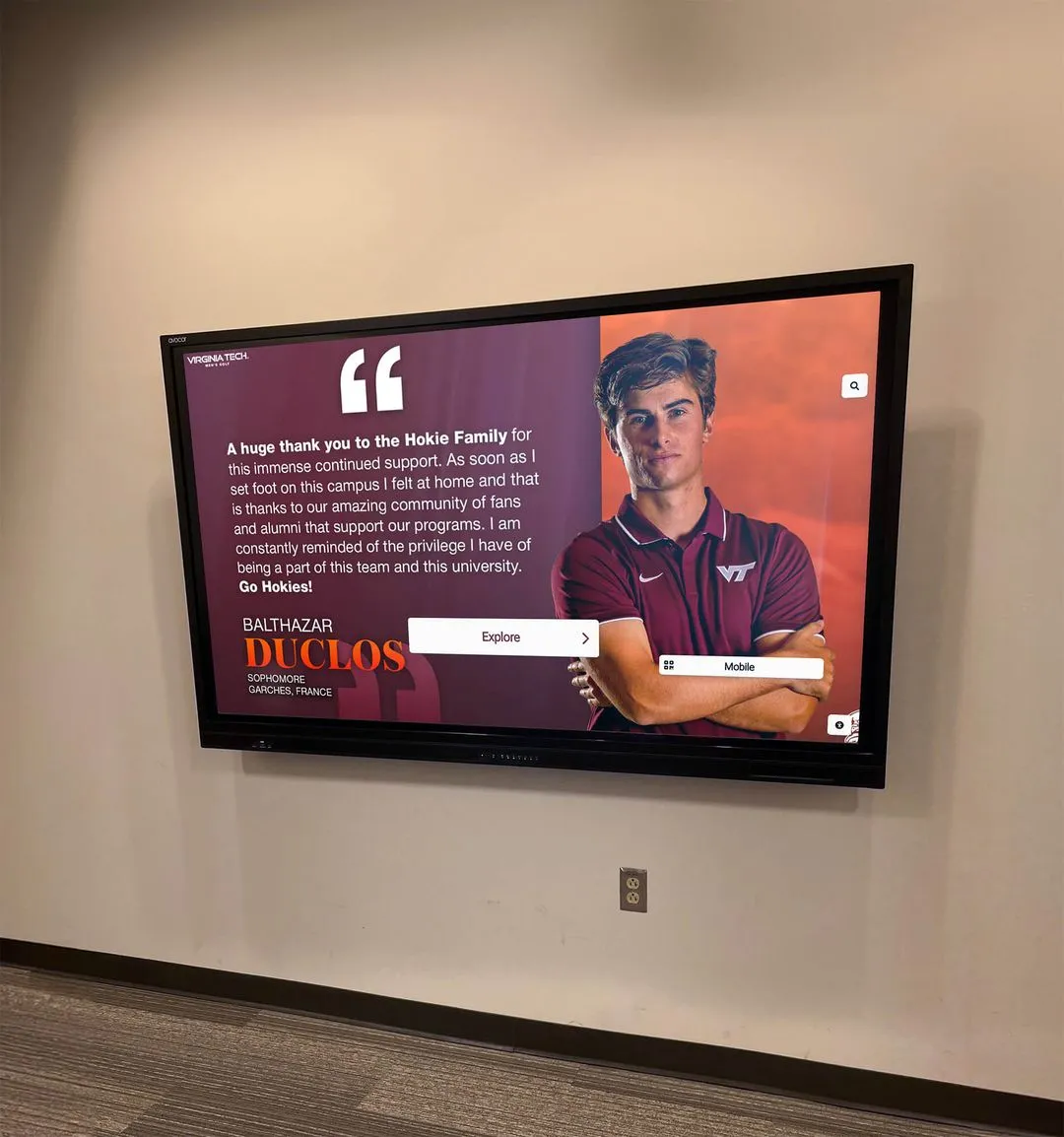
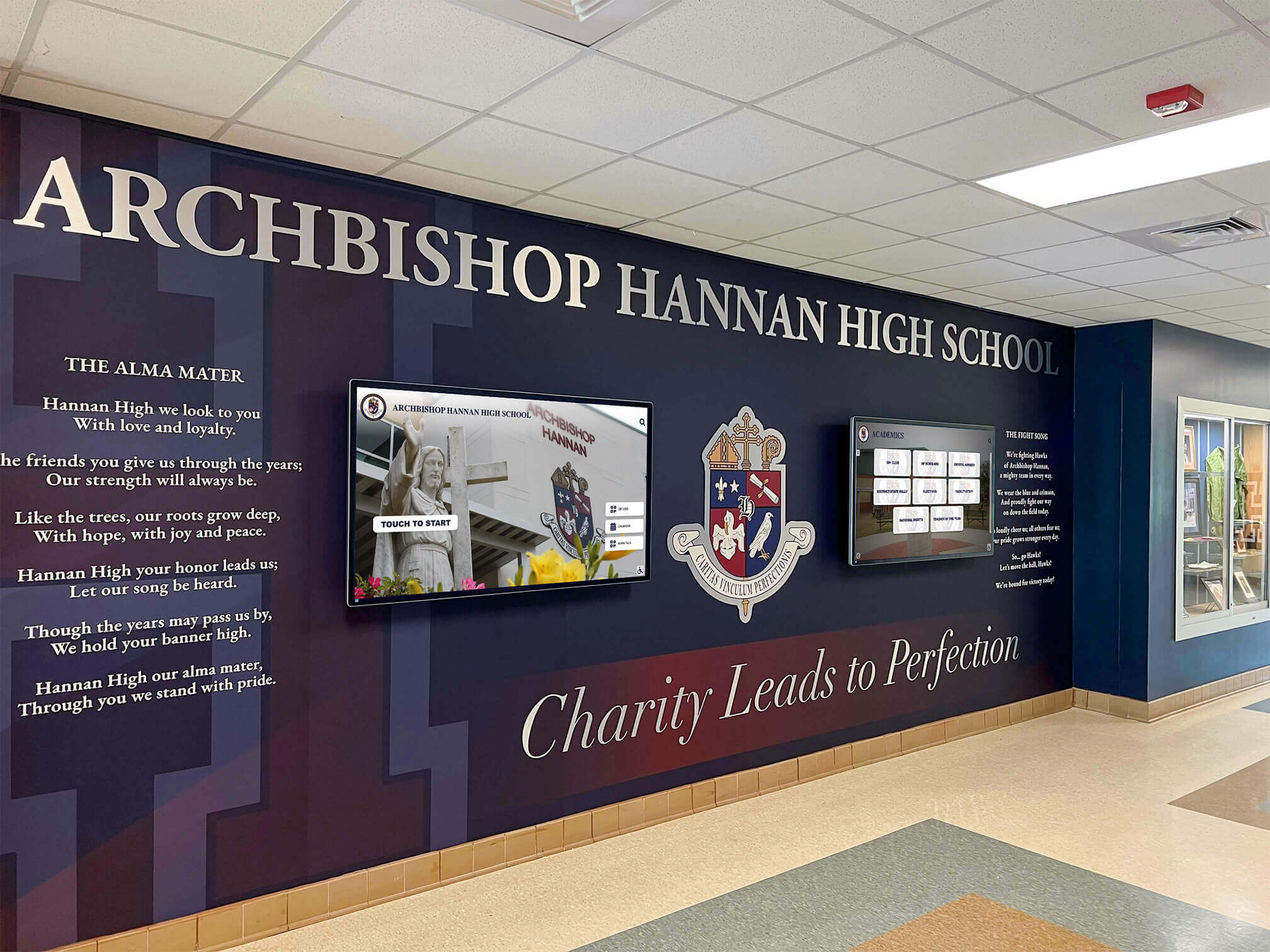
Visible recognition installations anchor the physical environment while ongoing stewardship keeps the relationship alive between visits
What Donor Relations Actually Means for a School Advancement Office
Most development literature treats donor relations as a nonprofit-sector concept that schools can borrow with minor adaptation. The reality is that school advancement operates in a distinct relational ecosystem that shapes how stewardship works in practice.
The School Relationship Advantage—and Its Risks
Your donors aren’t strangers to your institution. They are alumni who walked your hallways, parents whose children compete in your gym, and community members who attended your performances. That pre-existing emotional connection is a tremendous asset when stewardship reinforces it. It becomes a liability when poor communication makes those same people feel like they meant less to your school than their check did.
A parent who writes a five-figure gift to your capital campaign for a new science wing doesn’t just want a named lab. She wants to know whether the lab is actually changing how students learn. An alumnus whose endowed scholarship just funded its first recipient doesn’t just want a tax receipt. He wants to know the student’s name, their plans, and whether his own school experience shaped what they’re pursuing. These aren’t unreasonable expectations—they reflect the emotional investment that drove the gift in the first place.
The advancement offices that consistently outperform on retention recognize this distinction and build donor relations programs that honor the whole relationship, not just the transaction.
The Three Pillars of School Donor Relations
Effective donor relations for schools rests on three interdependent pillars:
Gratitude that feels personal. The most powerful acknowledgment your school can provide costs almost nothing: a specific, timely expression of appreciation that references the donor’s actual contribution, their history with your institution, and what their support enables. Generic form letters with filled-in blanks do not accomplish this. Handwritten notes from coaches whose programs were funded, personal calls from the head of school, and messages from scholarship recipients do.
Impact communication that closes the loop. Donors give because they believe something will change. Your stewardship job is to show them what changed. This means connecting each gift—not just vaguely to “student success”—but specifically to programs, spaces, students, or milestones their support made possible. The advancement office that masters impact storytelling builds a pipeline of donors who feel compelled to give again because they have seen their investment bear fruit.
Consistent presence that isn’t always asking. The single most common donor relations failure in schools is the silence that stretches between campaigns. Donors who hear from your institution only when a new campaign launches quickly feel transactional, and transactional donors lapse. Staying present with appreciation, updates, and invitations—none of which involve a solicitation—is what separates retained donors from lapsed ones.
Explore how storytelling through digital recognition can turn your physical facilities into ongoing impact communication tools visible every time a donor visits campus.
Build Your Donor Portfolio Map Before You Steward It
Donor relations best practices require differentiated approaches across giving levels. Treating every donor identically—regardless of gift size, relationship history, or giving potential—wastes limited advancement staff time while delivering impersonal experiences to your most invested supporters.
Major Donors (Typically $25,000 and Above)
At this level, donor relations is fundamentally a personal relationship business. These supporters have made transformational commitments to your institution and expect stewardship that reflects the depth of that commitment. Standard best practices for this tier include:
- A personal thank-you call from the head of school or principal within 24 hours of receiving a major gift commitment
- A handwritten note from a board member, program director, or beneficiary within one week
- A private meeting or campus visit within 60 days specifically focused on impact—not solicitation
- Customized impact reports at six-month intervals connecting the gift to specific outcomes with supporting data and stories
- Quarterly relationship maintenance through calls, personal notes, or event invitations
- Inclusion in an invitation-only major donor advisory council or steering committee when appropriate
Major donor stewardship should feel like a genuine friendship in which your institution happens to be one of the shared interests. When it works well, the relationship itself becomes the recognition—major donors who feel deeply connected to your school’s mission frequently need very little encouragement before upgrading their gifts or making planned giving commitments.
Mid-Level Donors ($5,000–$24,999)
This segment often receives the least strategic attention relative to its importance. Mid-level donors represent the cultivation pipeline feeding your major gift portfolio. Neglect at this stage produces the classic “missing middle” problem: an annual fund base at the bottom and a handful of major donors at the top, with nobody actively developing the middle tier into tomorrow’s lead gifts.
Stewardship for mid-level donors should include:
- Personalized acknowledgment letters signed by senior leadership within one week
- Segmented impact communications quarterly—not generic annual fund newsletters but specific updates about the programs or priorities their gifts support
- Invitation to at least one exclusive donor event per year focused on behind-the-scenes access
- A personal call or email check-in from a development officer semi-annually
- Recognition in annual reports and giving society listings with appropriate tier visibility
The goal of mid-level stewardship is not just retention—it is deliberate cultivation toward the next tier. Development officers should maintain written notes on each mid-level donor’s interests, family connections to the school, and any signals of capacity or readiness for a deeper conversation.
Annual Fund Donors (Under $5,000)
Efficient systems anchor stewardship at this level. The annual fund base is too large for fully personalized touches on every gift, but smart advancement offices still find ways to make acknowledgment feel meaningful:
- Automated acknowledgment within 48 hours with a receipt that includes impact language—not just tax information
- A segmented impact email 90 days after the gift showing what their support accomplished
- Invitation to at least one donor appreciation event or campus open house
- Inclusive recognition in annual reports, giving society listings, and digital displays
- Milestone recognition when donors cross giving anniversaries or cumulative total thresholds
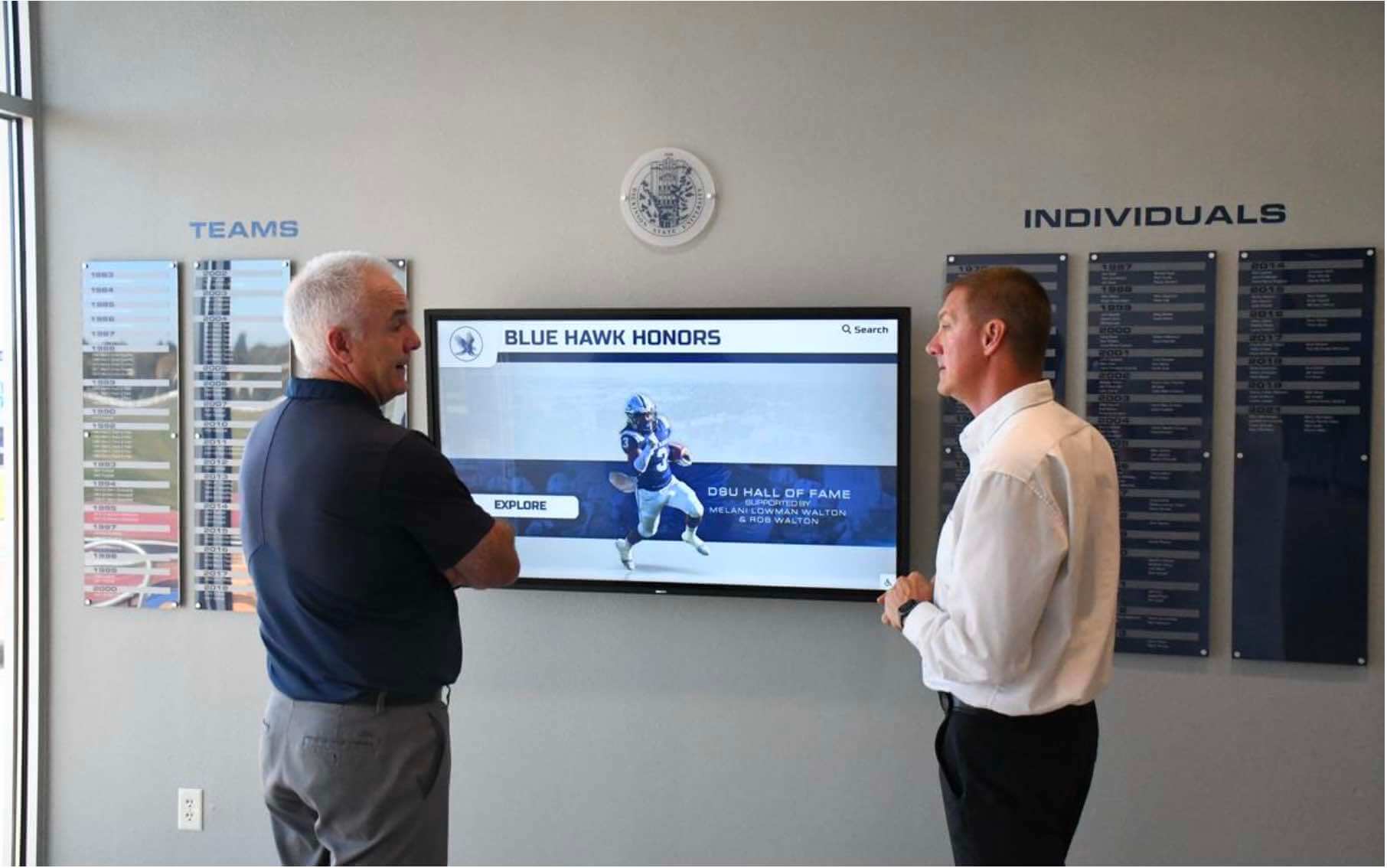
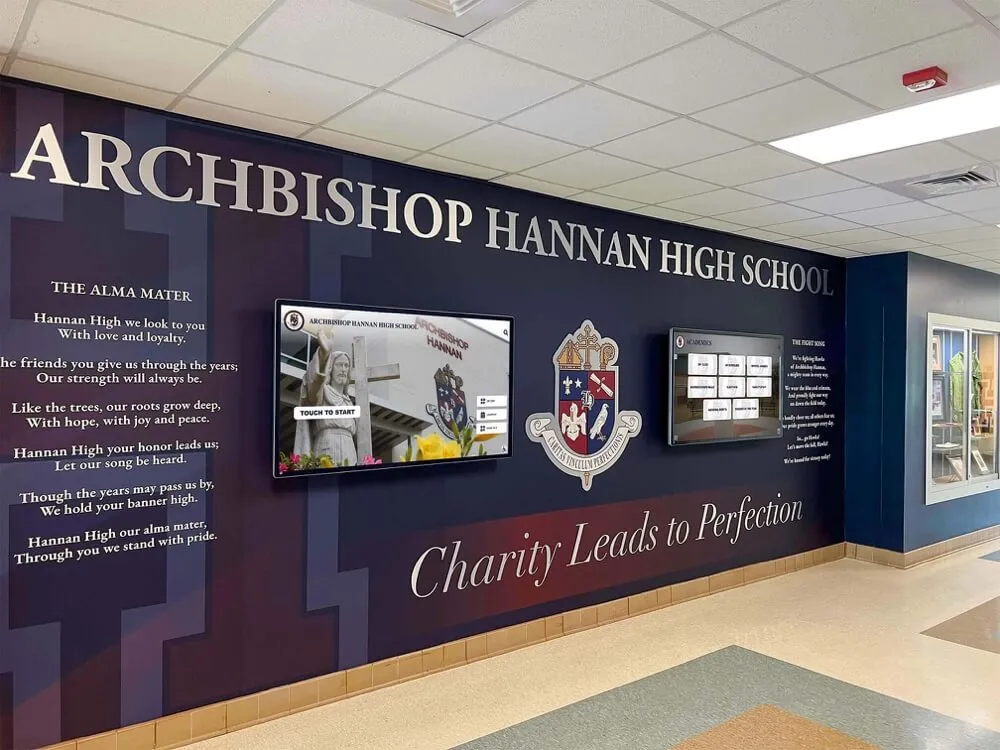
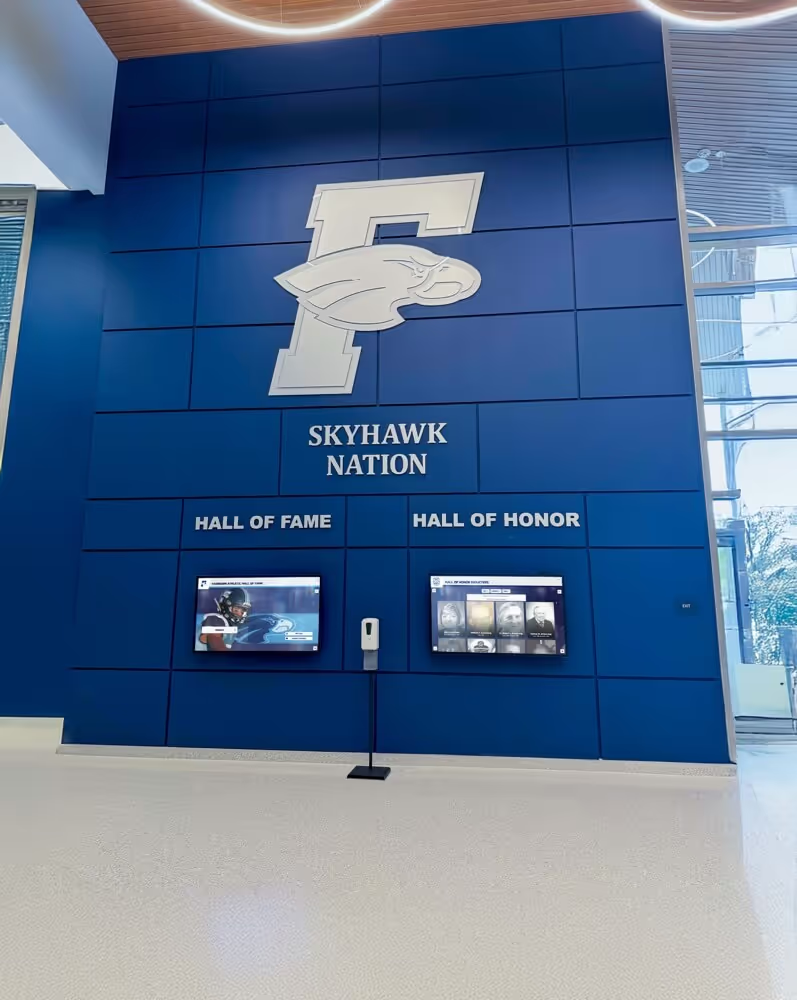
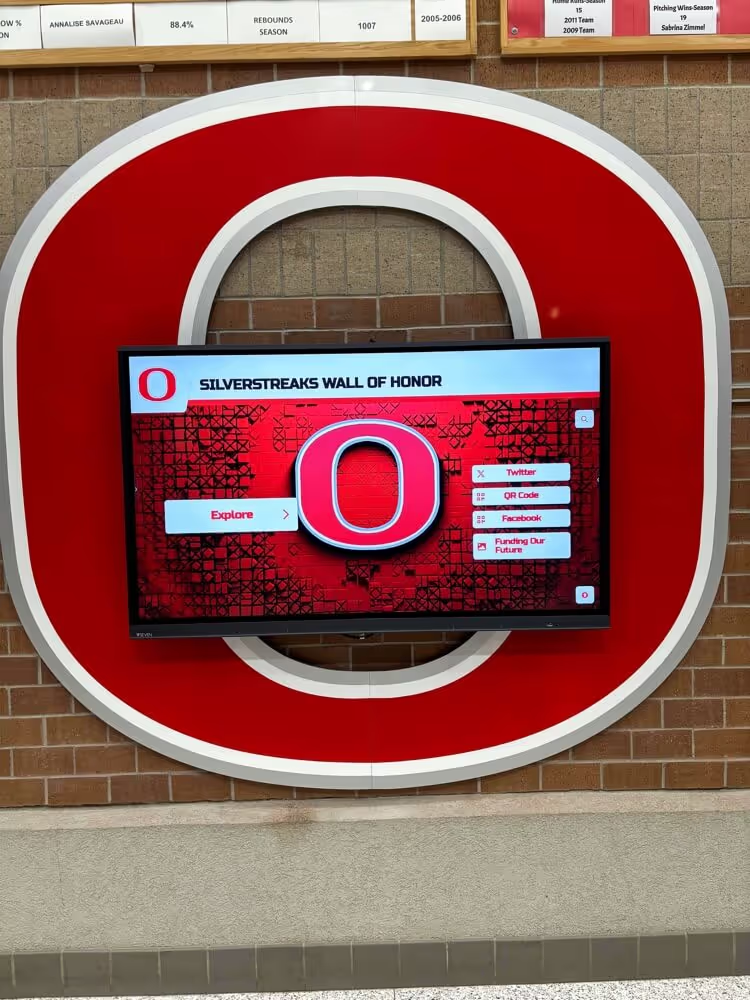
Digital displays serve as stewardship tools that advancement staff can update remotely as campaigns progress
Lapsed Donors: The Hidden Opportunity
Before launching any new stewardship initiative, audit your lapsed donor pool. Most advancement offices discover that a substantial percentage of formerly active donors—particularly those who gave consistently for several years—stopped not because of disillusionment with the mission but because communication dried up after their last gift.
Reactivation outreach to lapsed donors who gave at mid-level or above within the past three to five years often produces faster ROI than comparable new-donor acquisition efforts. A personal call from a development officer acknowledging the lapse and sharing specific impact since the donor’s last gift is frequently enough to re-engage supporters who assumed your institution had simply moved on without them.
The First 48 Hours: Acknowledgment Protocols That Set the Tone
Research on donor retention consistently points to the first acknowledgment experience as a decisive moment in relationship formation. Donors who receive prompt, warm, specific acknowledgment report higher satisfaction with organizational stewardship and demonstrate meaningfully better retention rates than those whose first receipt is a weeks-late form letter.
Automated vs. Personal Acknowledgment
Every gift should receive an automated acknowledgment within minutes of processing—this is table stakes. But automated receipts are legal documentation, not relationship communication. They confirm the transaction; they do not build the relationship.
The personal acknowledgment—a hand-signed letter, a phone call, a personal email from someone the donor knows—is where the relationship either begins or stalls. For gifts above your institution’s major gift threshold, personal outreach within 24 hours is non-negotiable. For mid-level gifts, within one week. For annual fund gifts, a personalized follow-up within two weeks should be standard protocol even if bandwidth requires batch processing.
The Major Gift Acknowledgment Call
Phone calls from heads of school to major donors following significant gifts are among the highest-leverage activities in advancement. Many development directors shy away from this because they’re concerned about imposing on a donor’s time. In reality, major donors almost universally appreciate a personal call from senior leadership—it signals that their contribution registered at the highest institutional level.
The call should be brief, warm, and free of any secondary solicitation agenda. Use this framework as a starting point:
Major Gift Acknowledgment Call Framework
─────────────────────────────────────────

OBJECTIVE: Express genuine gratitude, reinforce the donor's decision,
and open the door to ongoing relationship.

DURATION: 5–10 minutes. Respect the donor's time.

OPENING
"[Name], I'm calling personally because I wanted you to hear directly
from me how much your commitment means to [School Name]. This gift
is going to make a real difference for [specific program/initiative]."

SPECIFIC IMPACT BRIDGE
Reference something concrete: "When [funded program/space/scholarship]
is up and running, students are going to benefit from it for decades."

PERSONAL CONNECTION (if applicable)
"I know [School Name] has been part of your family for [X] years, and
that means this gift carries extra significance for all of us."

FORWARD-LOOKING CLOSE
"I'd love to have you see [the space / program / scholar] once things
are underway—would a campus visit sometime in [season] work for you?"

CLOSE WITHOUT ASKING
"I won't keep you—I just wanted to make sure you heard from me
directly. We're genuinely grateful for your partnership."

FOLLOW-UP ACTION
Log the call in your CRM within 24 hours.
Flag the donor for a campus visit invitation within 60 days.
Adapt the language to your school’s voice, but preserve the structure: specific gratitude, concrete impact, personal connection, forward invitation, and a clean close that asks nothing.
A Year-Round Stewardship Communication Calendar
The gap between campaigns is where donor retention is won or lost. Advancement offices that plan stewardship touchpoints across the full calendar year—not just around solicitation seasons—dramatically outperform those whose donor communication is campaign-centric.
The matrix below provides a 12-month stewardship framework adaptable to most school advancement contexts. Customize it based on your academic calendar, campaign schedule, and giving society structure.
Year-Round Donor Stewardship Communication Calendar
─────────────────────────────────────────────────────────────────────

MONTH       TOUCHPOINT TYPE             AUDIENCE SEGMENT
─────────────────────────────────────────────────────────────────────
July        Fall Stewardship Letter     All active donors
            (impact recap from prior    Include photos and specific
            year + preview of coming    program outcomes
            year priorities)

August      Major Donor Check-In Call   Major donor portfolio
            (before fall term begins;   Personal relationship
            share opening-of-school     maintenance call from
            news and ask about summer)  development officer

September   Campus Engagement Event     Mid-level + Major donors
            (fall open house, athletic  Invitation-only; no ask
            season opener, arts         present; pure cultivation
            preview, etc.)

October     First-Time Donor Welcome     All first-year donors
            Sequence                    3-touch series: thank you
                                        letter → impact snapshot
                                        email → welcome phone call

November    Scholarship/Program         Major + Mid-level donors
            Impact Report               Tied to specific gift
                                        designations; not generic

December    Year-End Gratitude          All active donors
            Communication               Holiday card or personal
                                        note; no solicitation
                                        language; milestone
                                        acknowledgments included

January     Giving Anniversary          Donors with anniversaries
            Recognition                 in Q1; personal note
                                        celebrating years of
                                        partnership

February    Mid-Year Impact Update      All active donors
            Newsletter                  Program updates, student
                                        stories, facility progress;
                                        visually strong format

March       Major Donor Advisory        Major donors (10–15 max)
            Roundtable or Dinner        Intimate event; leadership
                                        shares vision; donors
                                        invited to offer input

April       Scholarship Recipient       Scholarship donors
            Introduction                Personal letter or video
                                        from current recipient;
                                        coordinate with students

May         End-of-Year Celebration     Mid-level + Major donors
            Event                       Academic year close event;
                                        no ask; pure appreciation

June        Annual Report + Donor       All donors
            Listing Distribution        Premium quality; connect
                                        to impact data; confirm
                                        recognition name accuracy
                                        before printing
─────────────────────────────────────────────────────────────────────
NOTES:
- Major donors should receive all touchpoints plus personal
  relationship maintenance between calendar events.
- Solicitations should be layered into this calendar strategically
  (typically Oct–Nov annual fund; Feb–March major gift asks),
  never replacing stewardship touchpoints.
- Update this calendar annually based on donor feedback and
  retention data from prior year.
This calendar ensures your donors hear from your institution at least eight to ten times per year in non-solicitation contexts—which is the floor, not the ceiling, for major donor stewardship.
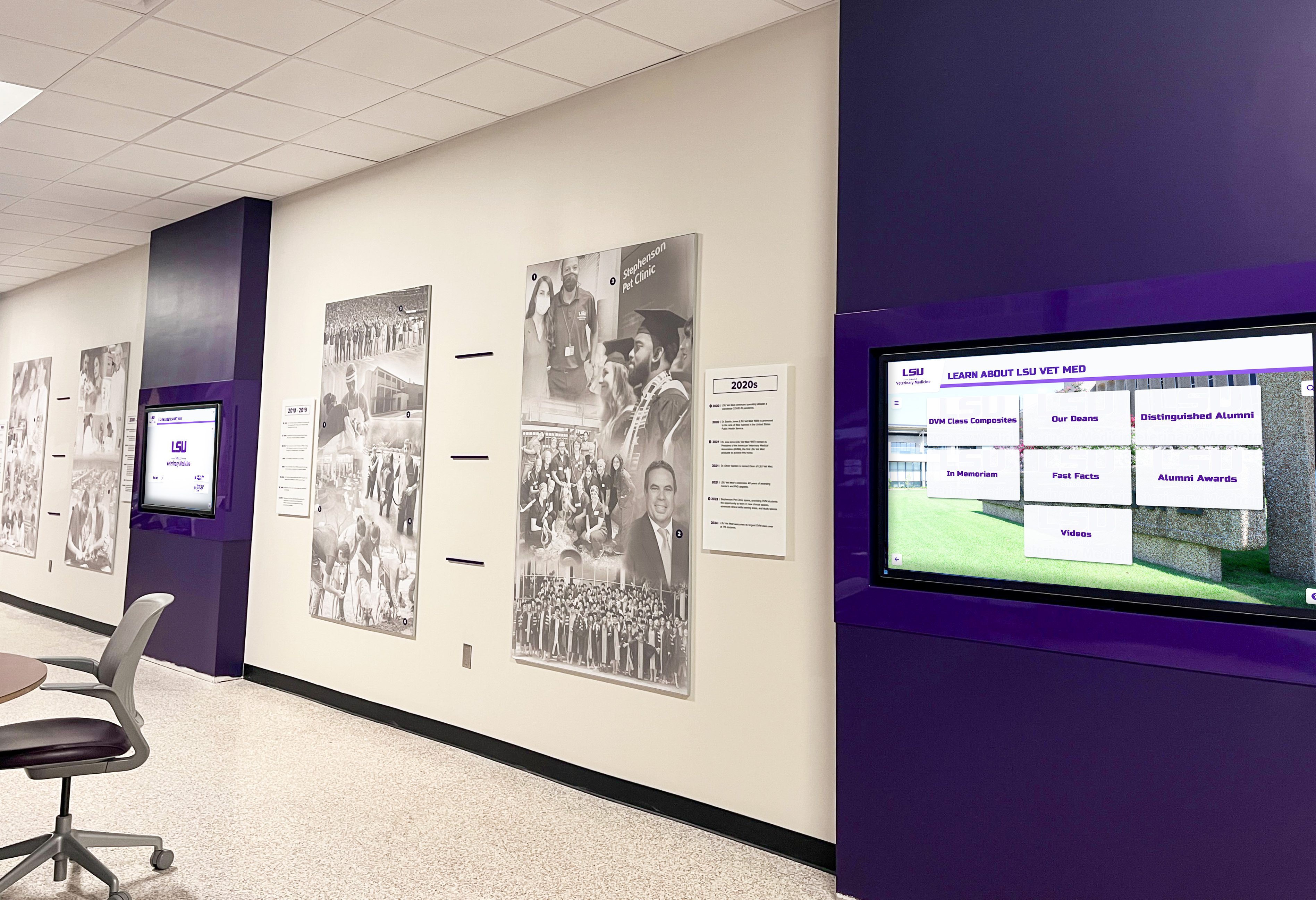
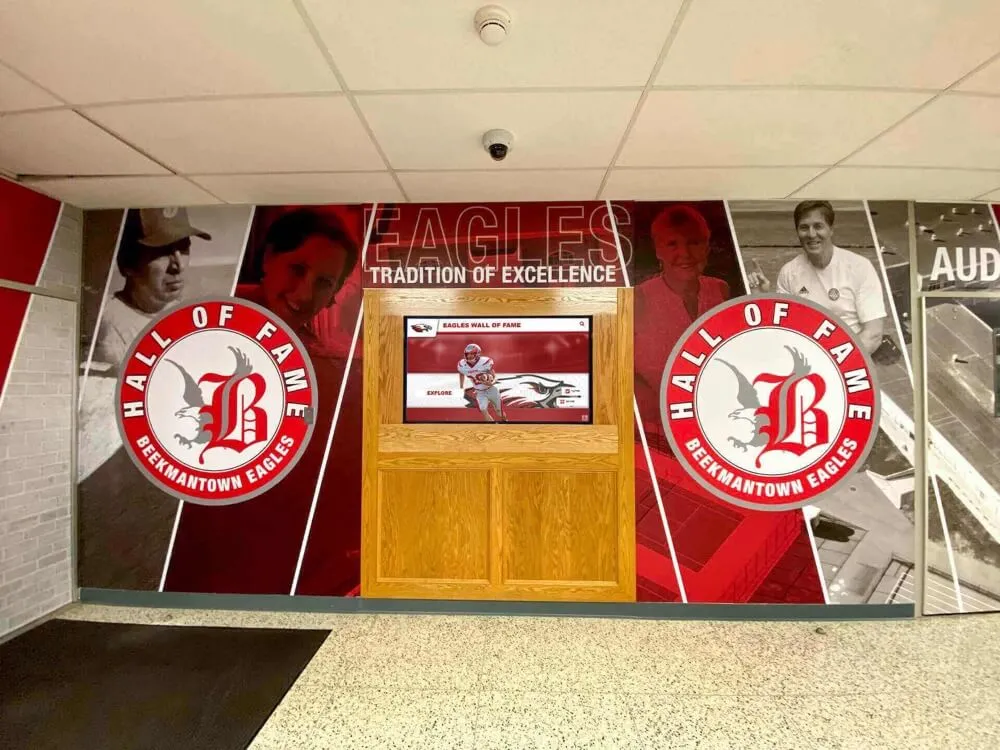
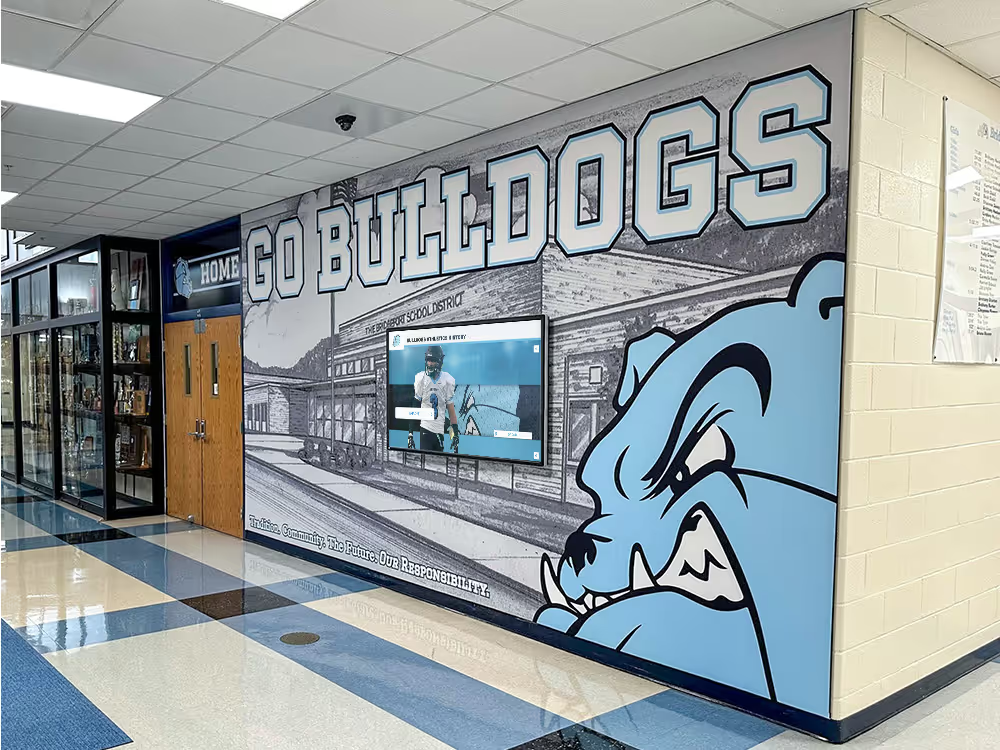
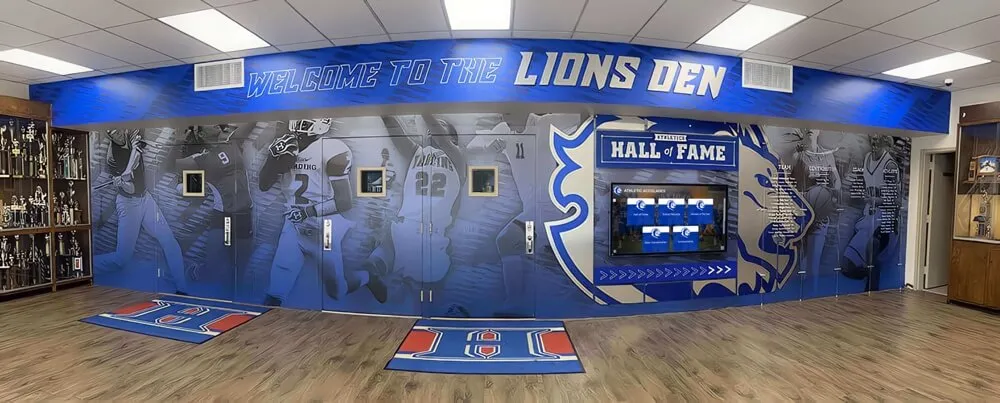
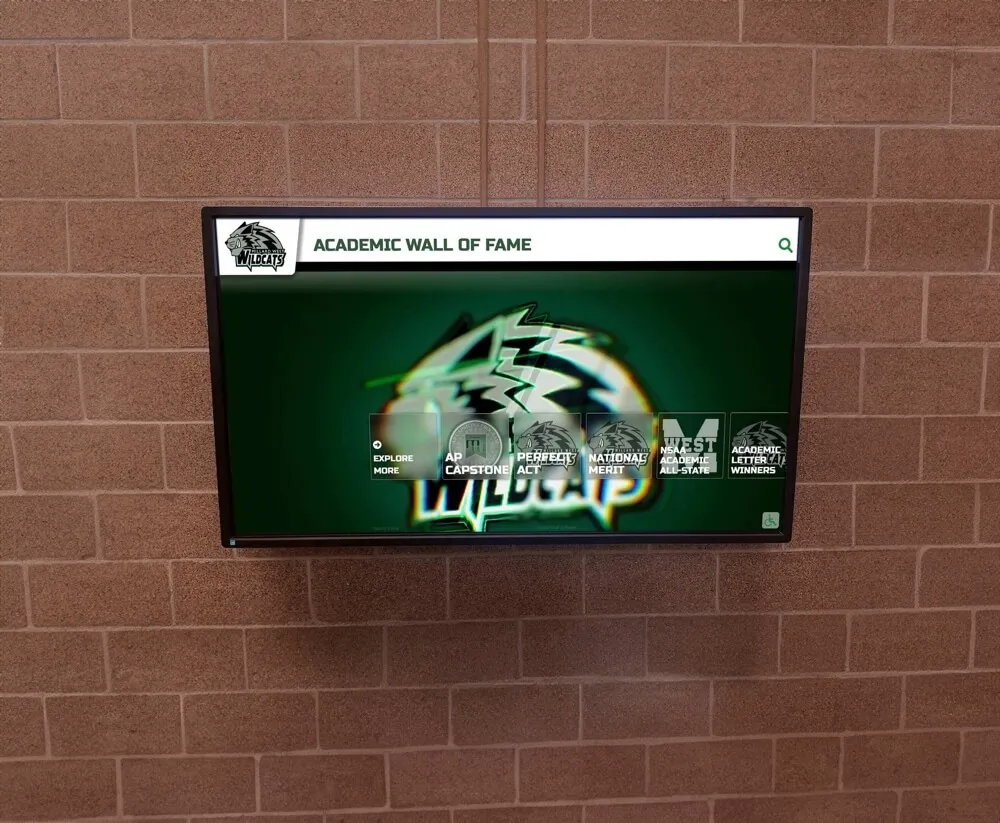
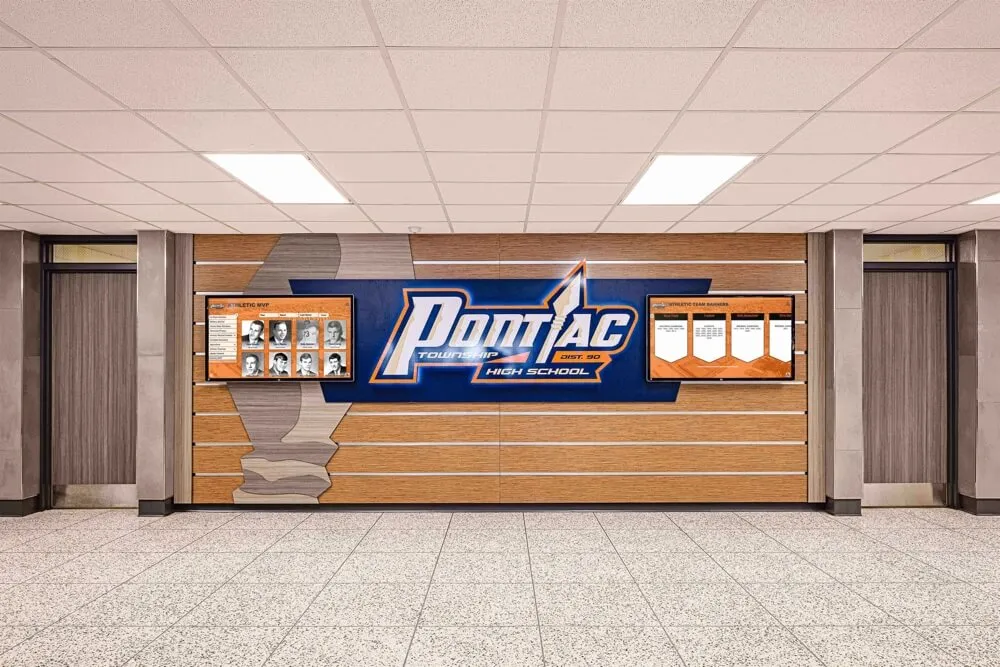
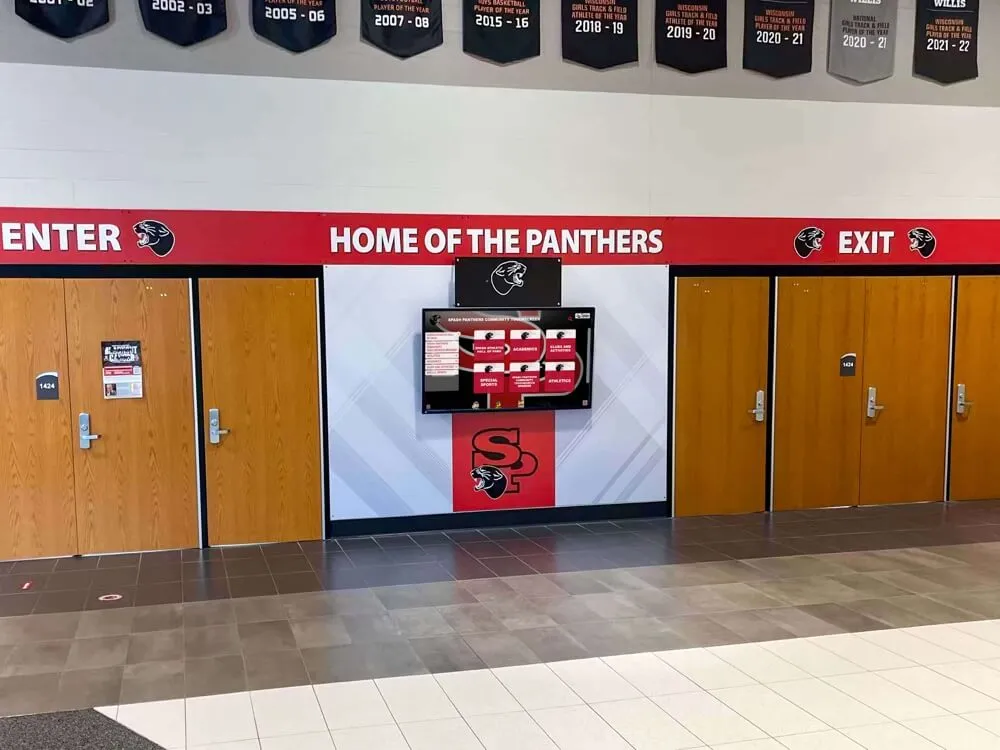
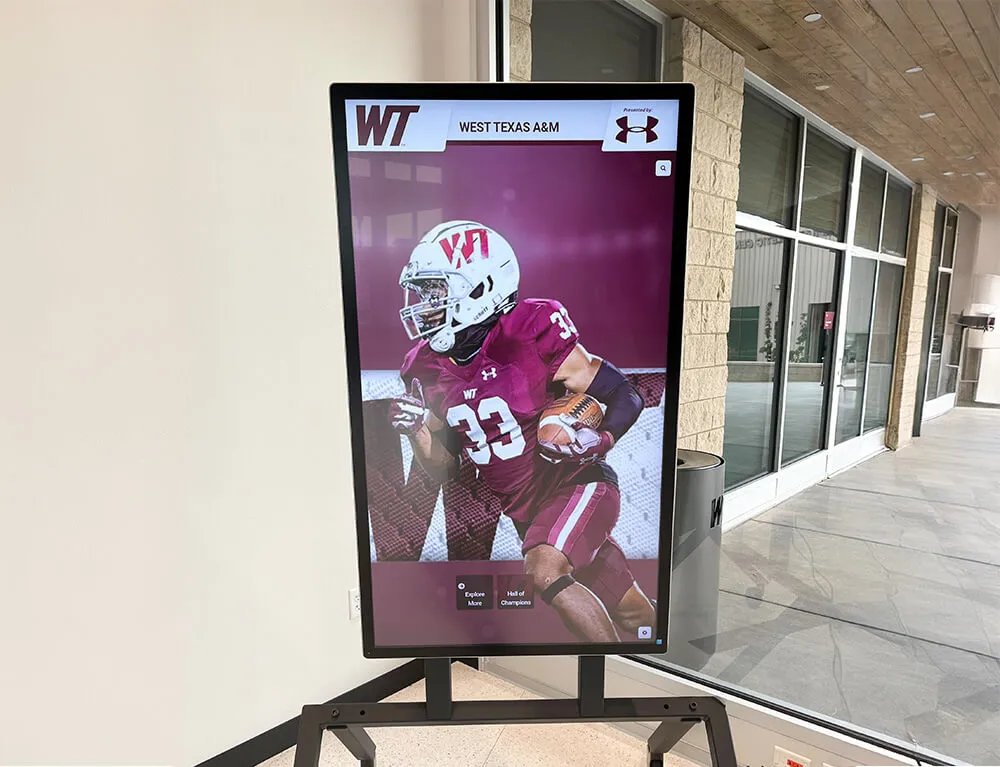
Physical display installations serve as year-round stewardship infrastructure that requires no additional staff activation once deployed
Recognition Strategies That Make Major Donors Feel Seen
Public recognition is not the whole of donor relations, but it is a foundational component that signals institutional gratitude in lasting, visible ways. The key is matching recognition strategies to what individual donors actually value—which varies considerably.
Named Spaces and Naming Opportunities
Facility naming remains the most significant public recognition most schools can offer. When executed well, naming opportunities honor donors permanently, create institutional legacy for families, and inspire other prospective major donors to consider similar commitments. When executed poorly—rushed decisions, inconsistent policies, or promises made informally without legal documentation—they become sources of conflict and embarrassment.
Establish a formal naming rights policy before you find yourself in an ad-hoc negotiation over a significant gift. The policy should address:
- Minimum gift thresholds for different naming categories (buildings, wings, rooms, programs, scholarships, endowed positions)
- Duration of naming rights for various facility types
- Circumstances under which names may be reviewed (behavioral standards, legal issues)
- Process for confirming name spelling and preferred designation
- Recognition installation standards and timelines
Clear policy protects both your donors’ expectations and your institution’s long-term interests. For a comprehensive overview of naming approaches, the complete donor recognition guide on touchwall.tv covers the full spectrum from policy development to display execution.
Donor Societies and Giving Circles
Structured donor societies create community among supporters at various giving levels and provide a framework for escalating recognition as relationships deepen. Most school advancement programs benefit from three to five named levels that reflect natural giving clusters in their donor pool rather than arbitrary round-number thresholds.
When designing society structures, consider:
Annual vs. cumulative recognition. Annual giving societies recognize current-year performance and motivate donors to maintain or increase contributions each cycle. Cumulative recognition programs celebrate lifetime giving relationships and reward the loyalty of long-term supporters who may give modestly in any single year. Many schools maintain both: a current-year society for annual motivation and a legacy circle for lifetime recognition.
Exclusive benefits that matter. Society membership has more value when the associated benefits are genuinely exclusive and experiential—private campus tours, invitations to meet the head of school, access to athletic or performing arts events, early announcements of initiatives. Benefits that can be purchased (priority seating, etc.) feel transactional; experiences that can’t be bought elsewhere feel like real recognition.
Visible society presence. Recognition that society members can see when they visit campus reinforces the value of their membership throughout the year, not just at events. This is where digital donor recognition infrastructure plays a particularly important role—society tiers visible on an interactive display in your main lobby communicate the reality of your institution’s gratitude every time a member walks through the door.
Private Recognition That Some Donors Prefer
Not every major donor wants their name on a wall. Anonymous giving at the transformational level is more common than most advancement offices realize, and respecting those preferences is a critical trust-building behavior. When donors request privacy, honor it completely—no subtle lobbying toward public recognition, no accidental disclosure in event programs, no mention in board meeting minutes.
Private stewardship for anonymous donors relies entirely on personal relationship maintenance: the same frequency of impact communication, the same access to leadership, the same event invitations—just without public acknowledgment. The relationship investment may actually be more important for anonymous donors because recognition can’t serve as a substitute for genuine connection.
How Digital Donor Walls Transform Ongoing Stewardship
Traditional static donor plaques served a legitimate purpose for decades. A brass nameplate in a polished frame communicates permanence and institutional respect. But static displays have fundamental limitations that create stewardship problems over time: they can’t be updated without replacement, they run out of physical space as donor rosters grow, they become visually outdated, and they can’t tell the story behind the names they display.
Modern digital donor walls address all of these limitations while creating new stewardship opportunities that static displays simply cannot provide.
What Dynamic Recognition Adds to Donor Relations
A well-implemented digital donor wall is not just a scrolling electronic version of a traditional plaque. The best systems support:
Real-time roster updates. New donors added immediately after processing. No waiting for the next print run or physical installation. Donors who gave this year see their names displayed this year—a small detail that matters to supporters who are looking for evidence that their gift registered.
Campaign progress visualization. Interactive displays can show a capital campaign thermometer updating as gifts come in, making every campus visitor an implicit witness to fundraising momentum. This creates social proof that motivates additional contributions and gives current donors visible evidence that others share their investment.
Impact stories alongside recognition. Rather than just displaying names and giving levels, digital systems can pair recognition with program photos, student testimonials, and outcome data. A donor whose name appears above a rotating gallery of students who received scholarships from her fund has a richer recognition experience than one whose name appears on a static plaque with no context.
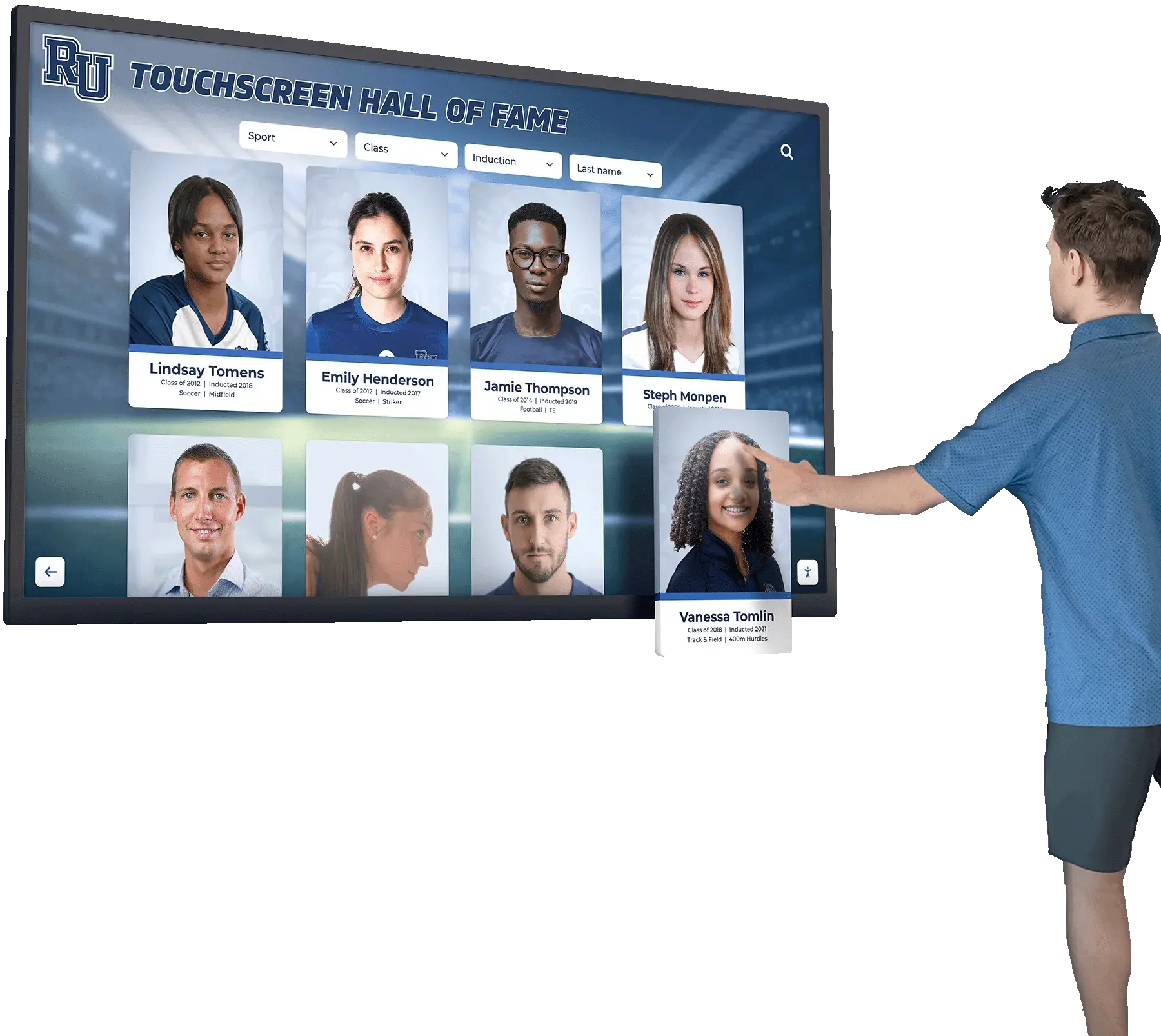
Searchable interfaces. Large donor rosters become navigable—donors can find their own names or the names of family members, and campus visitors can explore giving histories and institutional impact in ways that invite rather than frustrate engagement.
For a deep dive into implementation, the guide to digital donor walls covers hardware selection, content strategy, and ongoing management considerations relevant to school advancement contexts.
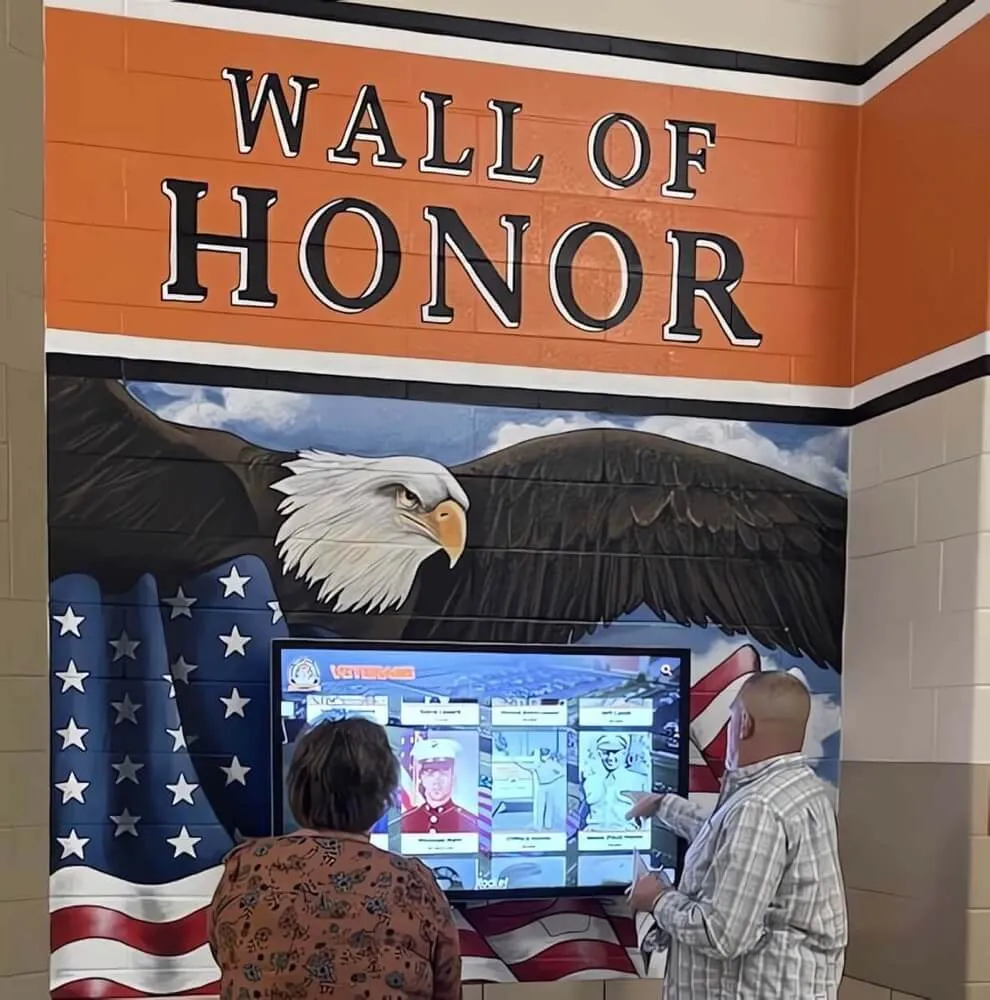
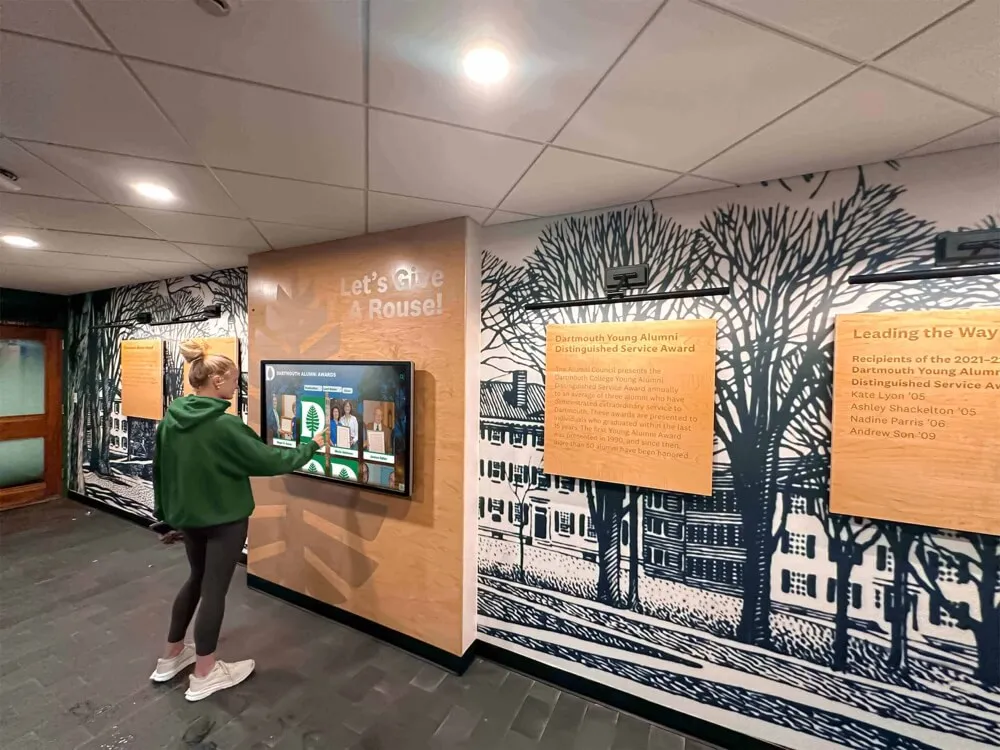
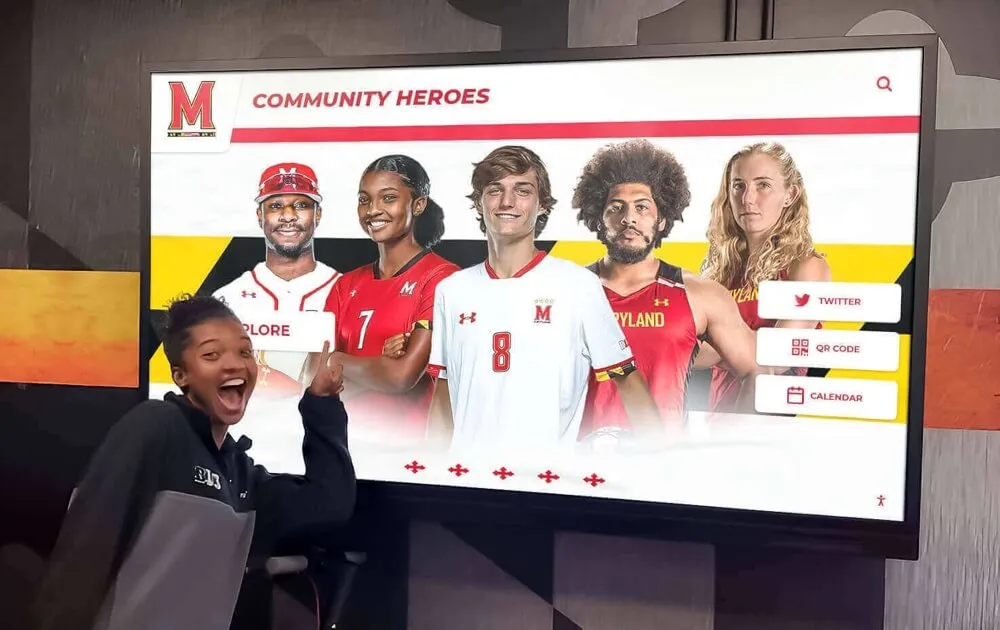
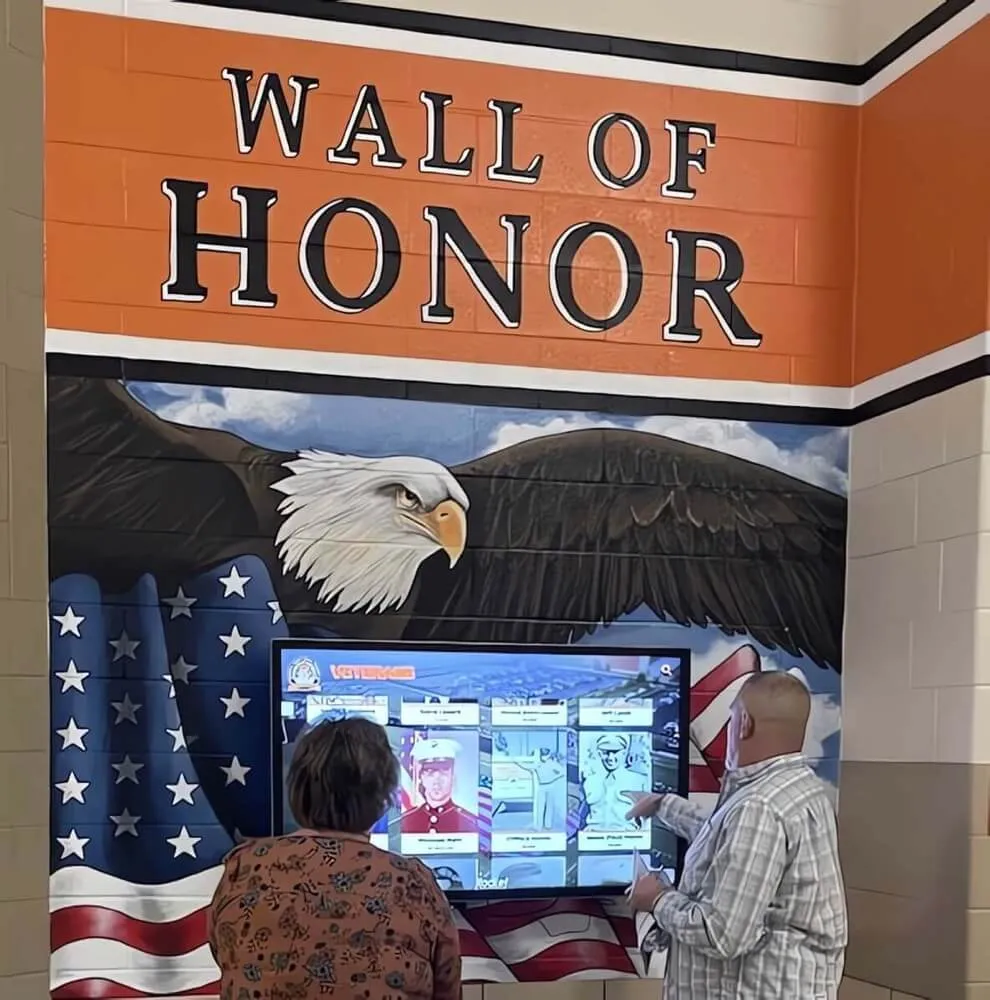
Interactive donor recognition engages visitors as participants rather than passive observers, creating stewardship moments that extend beyond formal events
Placement and Visibility Strategy
Where you install donor recognition displays matters as much as what they display. High-traffic locations that donors naturally pass through—main entrance lobbies, athletic facility corridors, performing arts center foyers, and administrative building entries—maximize the stewardship value of your investment.
Consider placement from the donor’s perspective: Where do your major donors walk when they visit campus? Do they attend athletic events? Parent nights? Alumni gatherings? Campus tours with their own children or grandchildren? Map your donors’ most common campus paths and ensure recognition is visible along those routes.
Explore donor recognition displays for schools and nonprofits for a comprehensive overview of display formats, placement considerations, and implementation approaches applicable to K-12 and higher education environments.
For campuses with outdoor donor recognition components, thoughtful placement and weather-resistant materials are essential—see outdoor donor wall options for design and materials guidance.
The Alumni Dimension of Digital Recognition
Alumni donor relations carries a specific emotional dynamic that digital recognition handles particularly well. Alumni donors care deeply about institutional continuity—they want to know that the school they attended is still worthy of the experience they had, and that their support connects to something enduring.
Digital alumni walls that combine historical recognition with contemporary achievement create exactly this sense of continuity. An alumnus whose name appears alongside the names of recent scholarship recipients, athletic champions, and faculty honorees sees himself as part of an ongoing story rather than a historical artifact. This positioning supports long-term retention far more effectively than a static plaque listing his class year and gift amount.
See how leading institutions approach creating an alumni wall that inspires current students—designs that serve both recognition and community-building functions simultaneously.
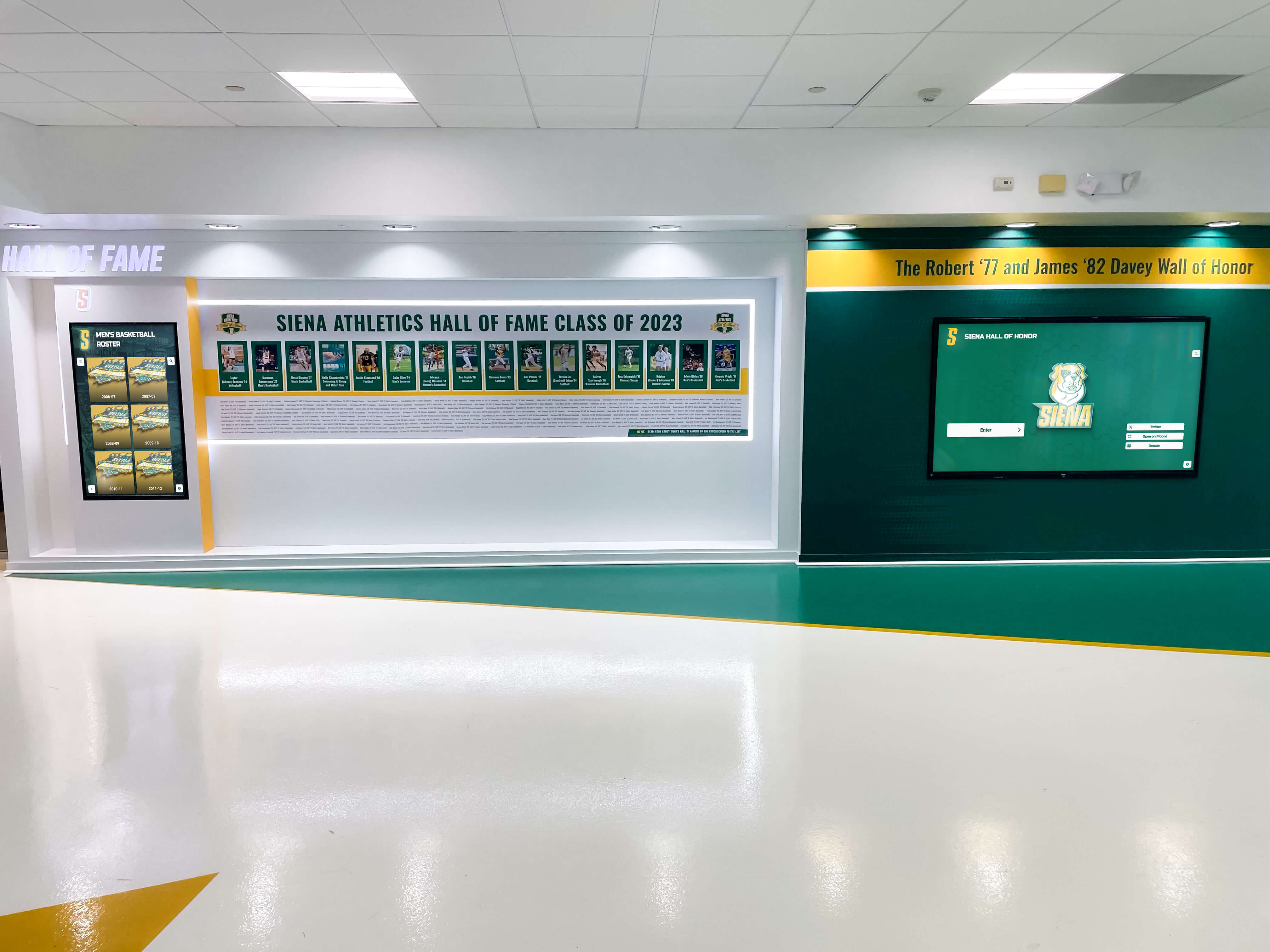
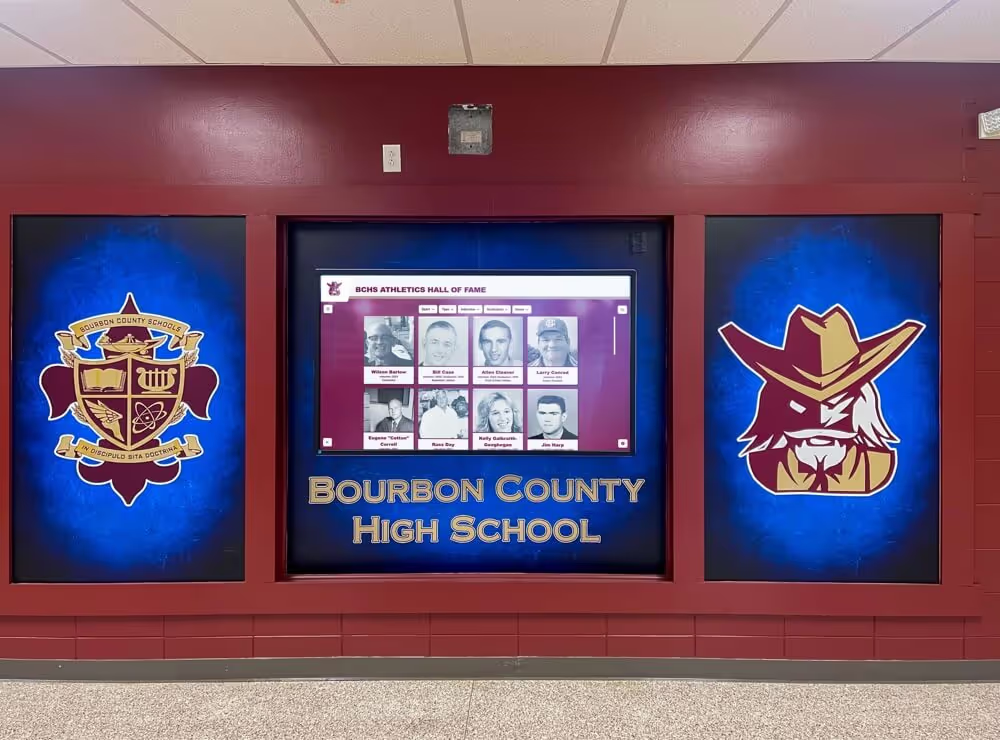
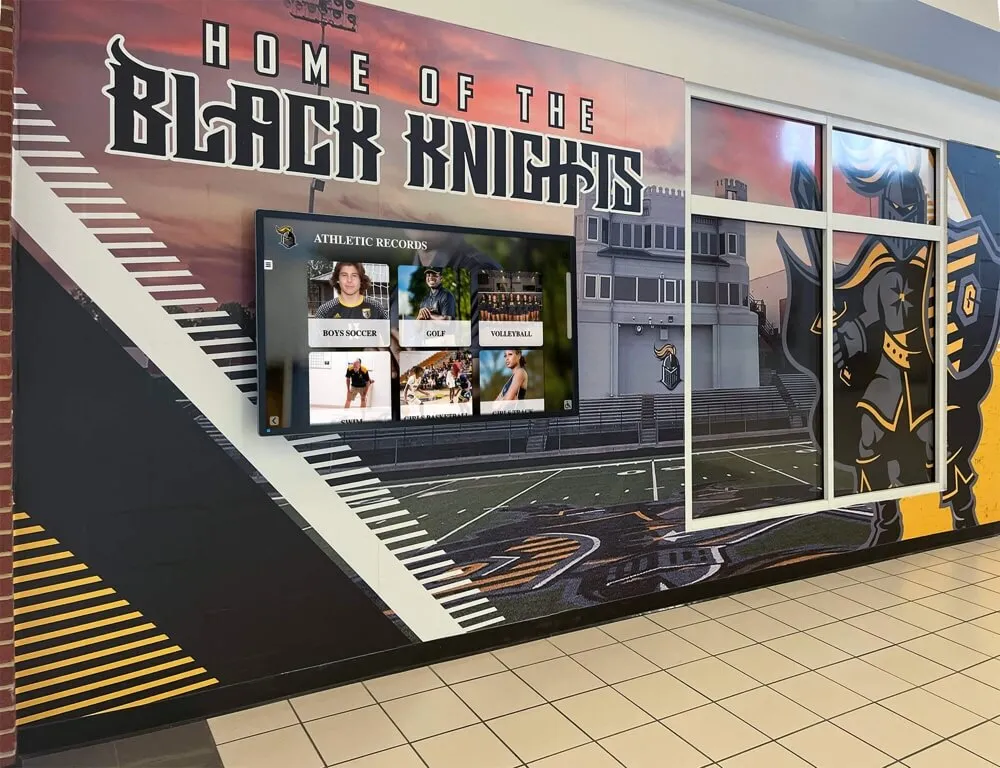
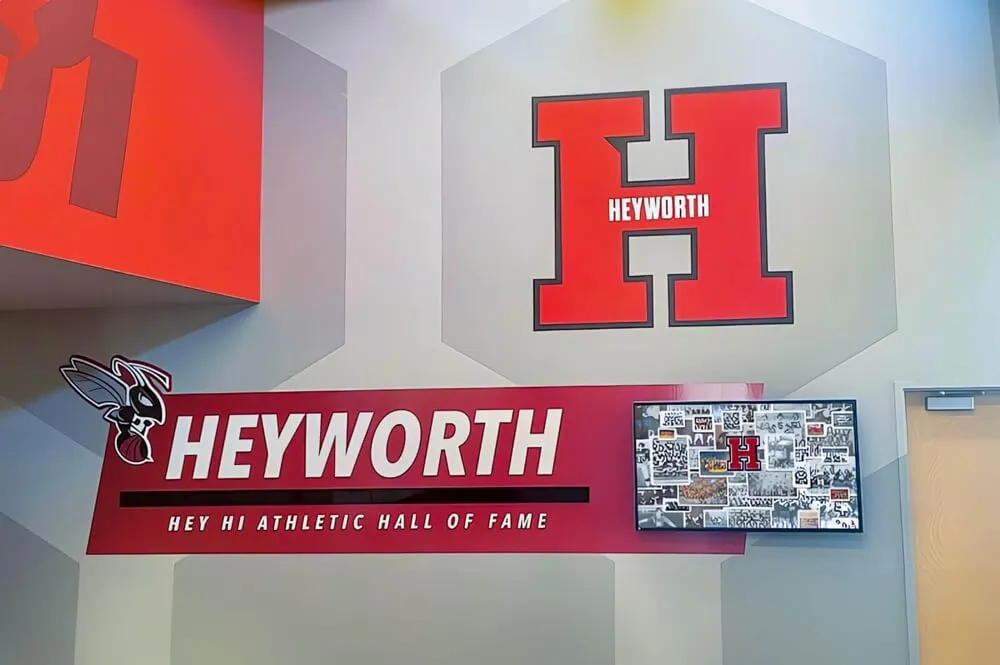
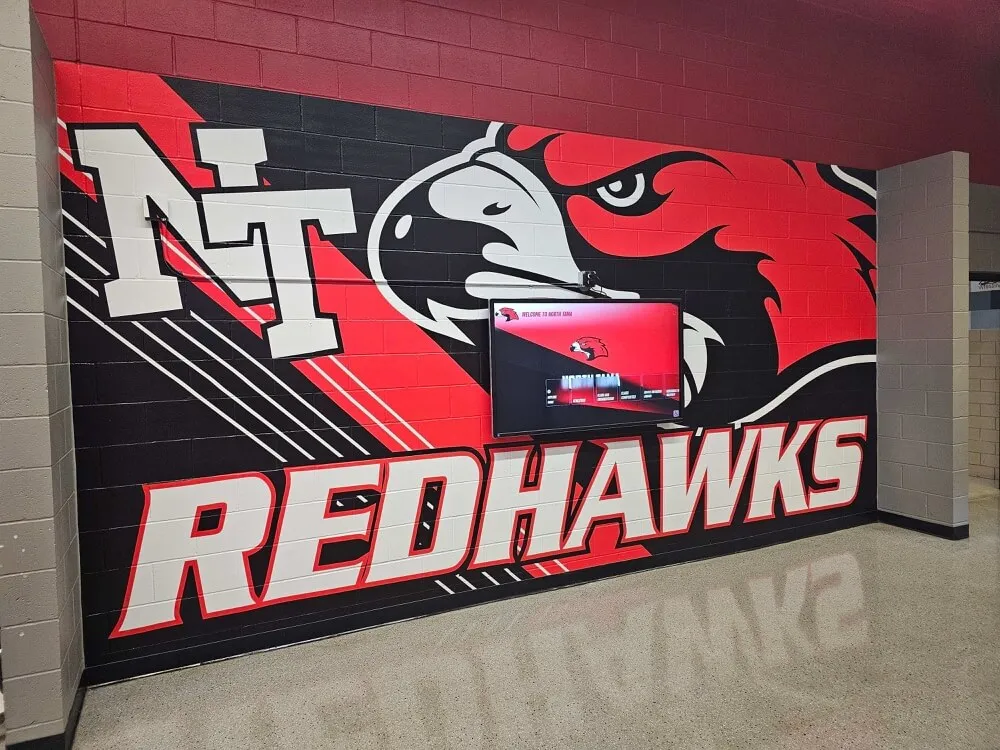
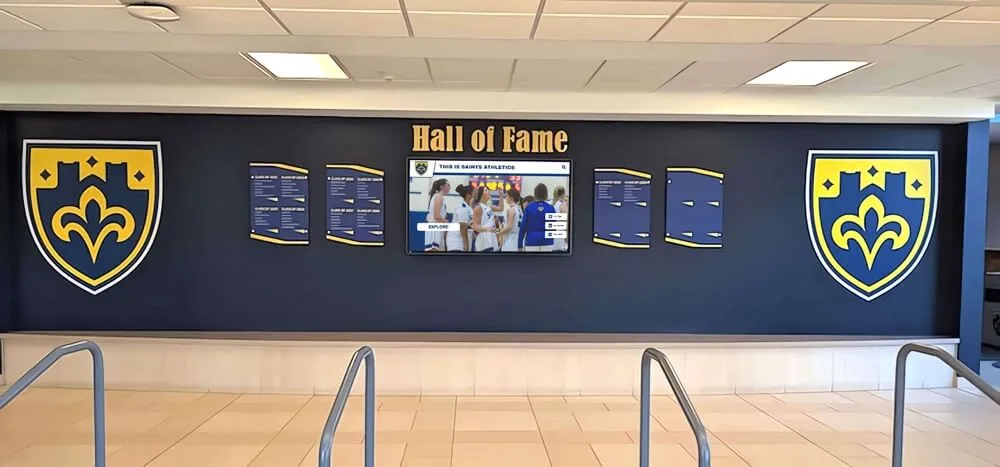
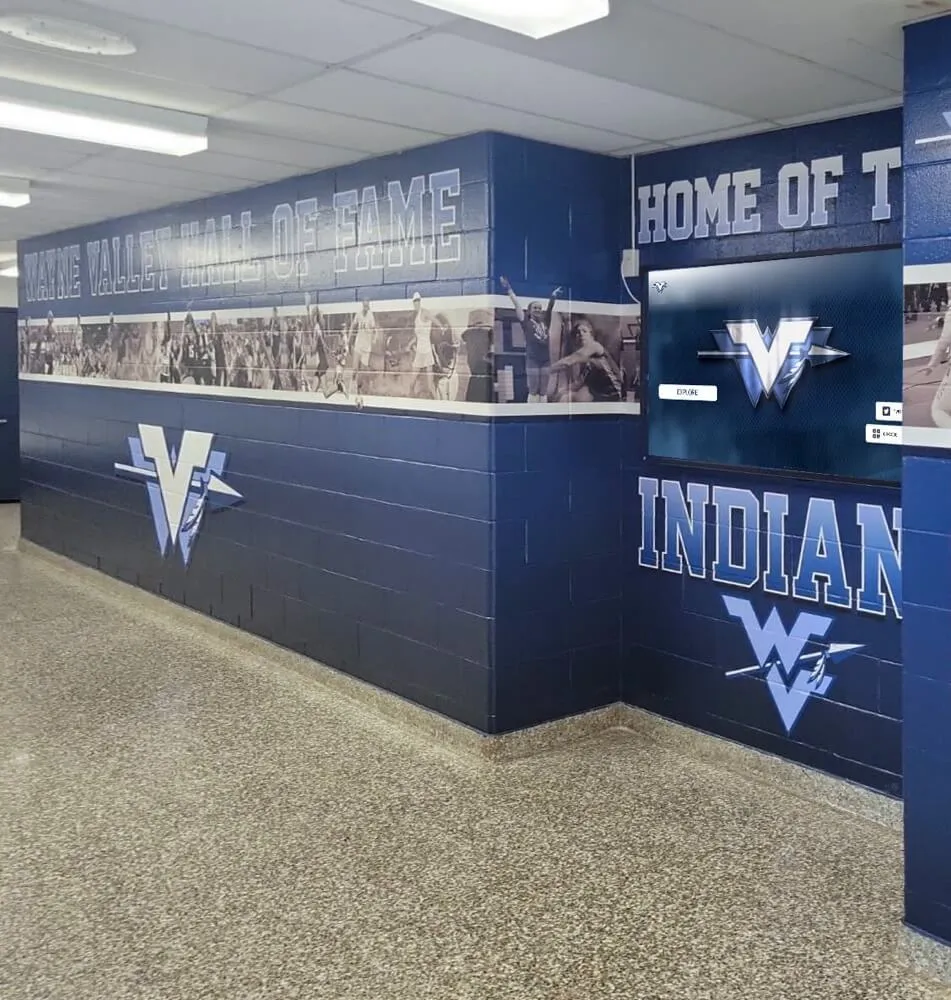
Recognition displays that reflect institutional identity reinforce donor pride while honoring the legacy of the school they love
Common Donor Relations Mistakes Advancement Offices Make
Even well-resourced advancement offices make predictable stewardship errors. Identifying and correcting these patterns produces faster improvement in donor retention than any new initiative built on a shaky existing foundation.
Waiting Too Long Between Touches
The most common—and most correctable—donor relations failure is simply going quiet between campaigns. Many advancement offices operate in campaign mode: intense communication during the solicitation period followed by silence until the next campaign begins. Donors experience this as attention that evaporates the moment the check clears.
The fix requires calendar discipline more than additional resources. Build your stewardship calendar before your solicitation calendar, not as an afterthought. Protecting stewardship touchpoints from being crowded out by campaign work requires treating them with the same scheduling urgency as solicitation deadlines.
Generic Mass Communications Sent to Everyone
An annual impact newsletter is better than nothing. But when every donor—regardless of giving level, relationship history, or personal connection to your school—receives identical communications, the implicit message is that your institution sees them as interchangeable parts of a list rather than individual partners in your mission.
Meaningful segmentation doesn’t require individualized communications for every donor. It requires at minimum distinguishing between:
- Major donors who receive personalized impact reports referencing their specific gifts
- Mid-level donors who receive communications specific to the programs or priorities they support
- Annual fund donors who receive impact-focused communications appropriate to their level
- First-year donors who receive a distinct welcome sequence acknowledging the novelty of the relationship
Even this basic segmentation produces meaningfully higher engagement than undifferentiated mass communication.
Neglecting Mid-Level Donors
The cultivation ladder from annual fund to major gift runs through the mid-level tier. Advancement offices that invest heavily at the top and the bottom while neglecting the middle find themselves with a chronically thin major gift pipeline because nobody was tending the relationships that would have fed it.
Mid-level donors are often closer to a major gift conversation than advancement staff realize—they simply haven’t been given the relationship investment that would make them ready. A personal call, an event invitation, or an impact report customized to their giving history frequently reveals readiness for a deeper conversation that generic communications would never surface.
Losing Relationship History at Staff Transitions
Development team turnover is a chronic challenge in school advancement. When a long-tenured development officer leaves, they often take institutional knowledge about dozens of donor relationships that never made it into the CRM—personal details, family histories, communication preferences, unspoken expectations.
Systematic relationship documentation in your donor database is not optional if you care about long-term stewardship continuity. Every significant donor interaction—calls, visits, personal notes, events attended, expressed interests—should be logged promptly. The officer who inherits a portfolio of well-documented relationships can provide something approximating continuity. The officer who inherits a spreadsheet of names and giving totals is starting from scratch.
Treating Recognition as the End of Stewardship
Public recognition—names on walls, listings in reports—is a component of donor relations, not its conclusion. Advancement offices that check the recognition box and then reduce communication intensity have misunderstood what recognition accomplishes. Recognition tells donors that their institution remembers their gift. Ongoing relationship tells them their institution values their partnership. Both are necessary; neither is sufficient alone.
For a broader framework of donor wall ideas for nonprofits in 2026, including current design trends and engagement strategies that go beyond static naming, the digitalwarming.net overview provides practical inspiration applicable to school contexts.
Engaging Alumni as a Special Donor Relations Case
Alumni occupy a distinct category in school donor relations that rewards specialized attention. Unlike parent donors whose giving often tracks their children’s enrollment, or community donors motivated by civic connection, alumni donors carry a deeply personal identification with your institution that creates both opportunity and obligation.
Alumni Giving Psychology
Alumni give to schools because those schools played a formative role in who they became. The most powerful stewardship communications for alumni tap into that formative identity—updates about programs that shaped them, stories about how current students experience the same traditions they remember, and recognition that places their support within a community of people who share a defining institutional experience.
Alumni donors who feel that their school is still worthy of the experience it gave them—that it has maintained quality, continued to grow, and remained true to its mission—are far more likely to give generously and consistently than alumni who feel their institution has changed beyond recognition or lost the qualities they valued.
Alumni-Specific Stewardship Channels
Beyond standard stewardship practices, alumni donors benefit from touchpoints that leverage the nostalgia and belonging dimensions of their relationship:
- Reunion engagement that positions donor recognition as a natural part of class celebration
- Student ambassador programs that connect alumni donors with current students pursuing paths the alumni themselves once walked
- Class-level participation campaigns that use friendly competition to drive annual fund engagement across alumni segments
- Legacy society invitation for alumni who have included the school in estate plans, creating a community of like-minded long-term supporters
For schools building or rebuilding alumni engagement infrastructure, alumni engagement software built around recognition outlines the technology features most directly linked to retention and giving growth.
Alumni recognition events serve a dual stewardship and cultivation purpose—they create the in-person touchpoints that deepen connection to institutional mission while providing natural opportunities to share campaign priorities. For planning guidance, alumni recognition event ideas covers format options from intimate dinners to large-scale reunion celebrations.
The physical environment matters too: alumni who arrive on campus for events and encounter a beautifully maintained, updated recognition presence—names displayed accurately and prominently, new honorees added since their last visit, digital storytelling integrated into the lobby—receive a powerful non-verbal message about how your institution values the people who invest in it. See how building lasting school pride connects physical environment design to long-term alumni engagement and giving culture.
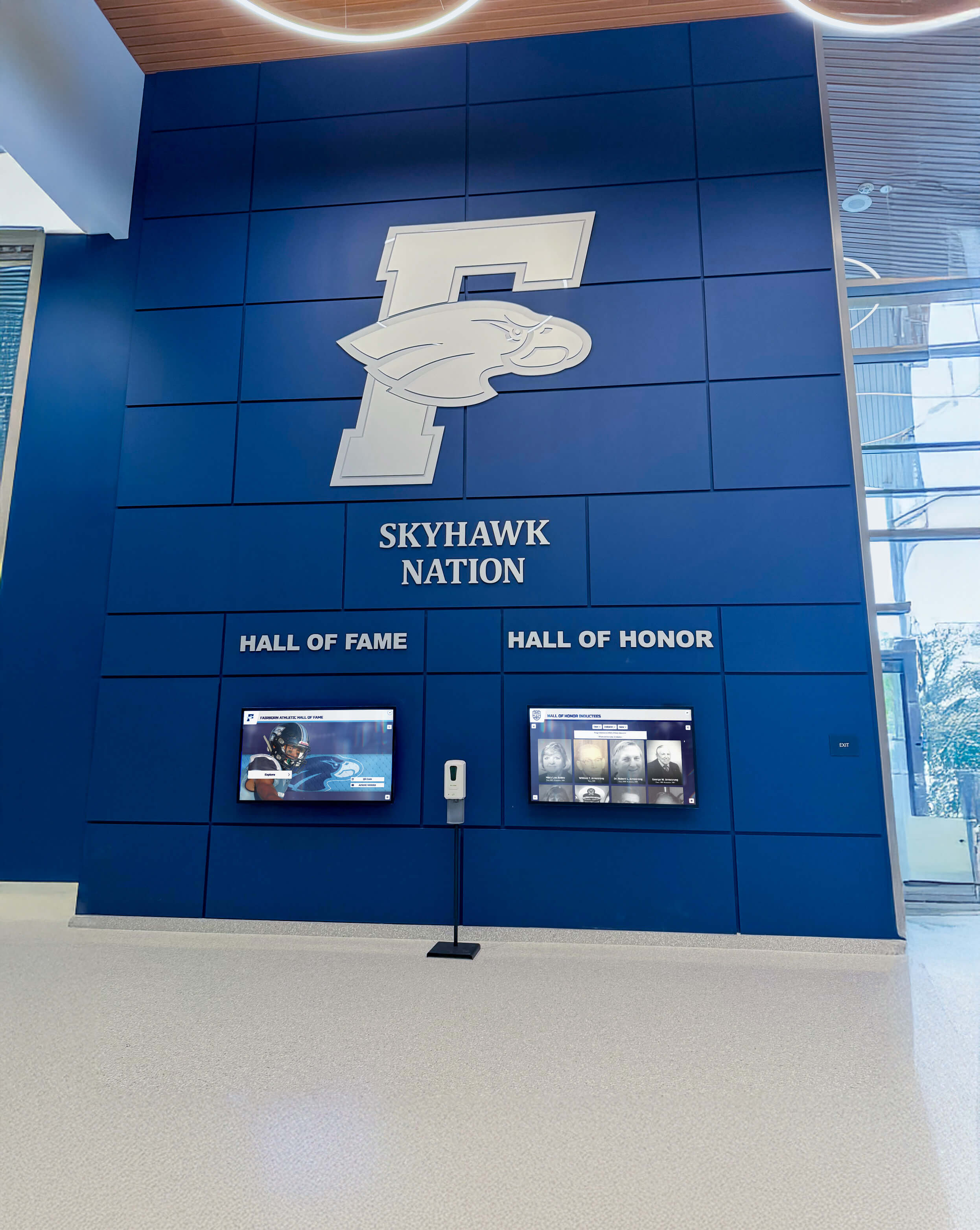
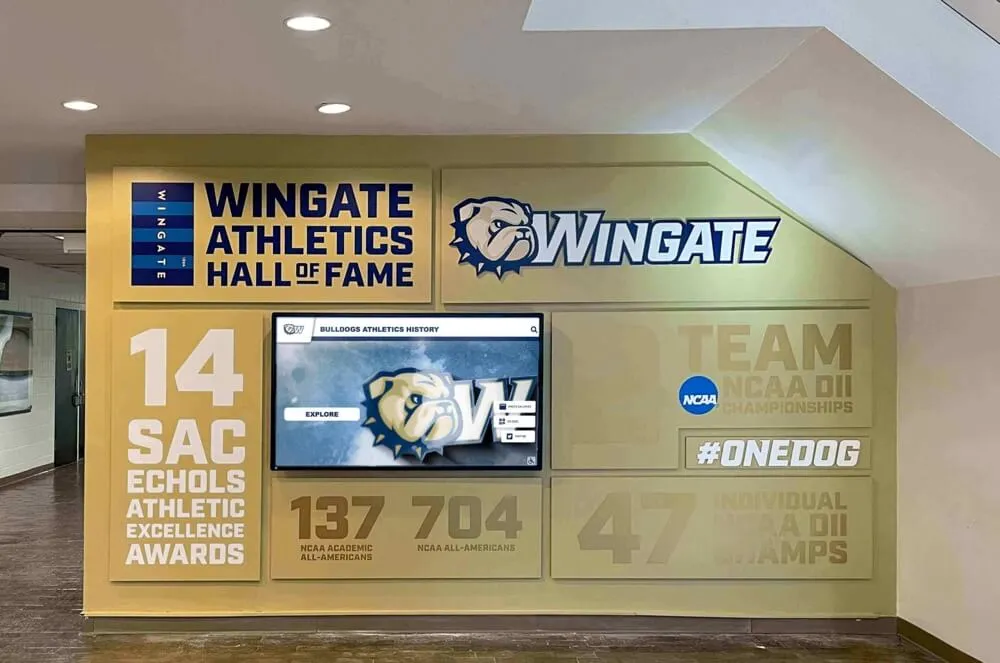
Lobby recognition installations communicate institutional pride and donor appreciation the moment visitors step through the door
Measuring the Health of Your Donor Relationships
Donor relations programs that aren’t measured can’t be improved. The following metrics provide a practical dashboard for advancement offices evaluating stewardship effectiveness:
Donor Retention Rate
The foundational metric. Calculate it as:
Donor Retention Rate = (Donors who gave in both Year 1 and Year 2)
                       ÷ (Total donors who gave in Year 1)
                       × 100

Example:
Year 1 total donors: 400
Of those 400, gave again in Year 2: 210
Retention rate: 210 ÷ 400 = 52.5%
Track retention separately by giving tier—major donor retention should be at or above 90 percent. Annual fund retention in the 45 to 55 percent range is typical nationally, but strong stewardship programs regularly achieve 60 to 70 percent and above. First-year donor retention is particularly critical and should be monitored as its own metric, as it often lags the overall rate by 10 to 20 percentage points.
Upgrade Rate
What percentage of your donors increased their gift year over year? A healthy upgrade rate—typically 15 to 25 percent of retained donors—signals that stewardship is deepening engagement, not just maintaining it. Declining upgrade rates often precede retention problems by one to two years, making this an early warning indicator worth tracking proactively.
Average Time Between Gifts
Track how long retained donors go between successive gifts. Shortening average inter-gift intervals indicates strengthening engagement. Lengthening intervals—even among donors who haven’t lapsed—may signal stewardship communication is losing relevance or frequency.
Engagement Score Beyond Giving
Giving is the measurable outcome of donor relations, but engagement is the leading indicator. Track event attendance rates among invited donors, email open rates for stewardship communications, campus visit frequency, and committee or advisory participation. Donors with high engagement scores across multiple dimensions almost always have stronger retention and upgrade rates than donors who only engage financially.
Qualitative Feedback
Systematically collected feedback from donors—through annual surveys, post-event debriefs, or periodic focus groups with major donor segments—reveals stewardship gaps that quantitative metrics miss. Donors who feel comfortable sharing feedback about what they value and what feels perfunctory are providing exactly the information you need to improve their experience. Make feedback solicitation a routine practice, and demonstrate responsiveness by acting on what you learn.
Building a Donor Relations Culture Beyond the Advancement Office
The strongest school donor relations programs engage the entire institutional community, not just development staff. When program directors, coaches, teachers, and students participate authentically in stewardship, the resulting communications carry a credibility and emotional weight that polished advancement materials cannot match.
Engage the head of school directly. The principal or head of school’s personal involvement in major donor stewardship—calls, visits, event presence, handwritten notes—signals institutional priority at the highest level. Development directors should provide simple briefing packets before any head of school donor interaction: key gift history, personal details, recent stewardship touchpoints, and the relationship objectives for the contact.
Involve program beneficiaries appropriately. Student letters to scholarship donors, coach thank-you notes to athletic fund supporters, and teacher acknowledgments to curriculum grant donors are among the most effective stewardship communications advancement offices can generate. They require coordination but cost almost nothing and carry authenticity that no form letter can replicate. Appropriate privacy permissions and institutional review of student communications are essential before implementation.
Train your board. Board members represent an underutilized stewardship resource at most schools. Personal thank-you calls from board members to major donors—especially when the caller has a personal connection to the donor or a shared history with the school—create relationship touchpoints that development staff cannot substitute. Provide board members with a simple call script and a monthly list of major donors who have recently given or whose anniversary is approaching.
Conclusion: Donor Relations as Institutional Culture
The donor relations best practices outlined here are not a checklist to complete and set aside. They are the habits and systems of an institution that genuinely values the people who invest in it—and that holds itself accountable for demonstrating that value consistently, not just when solicitations are open.
Schools that internalize these practices see the results in retention data, in upgrade patterns, and in the depth of major gift relationships that develop over years of disciplined stewardship. More importantly, they feel the results in the quality of relationships their advancement teams carry—relationships where donors call to share good news, show up to events because they want to be there, and speak openly about what comes next for their giving.
That culture of mutual investment is what sustainable school advancement looks like. It begins with the frameworks here and grows through the consistency with which your team executes them.
Bring Your Donor Recognition to Life
Your stewardship strategy is only as visible as the recognition infrastructure behind it. Rocket Alumni Solutions provides interactive digital donor walls that work as year-round stewardship tools—displaying accurate, updated recognition the moment a donor walks through your doors, telling the impact stories behind every name, and scaling effortlessly as your donor community grows.
From capital campaign progress visualization to searchable donor listings to multimedia impact storytelling, our systems are designed specifically for school advancement offices that take donor relations seriously.
Explore Rocket Alumni Solutions and discover how the right recognition infrastructure supports every dimension of your donor stewardship program.