Touchscreen Donor Recognition Kiosks for Schools: Features, Install, and ROI
When your school unveils a traditional bronze plaque donor wall after years of capital campaign fundraising, the moment should feel triumphant. Yet within months, advancement teams discover the limitations: a major donor increases their pledge but updating the engraved plaque takes six months and costs thousands, campaign success brings unexpected gifts from alumni you hadn’t anticipated but there’s no physical space remaining, and younger donors expect the same interactive digital experiences they encounter everywhere else—not static 1990s-era recognition that fails to tell compelling stories about why they gave or the impact their generosity creates.
Meanwhile, fundraising continues beyond the capital campaign conclusion. Annual giving programs need ongoing visibility, memorial gifts require timely acknowledgment, planned giving societies deserve regular celebration, and new campaign phases launch requiring flexible recognition frameworks. Traditional donor walls become frozen snapshots of a single moment rather than living testaments to sustained philanthropic partnership that evolves as relationships deepen and giving continues across decades.
School donor recognition touchscreen kiosks solve these fundamental challenges through interactive digital platforms that combine unlimited capacity with instant updates, multimedia storytelling with elegant design, and measurable engagement analytics with accessibility features ensuring every community member can explore and celebrate donor generosity. These systems transform recognition from static obligation into dynamic experiences that inspire future giving, strengthen donor relationships, and create institutional pride around philanthropic culture.
This comprehensive guide examines touchscreen donor recognition kiosks specifically designed for educational institutions, from core features and technical capabilities through installation requirements and proven return on investment. Whether your advancement team explores digital recognition for the first time or seeks to replace aging systems no longer meeting institutional needs, these frameworks provide practical guidance for implementing recognition technology that serves your school’s fundraising mission for decades.
Understanding Touchscreen Donor Recognition Technology
Before examining specific features or installation requirements, understanding what distinguishes purpose-built touchscreen donor recognition systems from generic digital signage or repurposed consumer technology helps schools make informed decisions aligned with advancement needs.
Purpose-Built Recognition vs. Generic Digital Signage
Many schools initially consider adapting commercial digital signage systems for donor recognition applications, assuming cost savings and familiar technology. However, fundamental differences between these categories quickly surface:
Content Management for Advancement Teams
Generic digital signage platforms optimize for retail environments or corporate communications, offering tools designed for marketing professionals pushing scheduled content to multiple displays. Advancement teams need entirely different capabilities: donor database integration enabling automatic recognition tier assignments, intuitive interfaces allowing non-technical staff to add memorial designations or update pledge fulfillment status, and approval workflows ensuring donor name accuracy before public display.
Purpose-built donor recognition systems understand advancement workflows, providing specialized tools for managing donor information, tracking giving levels, handling privacy preferences, and maintaining naming opportunities across complex organizational structures that generic signage platforms cannot accommodate without extensive custom development.
Interactive Exploration vs. Passive Display
Digital signage shows predetermined content sequences to viewers who walk past without interaction. Donor recognition requires opposite dynamics: visitors actively explore profiles, search for specific donors or families, discover impact stories, and engage deeply with content that celebrates community generosity. This fundamental difference demands touch-optimized interfaces, intuitive navigation patterns, and sophisticated search capabilities that passive signage platforms lack entirely.
Schools that attempt donor recognition with standard signage quickly discover visitors cannot find themselves or explore connections, defeating recognition’s core purpose: meaningful engagement with philanthropic community.
Long-Term Institutional Investment
Commercial digital signage typically operates on 3-5 year replacement cycles, acceptable for retail or corporate applications prioritizing latest visual trends over content permanence. School donor recognition represents 20-30 year institutional commitments where donor families expect sustained acknowledgment, not obsolescence when consumer technology refreshes.
Purpose-built systems design for institutional permanence through commercial-grade components, long-term software support commitments, and architectural integration ensuring recognition remains elegant and functional across decades rather than appearing dated within a few years.
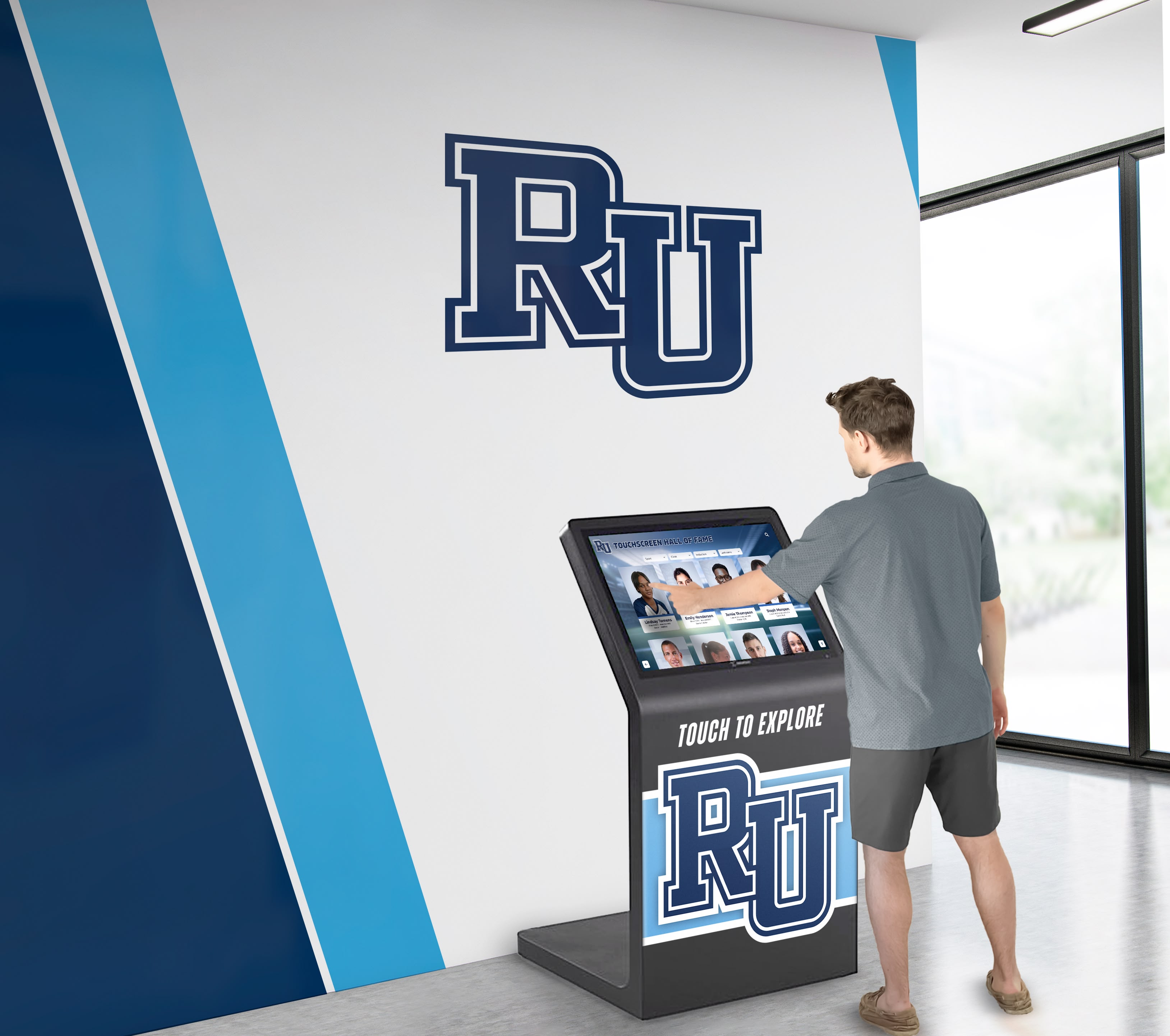
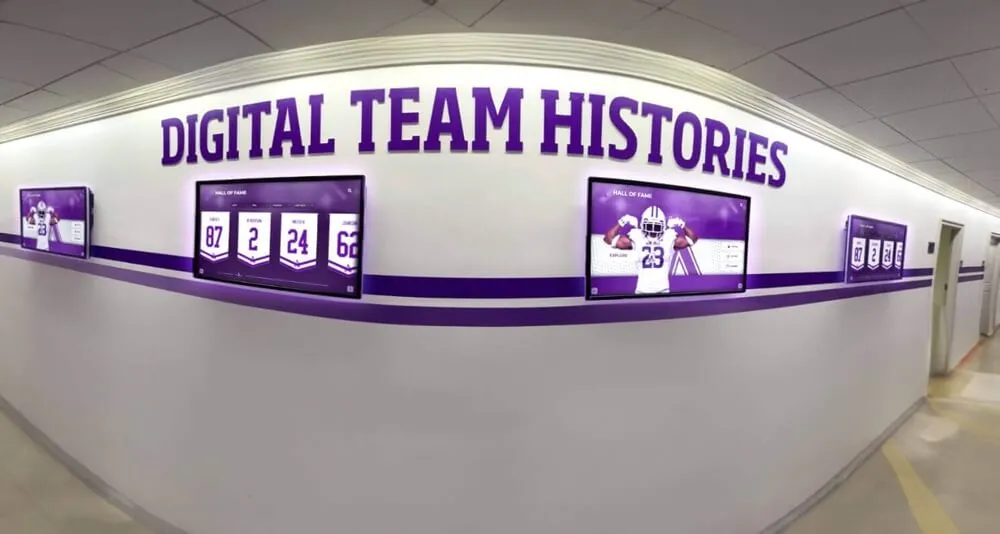
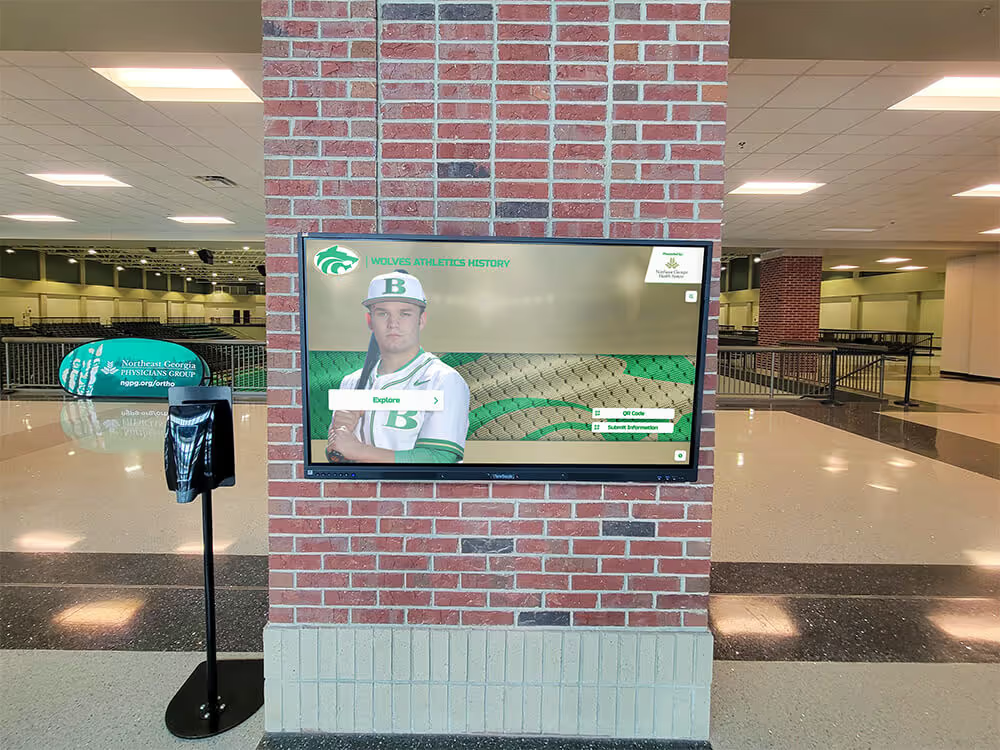
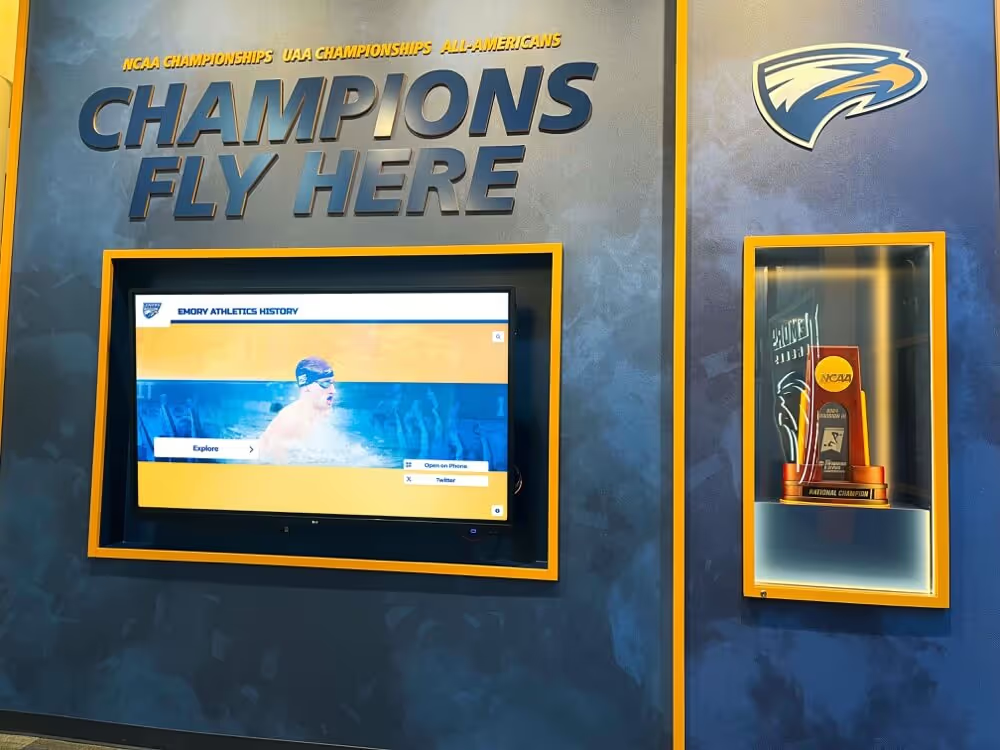
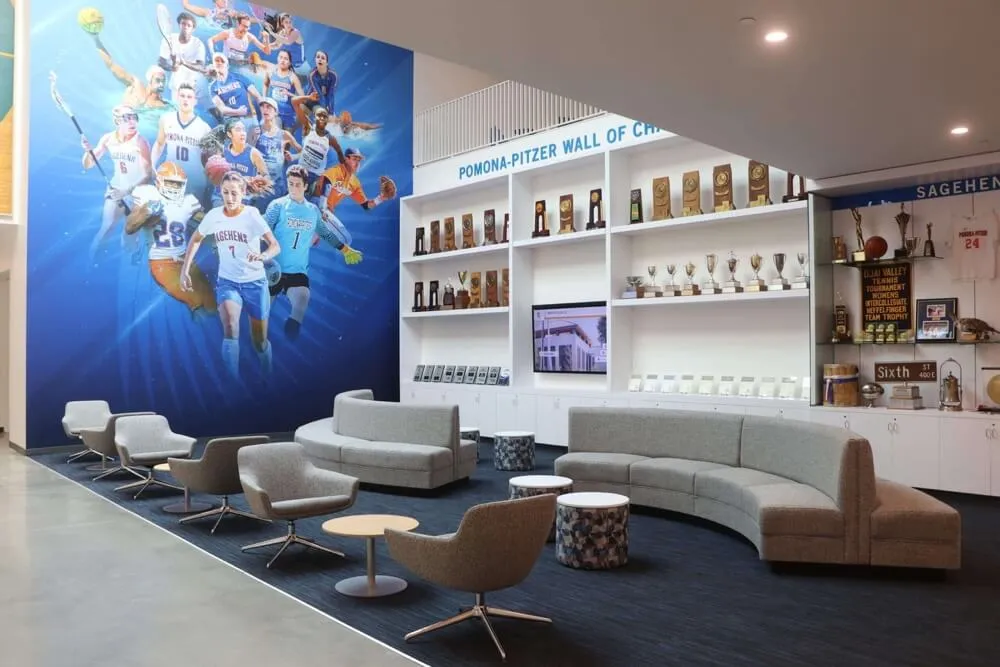
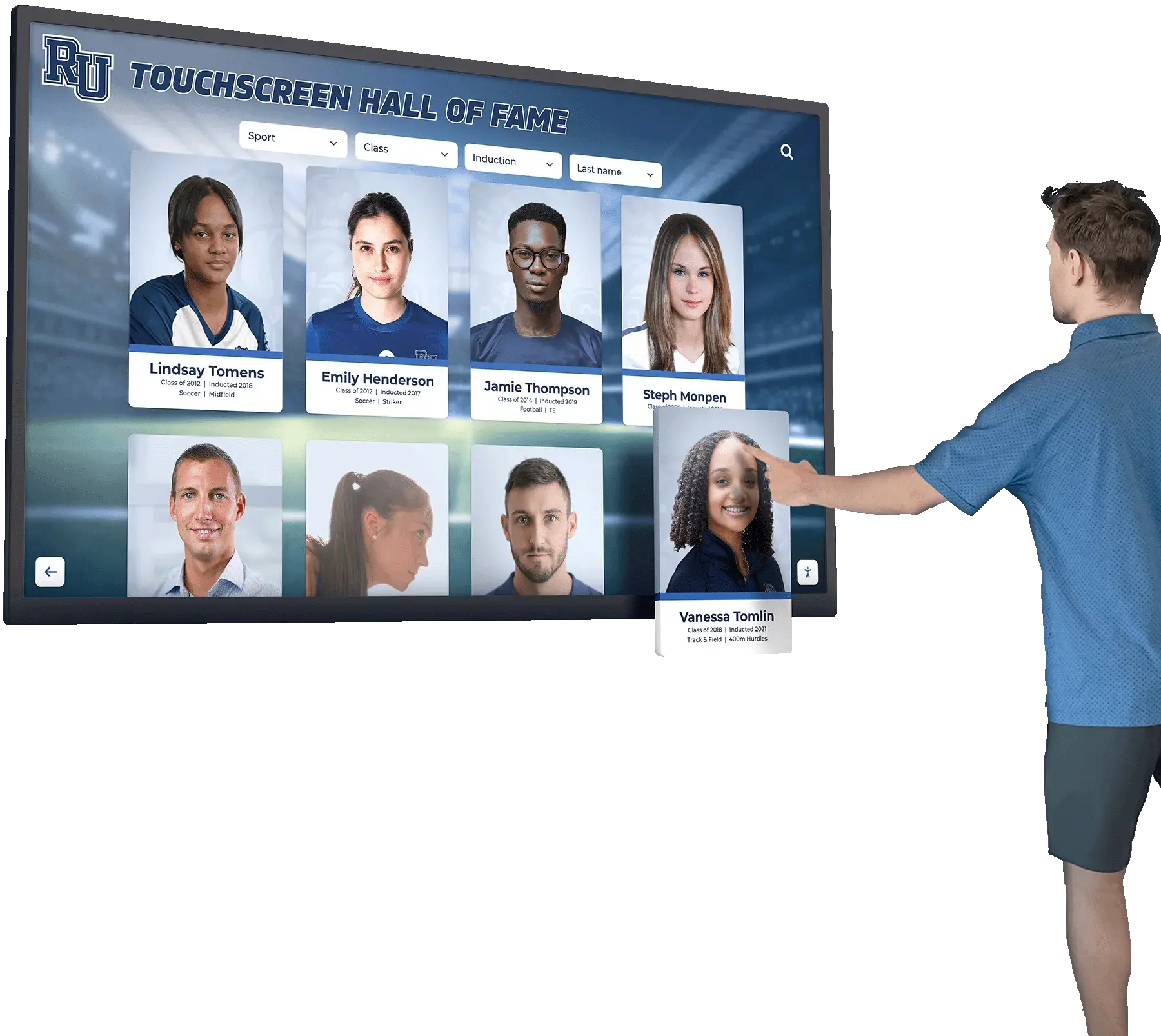
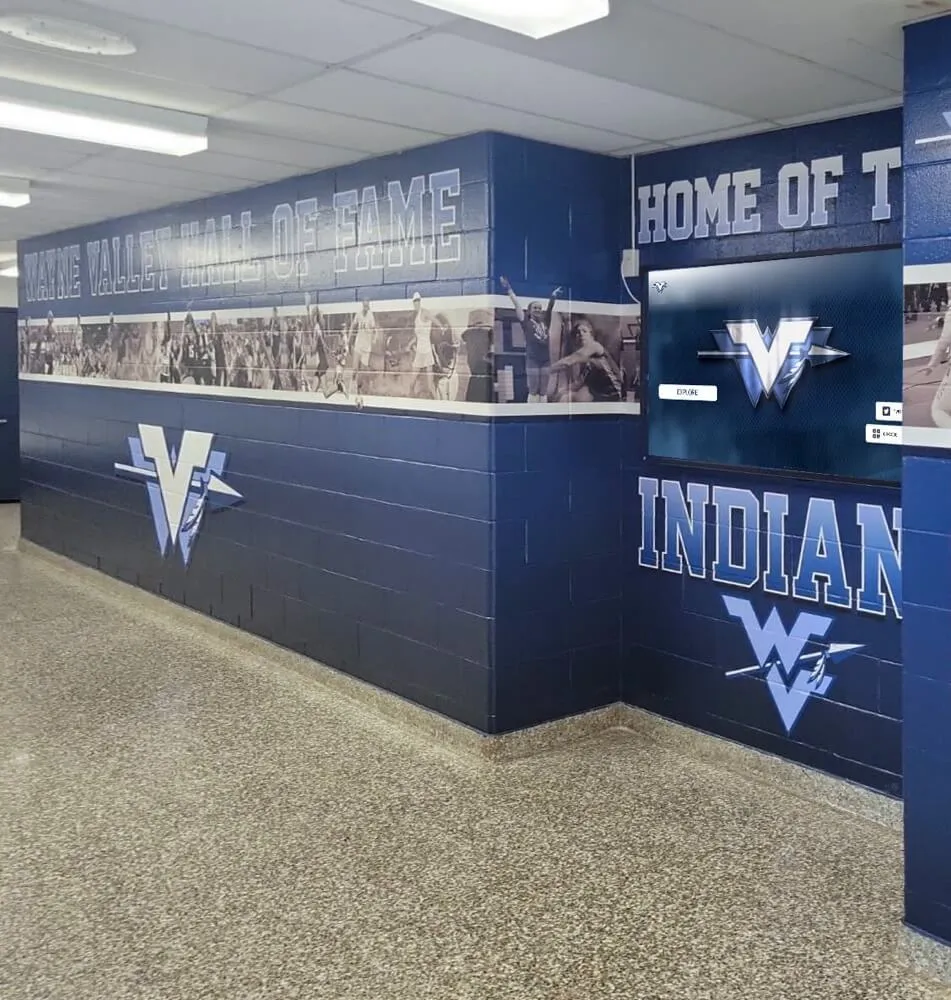
Modern touchscreen kiosks invite active exploration rather than passive viewing, transforming donor recognition into engaging community experience
Core Technology Components
Effective touchscreen donor recognition kiosks integrate several specialized technology layers working seamlessly together:
Commercial-Grade Interactive Displays
Educational environments demand displays engineered for continuous operation and frequent interaction rather than residential-grade screens designed for occasional home use. Commercial panels offer:
- Extended operational ratings supporting 16-18 hours daily operation without degradation
- Hardened touch surfaces withstanding thousands of daily interactions from students, visitors, and community members
- Optical bonding eliminating air gaps between touch sensor and display panel for superior visibility under varying lighting conditions
- Wide viewing angles ensuring recognition remains readable from multiple approach angles in hallways and gathering spaces
- Industrial temperature tolerance functioning reliably in environments where HVAC systems vary dramatically between occupied and unoccupied periods
Display sizes for donor recognition typically range from 43" to 65", balancing visibility in high-traffic areas with architectural integration that doesn’t overwhelm spaces designed primarily for other functions.
Purpose-Built Recognition Software
The software platform powering touchscreen experiences determines long-term functionality and administrative efficiency. Essential capabilities include:
- Donor profile management supporting unlimited entries with flexible metadata including photos, giving history, memorial designations, and custom fields matching institutional needs
- Recognition tier frameworks automatically categorizing and displaying donors according to configurable giving levels from annual fund through transformational gifts
- Search and filtering enabling visitors to find specific donors, families, class years, or giving categories through intuitive interfaces
- Content scheduling rotating featured donors, campaign updates, impact stories, and seasonal content without requiring technical expertise
- Multi-campaign support managing recognition across simultaneous initiatives including capital campaigns, annual giving, planned giving societies, and memorial programs
- Privacy controls respecting donor preferences for public recognition, anonymous giving, or name-only acknowledgment without contribution amounts
Modern recognition platforms deliver these capabilities through cloud-based management portals advancement teams access from any web browser, eliminating traditional installation requirements for specialized software on specific computers.
Secure Content Management Systems
Donor information sensitivity demands robust security protecting personal details, giving history, and contact information from unauthorized access. Enterprise-grade systems provide:
- Role-based access controls ensuring only authorized advancement staff can modify donor profiles or recognition content
- Audit logging tracking all system changes for compliance and accountability
- Encrypted data transmission protecting information moving between management interfaces and display hardware
- Regular security updates addressing emerging vulnerabilities throughout system lifecycle
- Compliance frameworks supporting institutional policies around data governance, privacy regulations, and donor stewardship obligations
These security foundations create confidence among donors that their information receives professional protection worthy of the trust their generosity represents.
Essential Features for School Donor Recognition Kiosks
Distinguishing comprehensive touchscreen recognition systems from basic digital displays requires examining specific features that transform static acknowledgment into engaging donor celebration.
Unlimited Donor Capacity and Dynamic Updates
The most fundamental advantage touchscreen systems provide over traditional donor walls involves removing physical capacity constraints that plague static recognition.
Accommodating Growth Without Renovation
Traditional bronze plaque walls reach capacity predictably: a wall designed for 200 donors fills during successful campaigns, forcing difficult decisions about removing earlier supporters to accommodate new gifts or launching expensive renovations adding physical space. These capacity crises occur precisely when fundraising momentum should accelerate, not when teams face donors with news that recognition space limitations might delay their acknowledgment.
Digital systems eliminate capacity anxiety entirely. Schools can recognize 2,000 donors as easily as 200, accommodate unexpected campaign success without architectural modifications, and maintain complete historical archives ensuring early supporters receive perpetual acknowledgment even as donor bases grow across decades. This unlimited capacity proves especially valuable for comprehensive campaigns recognizing diverse contribution types from major gifts through modest annual fund support, where inclusive recognition inspires broad participation that traditional walls cannot accommodate.
Instant Updates Responding to Donor Activity
Between engraved plaque fabrication, shipping, and installation scheduling, updating traditional donor walls typically requires 3-6 months from the moment advancement teams request changes. During this extended timeline, donors who increased pledges wait for acknowledgment, memorial designations requested by families remain absent, and pledge fulfillment milestones pass without updated recognition—all creating frustration contradicting the gratitude recognition should express.
Touchscreen systems enable updates within hours rather than months. When advancement staff learn a donor fulfilled a multi-year pledge, upgraded to a higher recognition tier, or requested memorial designation following a family loss, appropriate changes appear on public displays the same day. This responsiveness demonstrates organizational competence and respect that strengthens donor relationships precisely when supporters notice whether institutions honor commitments about recognition timing.
Schools managing dynamic capital campaign recognition particularly value update flexibility as campaigns evolve, donors adjust commitments, and recognition requirements change throughout multi-year initiatives.
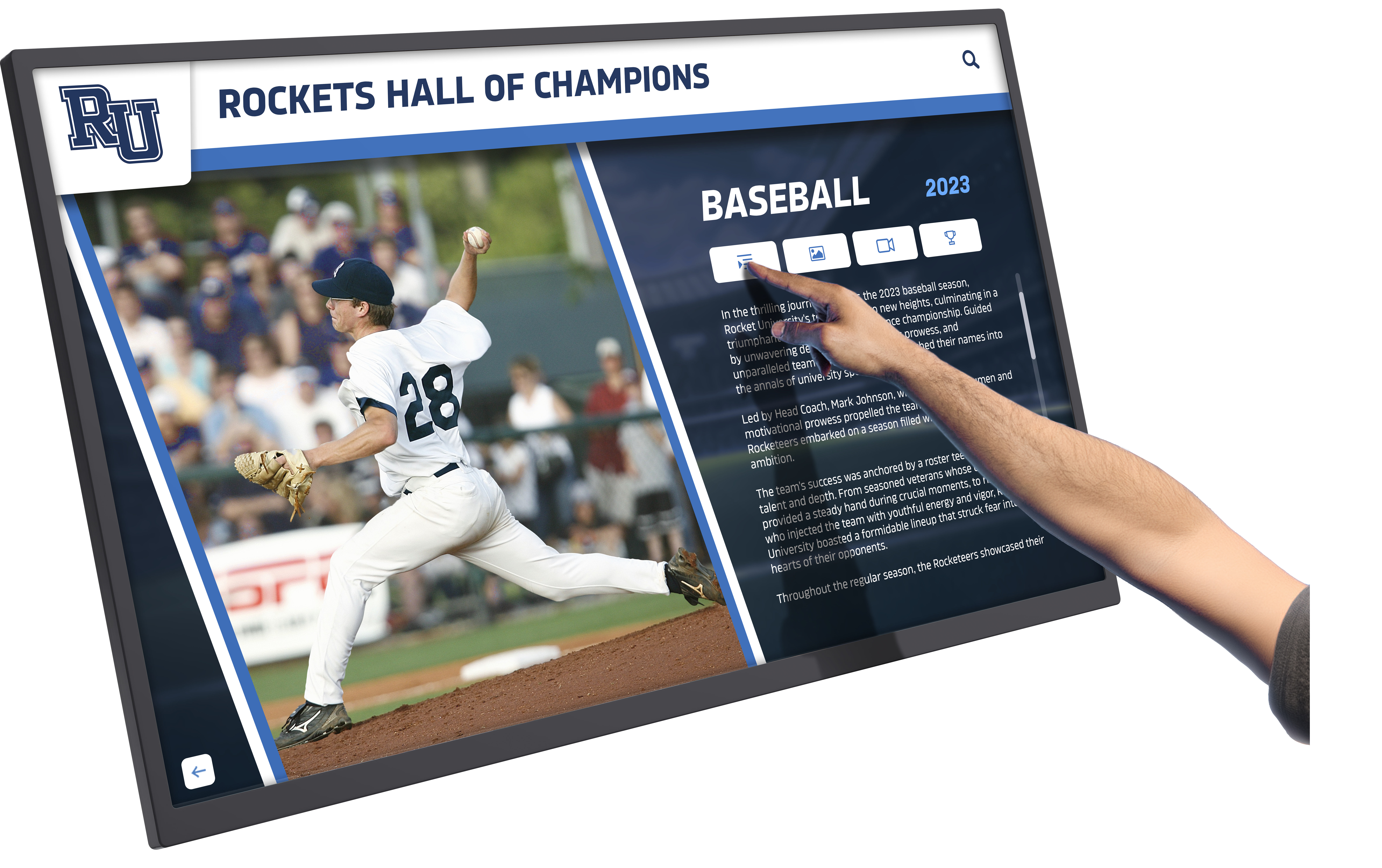
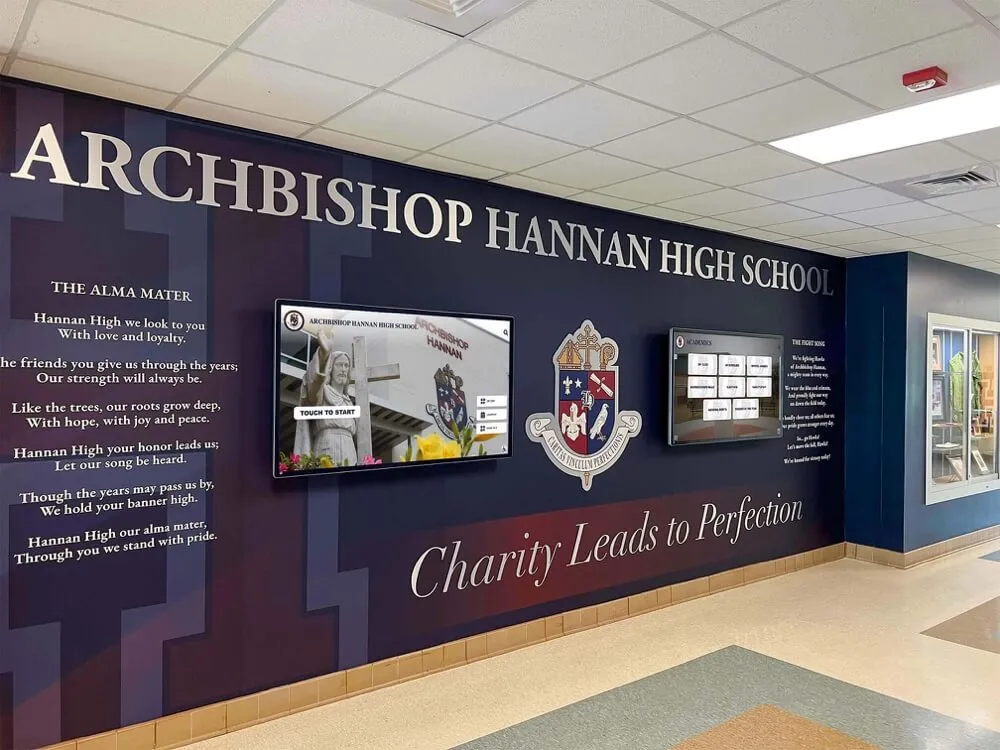
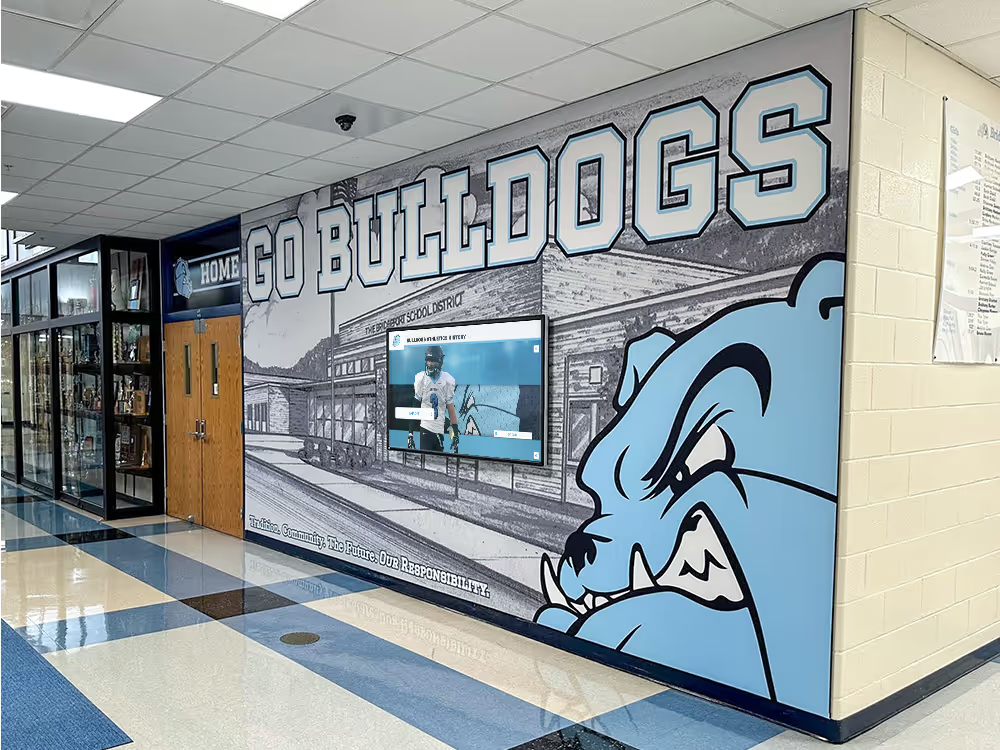
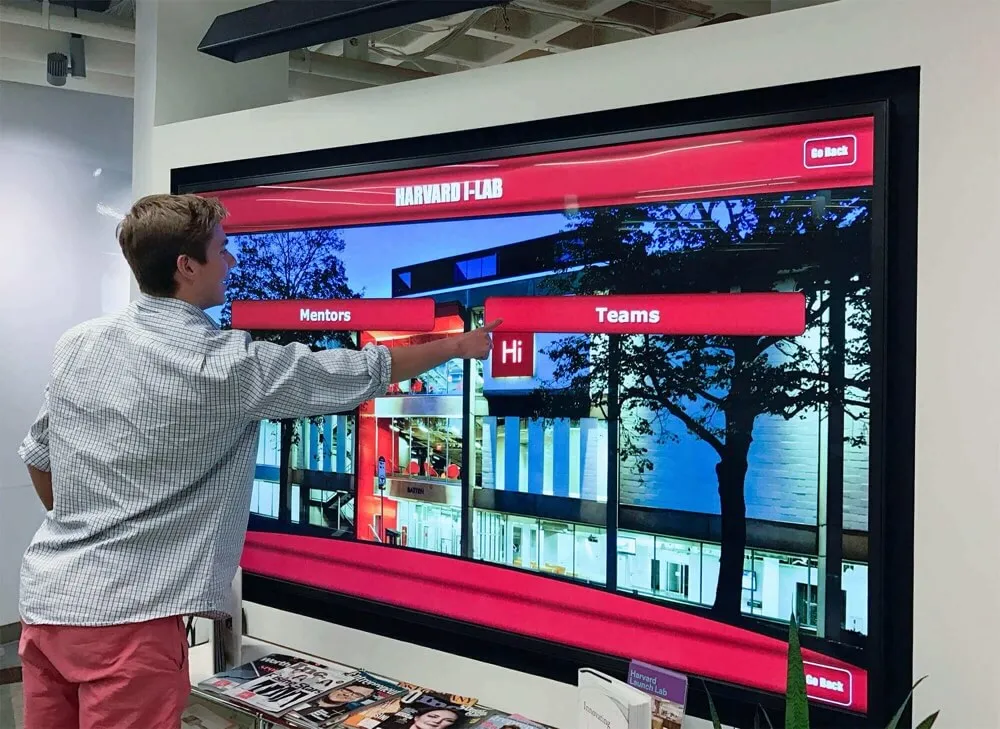
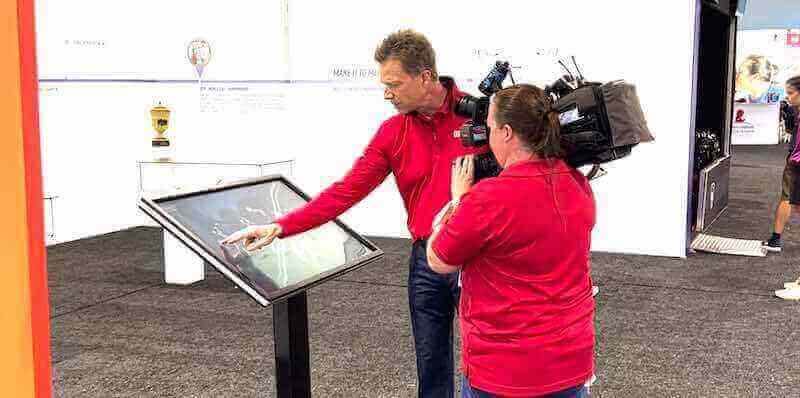
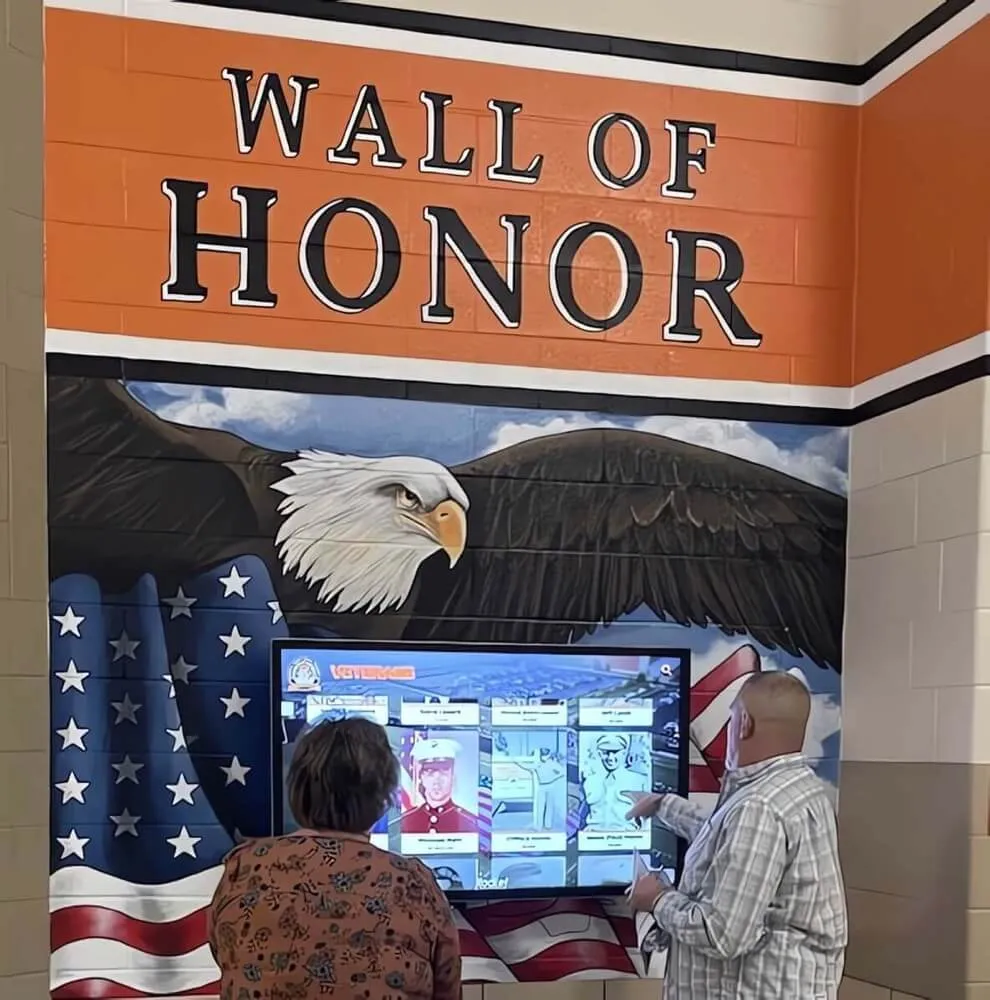
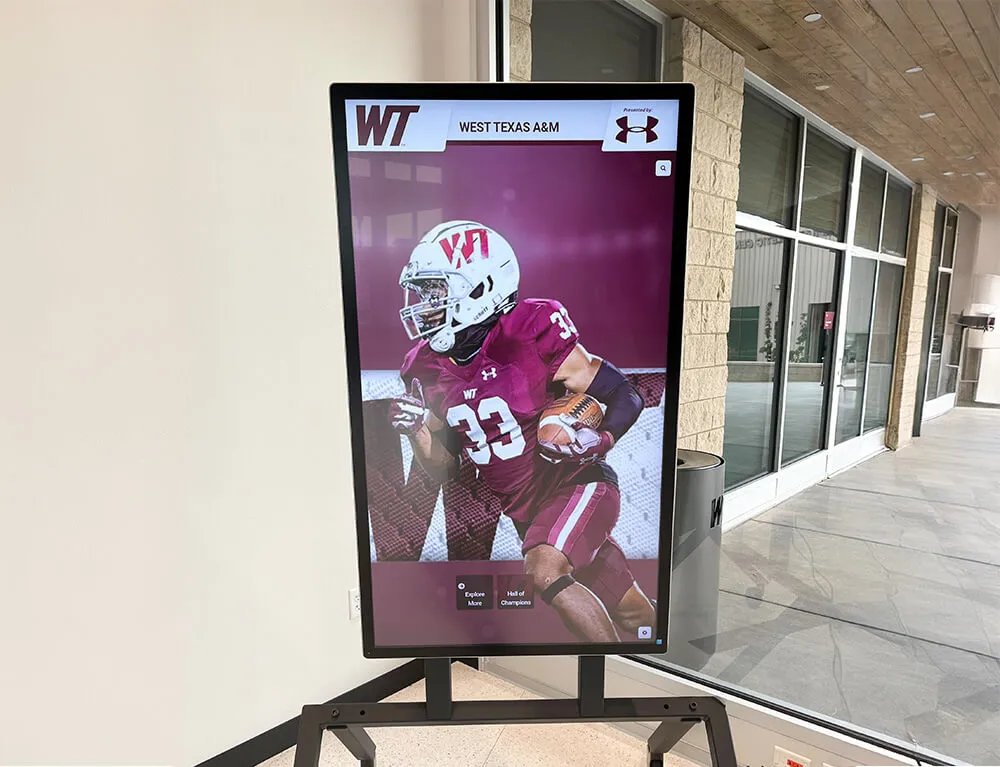
Intuitive touch interfaces make donor exploration natural and engaging for all community members from students through visiting alumni
Multimedia Storytelling and Rich Content
Static donor walls communicate “who gave” through engraved names, missing opportunities to share compelling stories about “why donors gave” and “what their generosity accomplished.” Touchscreen kiosks transform one-dimensional listings into rich multimedia narratives.
Donor Profile Depth
Comprehensive donor profiles extend far beyond name and contribution amount, including:
- Professional photography presenting donors in campus settings or at recognition events, creating personal connections between community members and philanthropic supporters
- Video testimonials where donors explain motivation for giving, connections to institutional mission, or hopes for impact their contributions enable
- Written narratives sharing donor histories, family connections to schools, career accomplishments, or philanthropic philosophies guiding their generosity
- Giving timelines illustrating sustained support across years or decades, demonstrating committed partnership rather than single-transaction acknowledgment
- Family connections linking related donors, celebrating multi-generational support, and recognizing households where multiple members contribute independently
This profile depth transforms recognition from transactional listing into meaningful celebration that honors donors as complete individuals whose generosity reflects values, relationships, and belief in institutional mission.
Impact Visualization
Connecting donors to tangible outcomes their gifts enable creates powerful recognition experiences that transcend acknowledgment, instead celebrating real change. Effective systems showcase:
- Project photography documenting facilities, programs, or initiatives donor contributions funded, from groundbreaking through completion and ongoing use
- Beneficiary stories featuring students who received scholarships, participated in programs, or accessed opportunities donor generosity created
- Before and after comparisons illustrating transformation donor support enabled, particularly powerful for facility projects or program launches
- Usage statistics quantifying impact such as students served, programs delivered, or facilities utilized demonstrating return on philanthropic investment
- Milestone celebrations marking significant achievements like campaign goal completion, facility dedications, or program anniversaries
This impact focus shifts recognition conversations from “what we asked donors for” toward “what donors made possible,” reinforcing the meaningful difference generosity creates rather than simply acknowledging financial transactions.
For schools developing comprehensive historical timeline displays, integrating donor recognition within broader institutional narratives creates powerful connections between philanthropic support and organizational evolution.
Search, Discovery, and Engagement Tools
Unlike passive displays where visitors absorb whatever content designers scheduled, interactive kiosks empower active exploration through sophisticated discovery tools making recognition personally relevant.
Intuitive Search Capabilities
Visitors approach donor recognition displays with specific intentions: finding themselves or family members, locating classmates or colleagues, discovering who supported specific facilities or programs, or browsing recognition tiers. Comprehensive search accommodates all exploration patterns through:
- Text search accepting names, class years, locations, or other identifiers visitors might know
- Alphabetical browsing presenting organized donor lists visitors scan visually
- Recognition tier filtering showing only donors at specific giving levels from leadership gifts through annual fund support
- Campaign or program filters isolating recognition for specific initiatives like capital campaigns, scholarship endowments, or athletics support
- Class year or affiliation sorting enabling alumni to find classmates or colleagues who share institutional connections
- Geographic organization grouping donors by location for regional recognition or alumni chapter celebrations
These varied access paths ensure all visitors successfully find content personally meaningful, whether they know exactly whom they seek or browse casually to discover broader philanthropic community.
Featured Content and Rotation
While search serves visitors with specific intentions, featured content engages casual browsers and introduces community members to compelling donor stories they wouldn’t discover independently. Effective rotation strategies include:
- Donor of the month spotlights highlighting individual supporters or families with expanded profiles celebrating their generosity and institutional connection
- Campaign milestone celebrations marking progress toward goals or announcing achievement of fundraising targets
- Seasonal acknowledgment featuring donors whose support connects to current activities like athletic seasons, performing arts productions, or academic milestones
- Memorial tributes honoring donors during appropriate remembrance periods or anniversaries of their passing
- Anniversary recognition celebrating significant giving milestones like 25-year sustained support or major pledge fulfillment completion
Content rotation maintains freshness encouraging repeat visits while ensuring recognition remains current rather than static, reflecting ongoing donor engagement rather than historical snapshot frozen at wall installation.
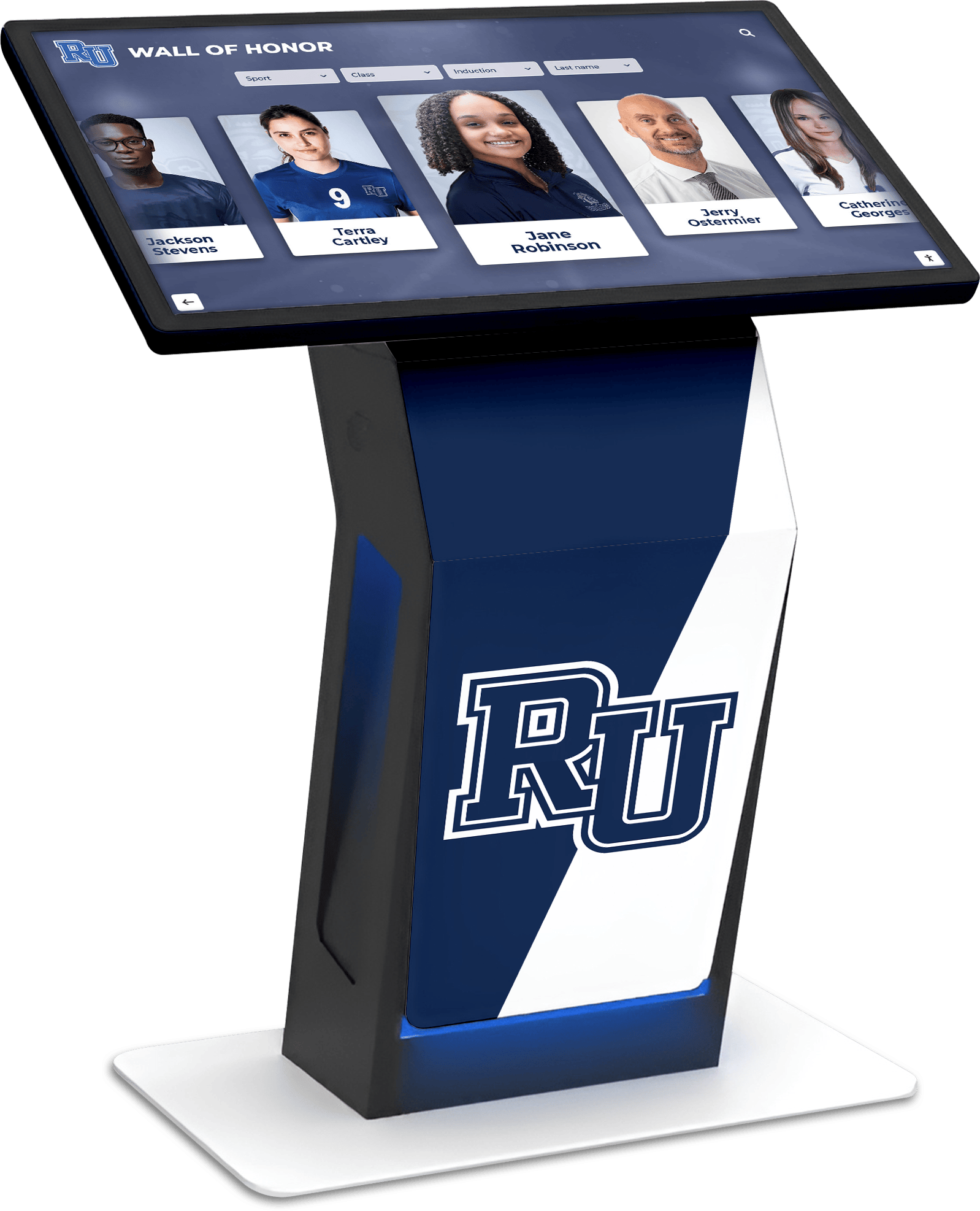
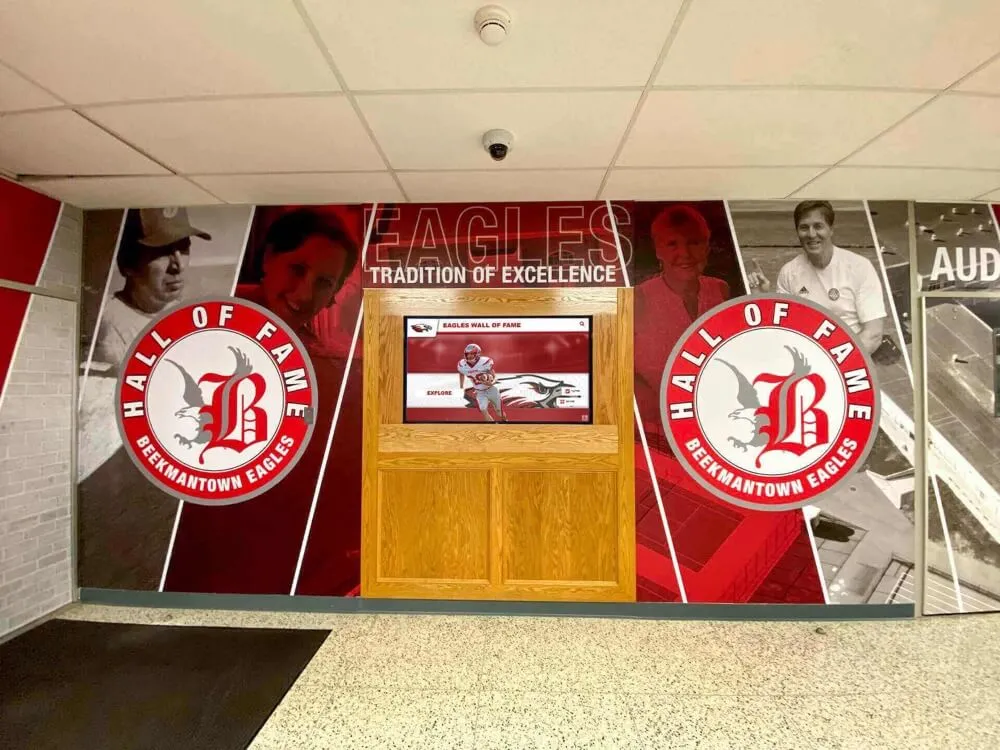
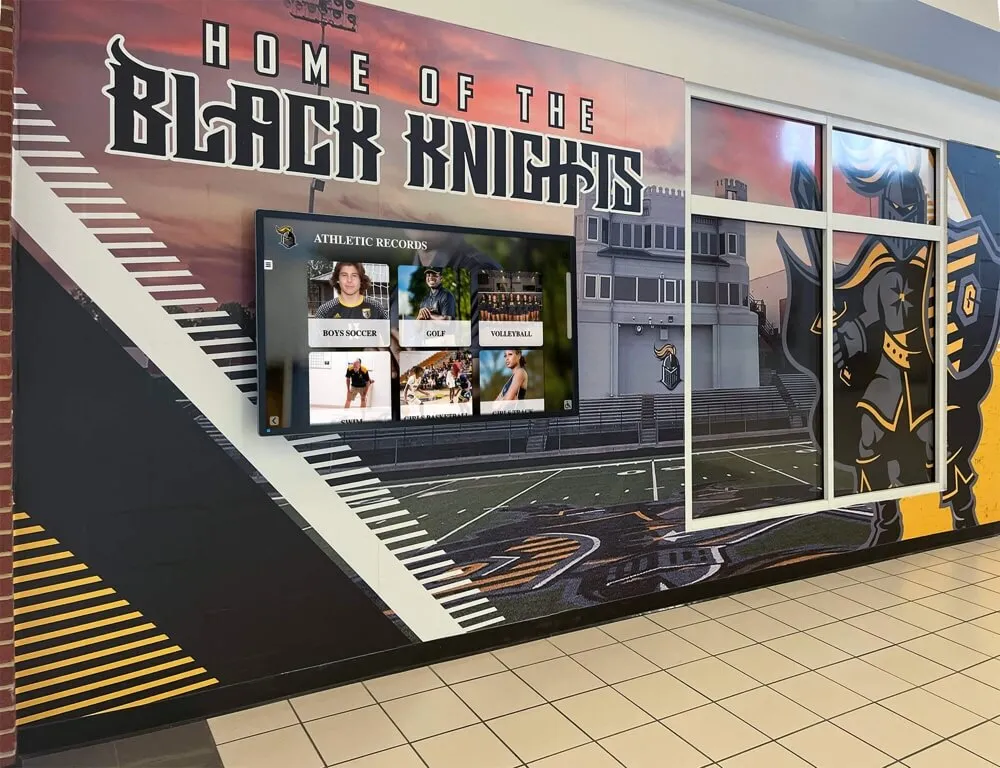
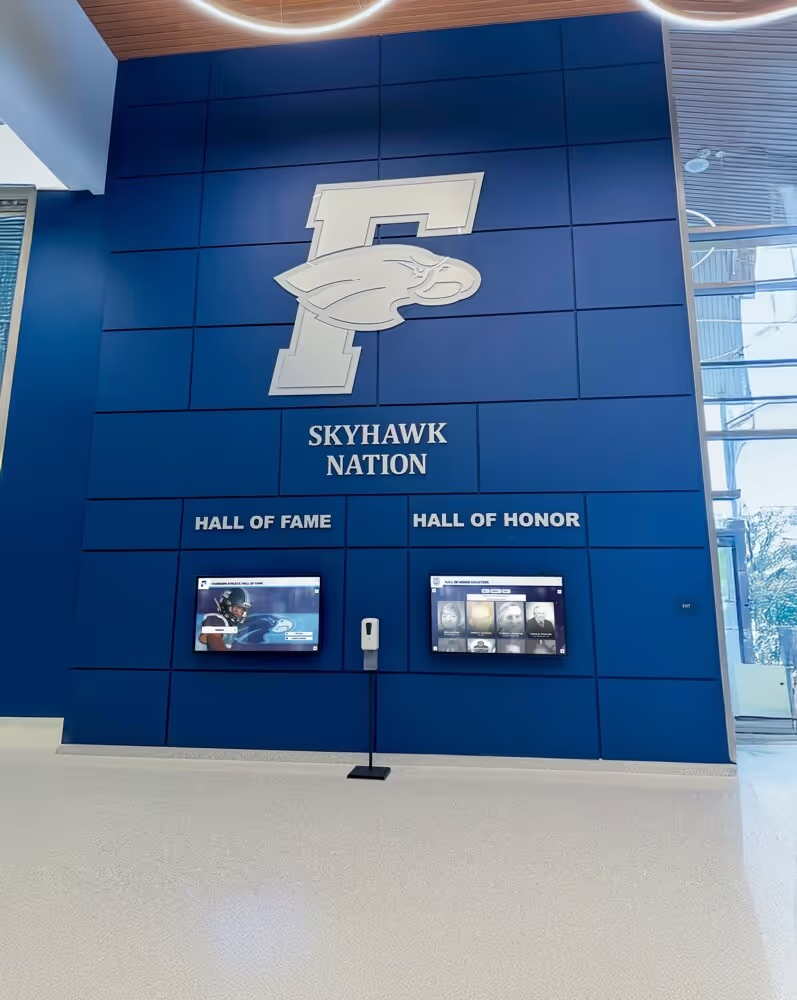
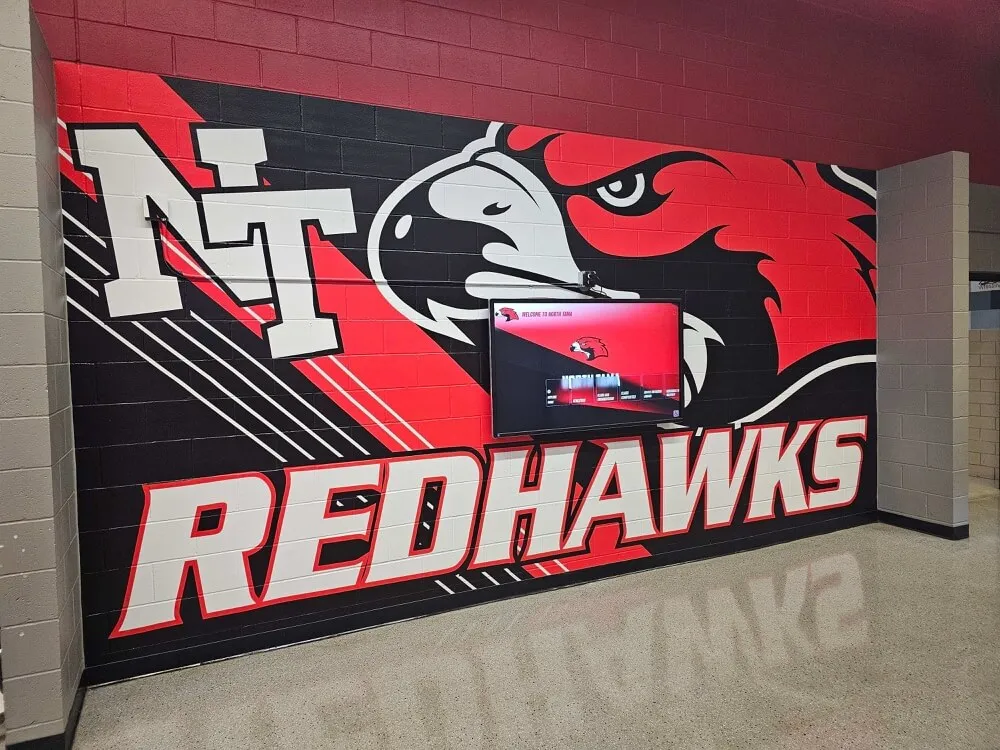
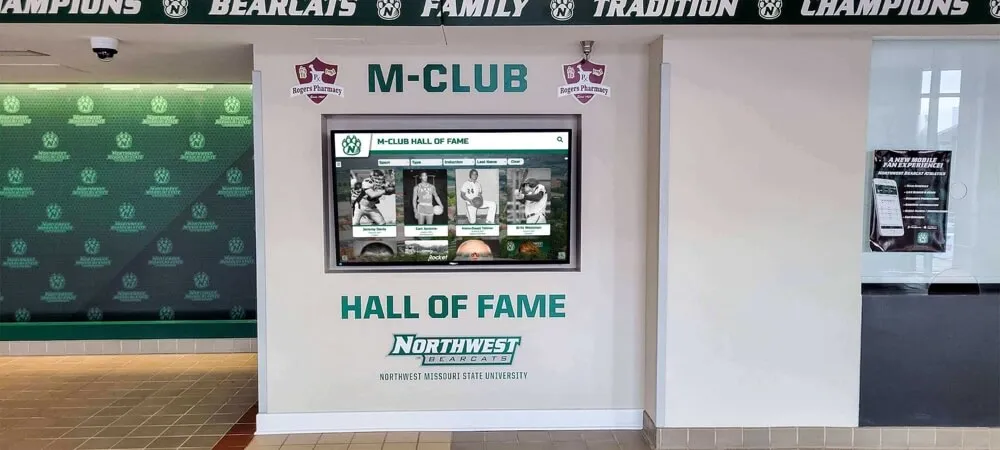
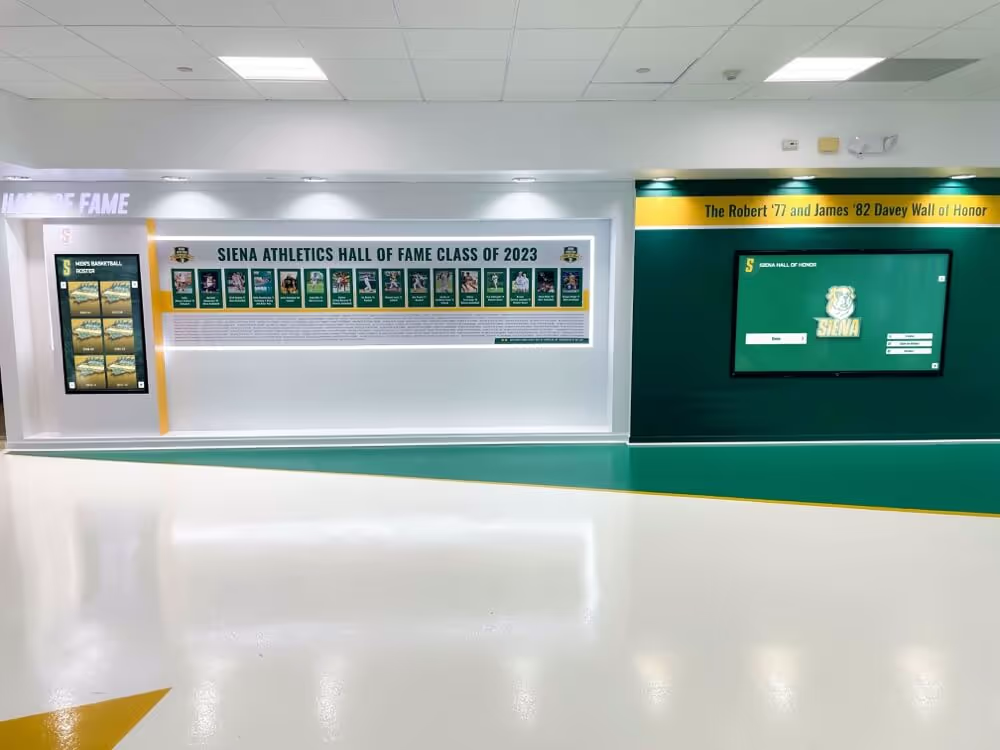
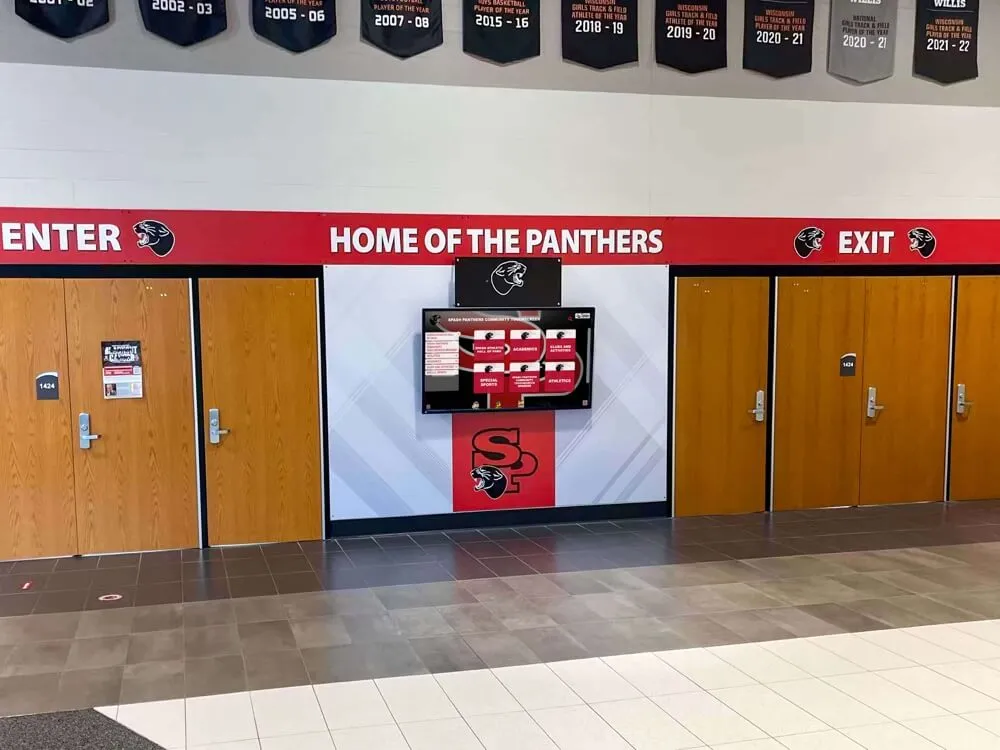
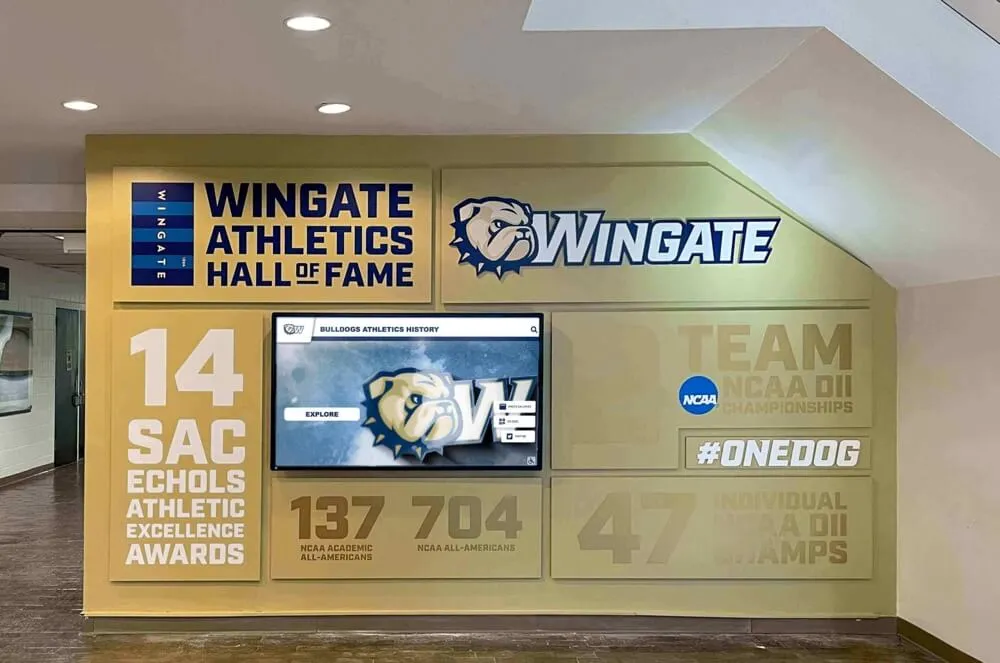
Purpose-built recognition kiosks integrate seamlessly with institutional branding while providing professional presentation worthy of donor generosity
Analytics and Engagement Measurement
Unlike traditional donor walls where advancement teams never know whether anyone actually stops to view recognition, interactive systems provide detailed engagement analytics demonstrating recognition program effectiveness.
Usage Metrics and Reporting
Comprehensive analytics platforms track and report:
- Total interactions quantifying how many visitors engage with kiosks daily, weekly, or across custom periods
- Session duration measuring how long visitors spend exploring content, indicating engagement depth
- Search patterns revealing which donors, giving levels, or campaigns visitors seek most frequently
- Content popularity identifying which donor profiles, stories, or multimedia elements receive most views
- Time-of-day patterns showing peak usage periods informing content scheduling and placement decisions
- Demographic insights when integrated with campus access systems, connecting engagement to visitor types such as prospective families, alumni, or community members
These quantitative measures prove recognition program value to advancement leadership and institutional administrators, justifying investment through documented engagement levels traditional walls cannot provide.
Stewardship Intelligence
Beyond general usage metrics, analytics provide actionable stewardship insights including:
- Donor self-searches identifying when recognized donors view their own profiles during campus visits, creating natural stewardship conversation opportunities
- Peer discovery patterns revealing when donors search for colleagues or classmates, indicating social network connections advancement teams might leverage
- Giving tier interest showing which recognition levels receive most exploration, potentially informing future campaign goal setting
- Content gaps highlighting search terms or queries that return no results, indicating content development opportunities
Forward-thinking advancement teams integrate these analytics into comprehensive stewardship programs, using engagement data to personalize donor communications, time outreach strategically, and demonstrate recognition visibility when reporting back to supporters about their public acknowledgment.
Schools implementing student achievement recognition programs similarly benefit from analytics demonstrating which honorees receive most community engagement.
Accessibility and Inclusive Design
Ensuring all community members can explore donor recognition regardless of physical abilities, language preferences, or assistive technology needs represents both legal obligation and ethical imperative for educational institutions.
ADA Compliance Requirements
The Americans with Disabilities Act mandates accessible design for public accommodations including schools, with specific requirements affecting digital recognition systems:
- Height placement positioning touchscreens between 15 and 48 inches from floor for wheelchair users
- Reach ranges ensuring all interactive elements fall within forward or side reach distance of 48 inches maximum
- Screen reader compatibility providing text alternatives for all visual content enabling audio description for visitors with vision impairments
- Color contrast ratios meeting WCAG 2.1 standards ensuring text remains readable for visitors with low vision or color blindness
- Non-visual interaction alternatives offering keyboard navigation or voice control options for visitors unable to use touchscreens
- Caption and transcript availability ensuring all video content includes synchronized captions and text transcripts
Purpose-built donor recognition systems incorporate these accessibility features from initial design rather than retrofitting compliance after launch, ensuring seamless experiences for all visitors.
Multilingual Support
Schools serving diverse communities where families speak multiple languages benefit from recognition systems offering content in Spanish, Mandarin, or other languages reflecting local demographics. Multilingual interfaces demonstrate inclusive values while ensuring all community members can engage with donor celebration regardless of English proficiency.
Translation capabilities should extend beyond interface navigation to include donor profiles, impact stories, and other narrative content, creating truly accessible recognition experiences rather than superficial language selection that leaves actual content untranslated.
Universal Design Principles
Beyond specific accessibility requirements, universal design creates recognition experiences naturally usable by broadest possible audience:
- Intuitive navigation requiring minimal instruction or prior technology experience
- Generous touch targets accommodating various fine motor capabilities
- Clear visual hierarchy helping visitors understand content organization at a glance
- Legible typography ensuring readability from various distances and angles
- Adjustable text size allowing visitors to increase font sizes for improved readability
- Timeout accommodations providing sufficient time for content exploration without premature session resets
These principles create recognition that welcomes all visitors rather than implicitly or explicitly excluding community members based on abilities or backgrounds.
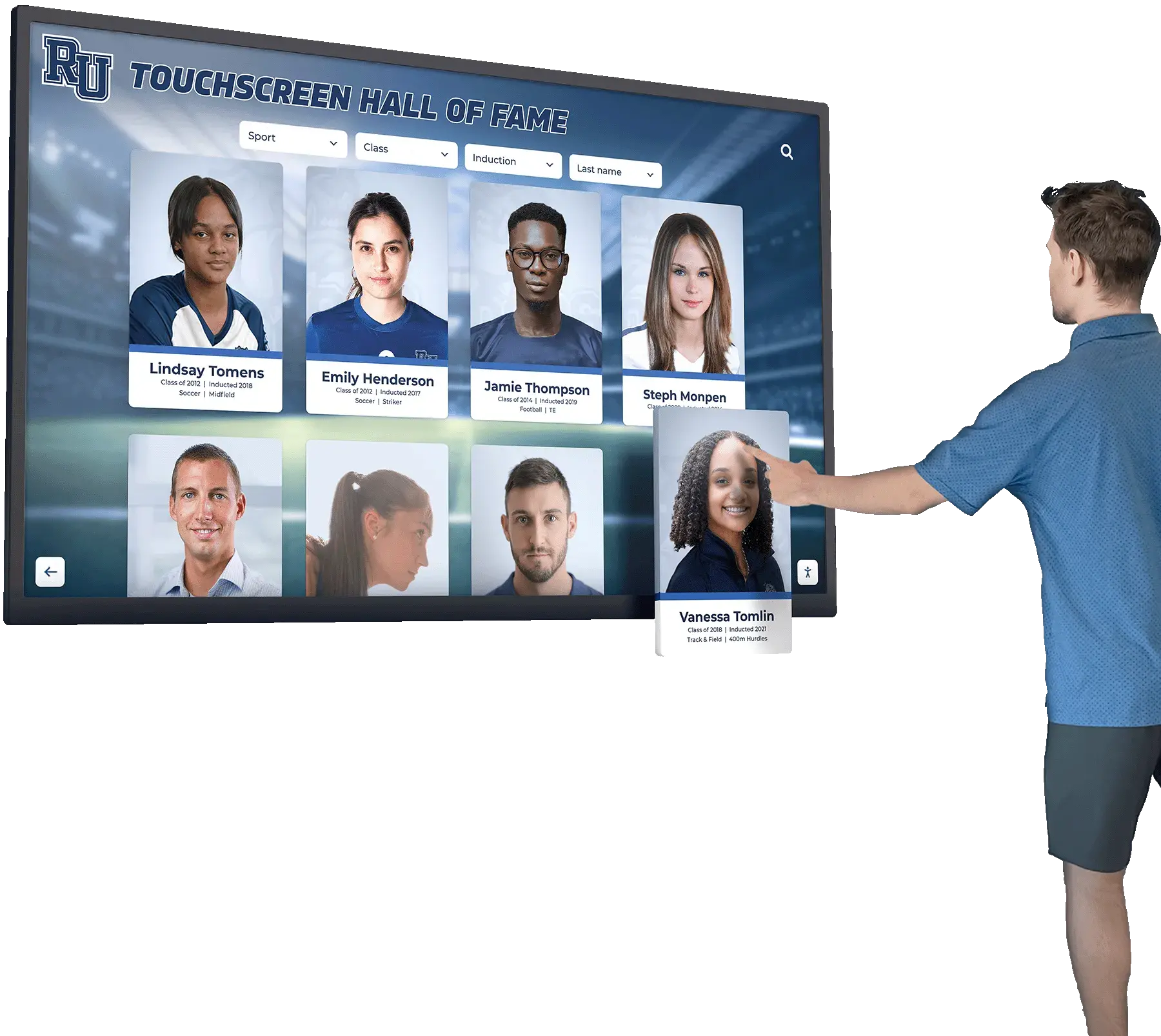
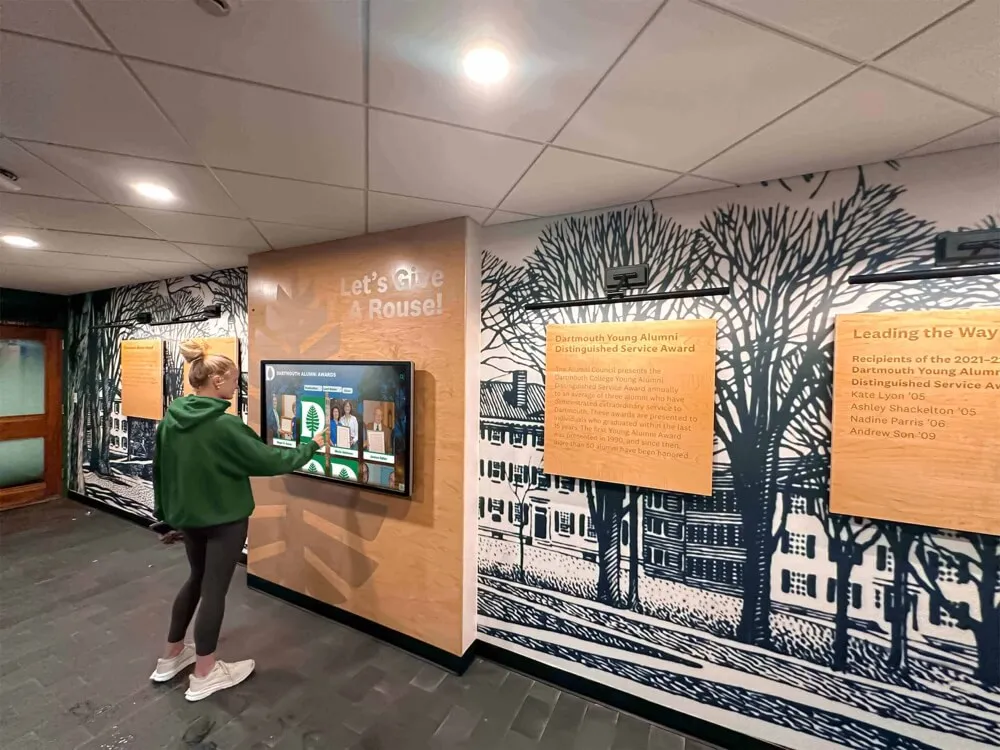
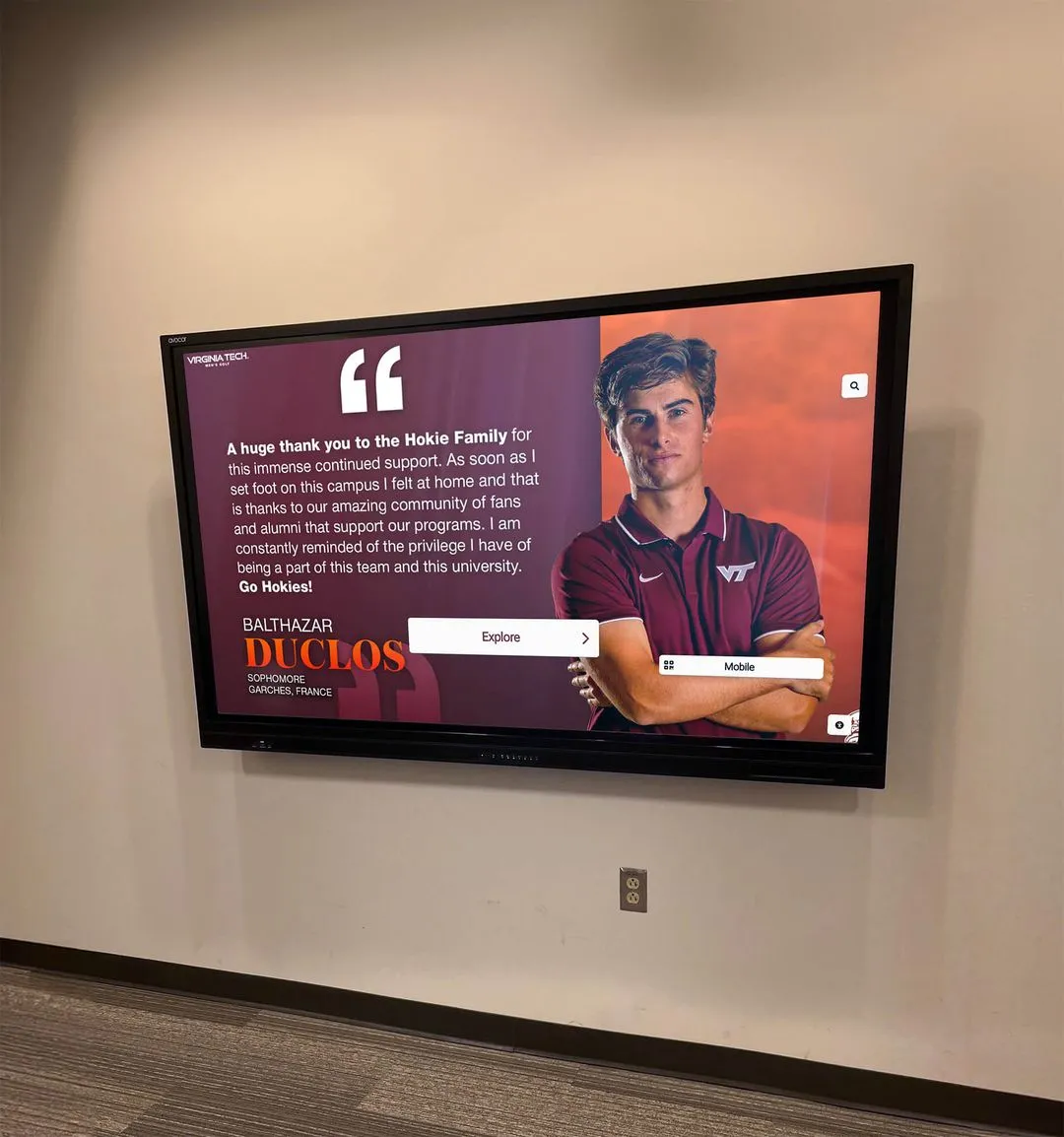
Well-designed kiosks accommodate various physical abilities and interaction preferences ensuring inclusive recognition experiences
Installation Requirements and Implementation Process
Understanding practical requirements for implementing touchscreen donor recognition helps schools plan effectively and avoid common pitfalls that delay launches or compromise long-term functionality.
Site Assessment and Location Selection
Successful recognition kiosk performance begins with strategic placement in locations maximizing visibility while meeting technical requirements for reliable operation.
High-Traffic Visibility
Donor recognition serves multiple purposes: honoring supporters, inspiring future giving through visible philanthropy, and building community pride around fundraising success. These objectives require placement where community members naturally congregate or pass frequently, such as:
- Main entrance lobbies where all campus visitors pass during arrival
- Athletic facility entrances celebrating donors who funded sports facilities specifically
- Performing arts center lobbies acknowledging supporters of cultural programming
- Student center gathering spaces reaching daily population of students, faculty, and staff
- Administration building corridors visible to prospective families during campus tours
- Alumni center locations ensuring visiting graduates encounter recognition celebrating peer generosity
Schools commonly install multiple kiosks in distributed locations, each potentially featuring content tailored to location context—for example, athletic facility kiosks might highlight sports program donors while library installations emphasize scholarship supporters.
Technical Infrastructure Requirements
Beyond visibility considerations, installation locations must provide essential utilities:
- Electrical service ideally within 10 feet of installation location, avoiding long extension cords creating trip hazards or code violations
- Network connectivity either through wired Ethernet connections providing most reliable performance or secured WiFi networks meeting bandwidth requirements for content updates and analytics reporting
- Climate control maintaining operational temperature ranges year-round, particularly important for locations like gymnasiums where HVAC systems may power down during unoccupied periods
- Adequate lighting balancing screen visibility with ambient light that doesn’t create glare compromising readability
- Structural support ensuring walls or floor mounting can support kiosk weight securely without risk of tip-over or mounting failure
Professional installation teams conduct detailed site surveys assessing these factors before finalizing placement recommendations, avoiding costly relocations after discovering infrastructure limitations.
For schools planning comprehensive digital history displays, coordinating donor recognition placement with broader storytelling installations creates cohesive campus recognition ecosystems.
Hardware Configuration Options
Touchscreen donor recognition hardware ranges from compact single displays through elaborate architectural installations, with selection depending on space availability, budget, and institutional aesthetic preferences.
Freestanding Floor Kiosks
Self-contained floor units offer installation flexibility requiring only electrical and network connections without wall mounting or structural modification. These systems typically feature:
- Integrated enclosures housing displays, computers, and power supplies in unified designs
- Weighted bases providing stability without floor anchoring in most situations
- Cable management concealing power and network connections for professional appearance
- Optional branding incorporating school logos, colors, or custom graphics
- Portability enabling relocation if needs change, though units generally remain permanently placed
Floor kiosks work well in open lobby spaces where wall mounting isn’t practical or when schools want recognition flexibility to relocate if future renovations alter floor plans.
Wall-Mounted Displays
Wall-mounted configurations integrate displays directly into existing surfaces, creating cleaner architectural appearance and saving floor space in compact locations. Implementation requires:
- Structural assessment ensuring walls can support display weight, typically 100-150 pounds including mounting hardware
- Stud location for secure attachment or supplemental blocking installation
- Cable concealment either within walls during construction or through surface-mounted raceways for retrofit installations
- Viewing height optimization balancing accessibility requirements with line-of-sight from typical approach angles
Wall mounting suits hallways or locations where floor space is limited but wall surfaces offer good visibility and appropriate viewing angles.
Custom Architectural Integration
For new construction or major renovations, schools sometimes commission custom millwork or architectural elements incorporating displays within permanent installations. These bespoke solutions might include:
- Built-in cabinetry surrounding displays with wood or stone materials matching architectural finishes
- Multi-screen arrays combining several displays in coordinated layouts for expanded content capacity
- Donor wall hybrids blending traditional engraved elements with integrated digital displays
- Themed environments where recognition integrates with broader design narratives like athletic trophy displays or historical photo galleries
Custom integration requires coordination between advancement teams, architects, general contractors, and technology integrators during design phases, adding complexity but creating recognition installations that feel permanent and prestigious.
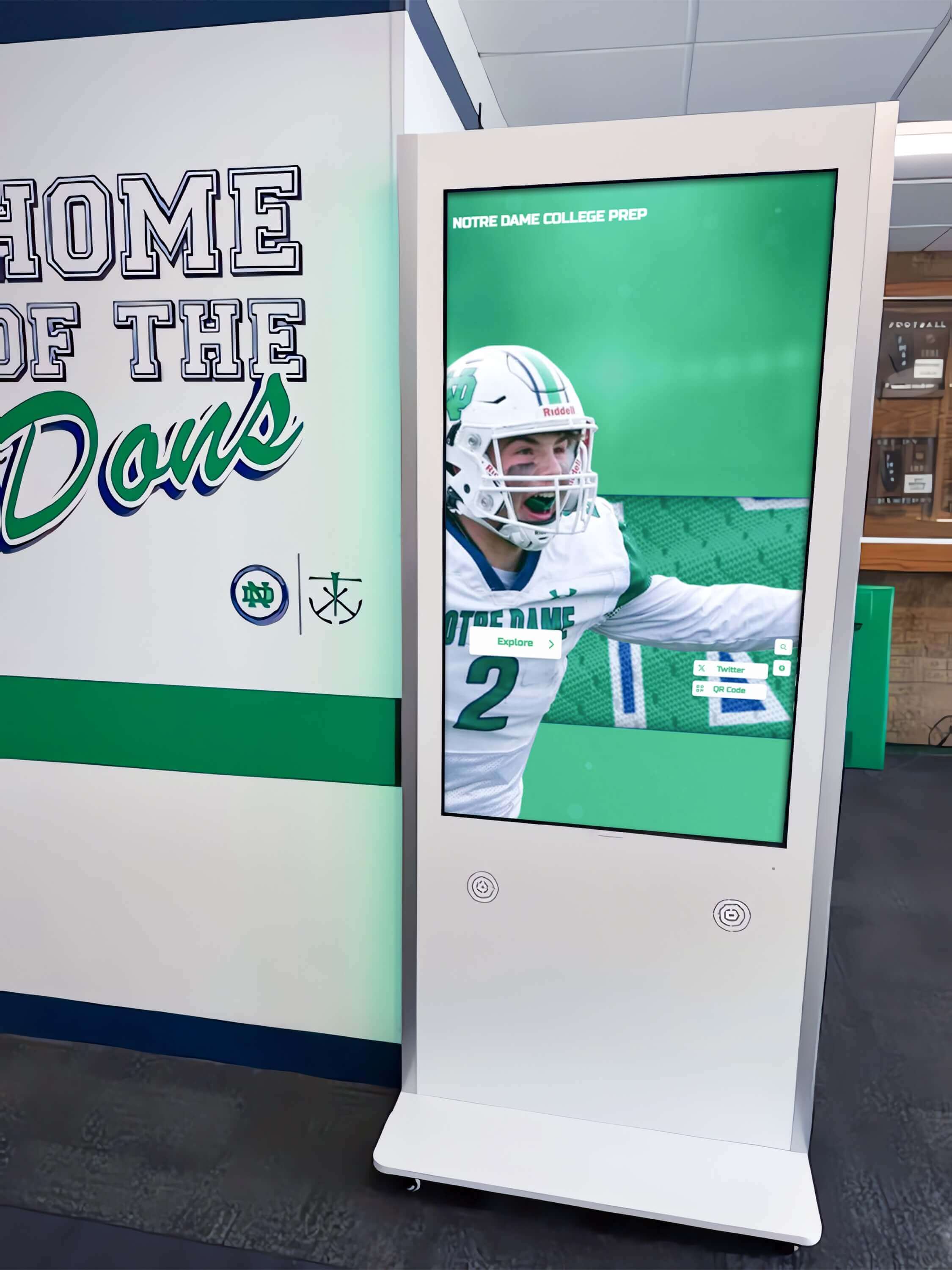
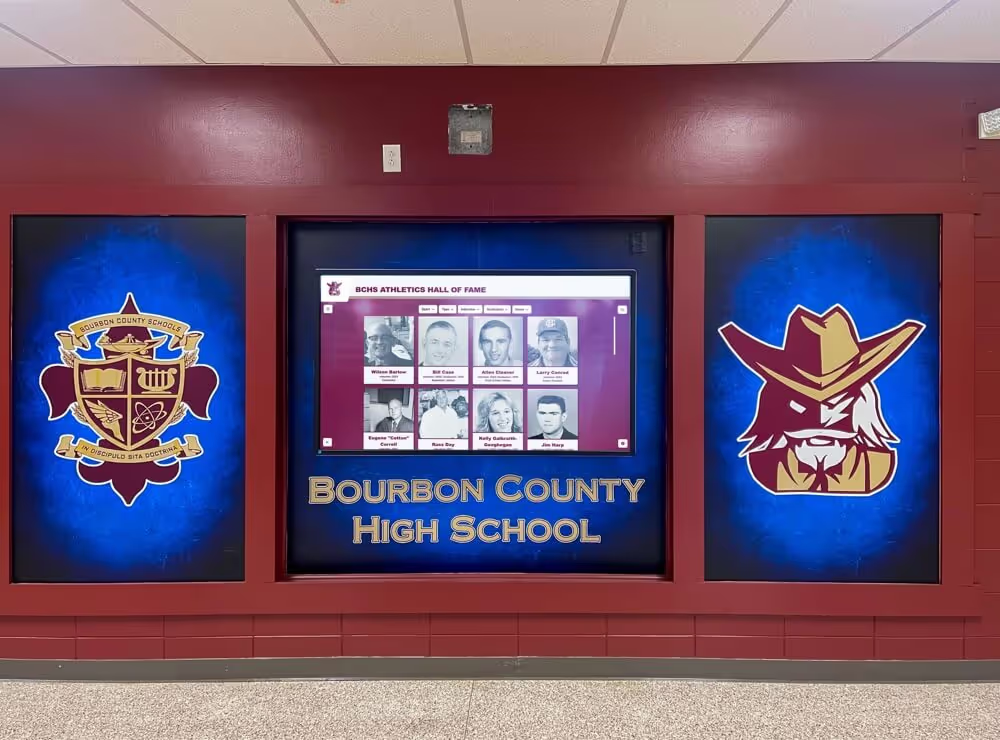
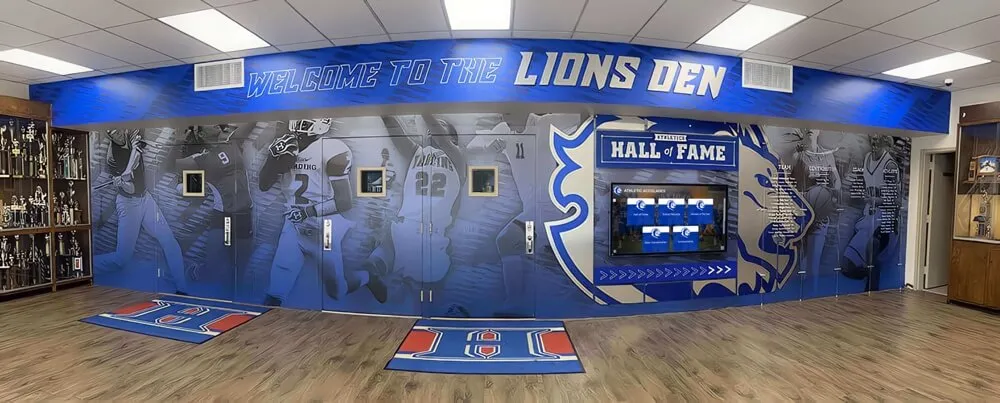
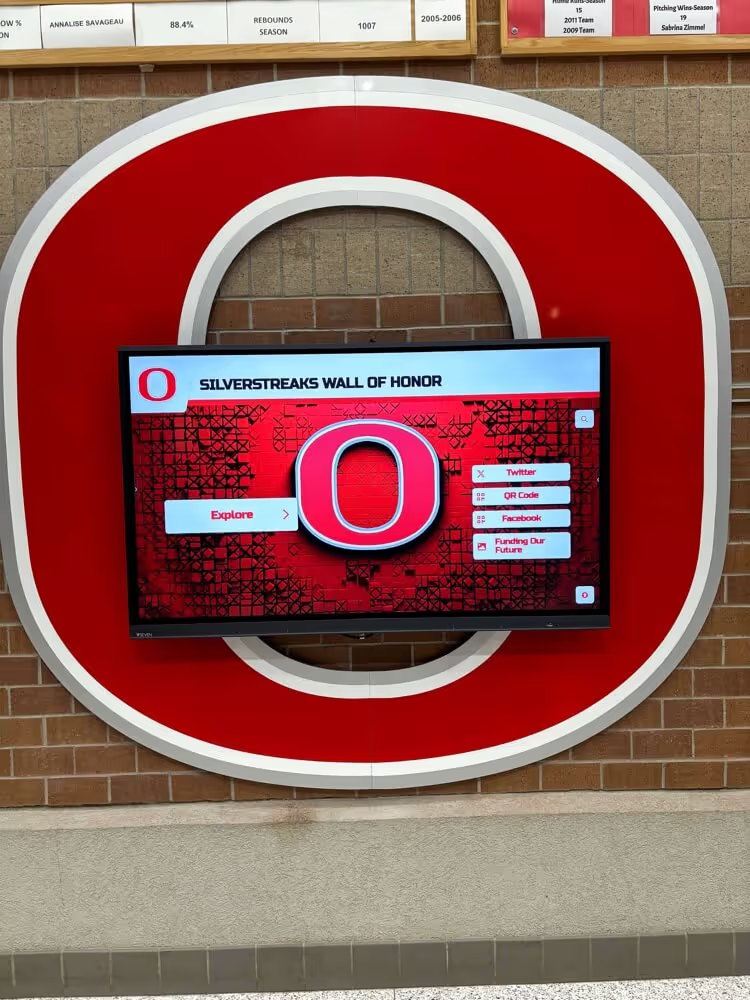
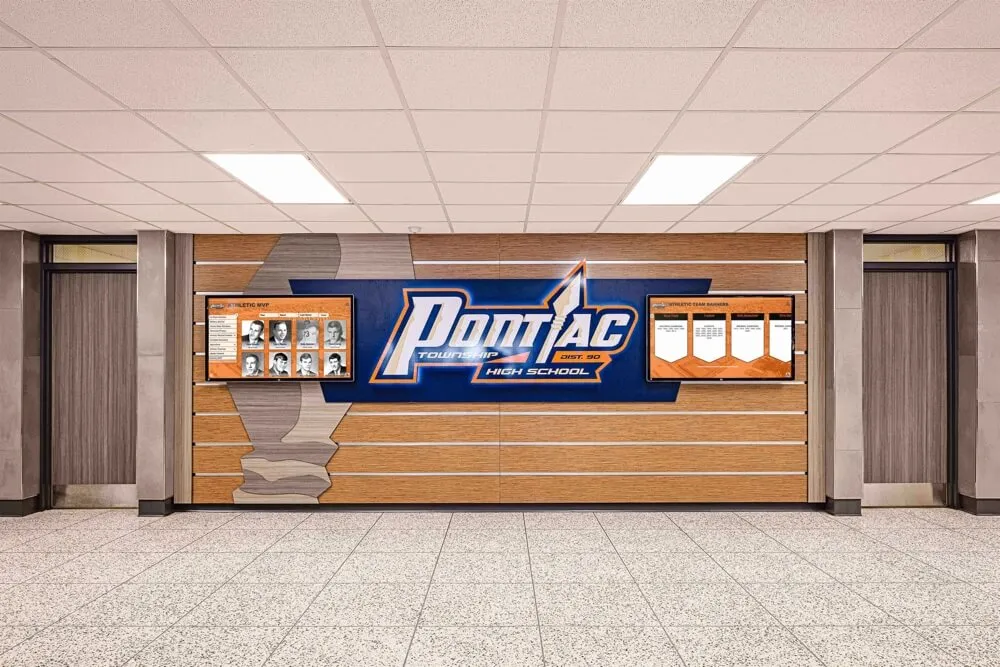
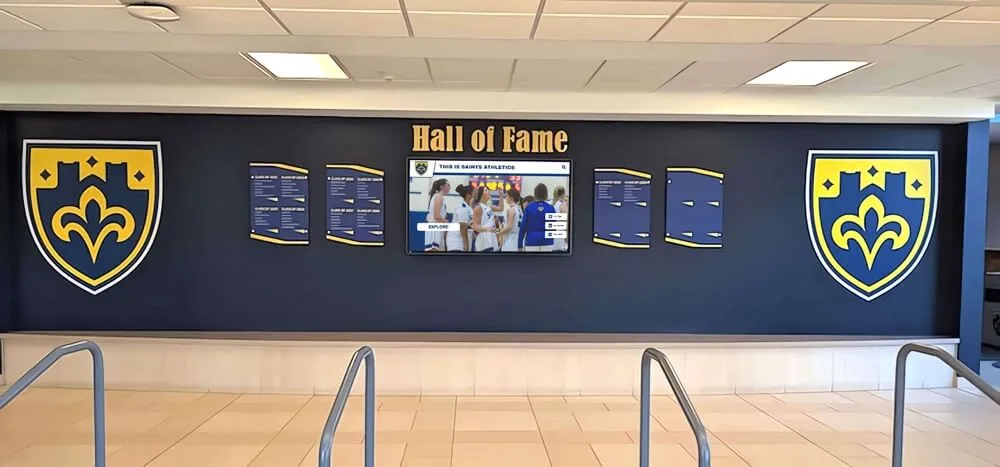
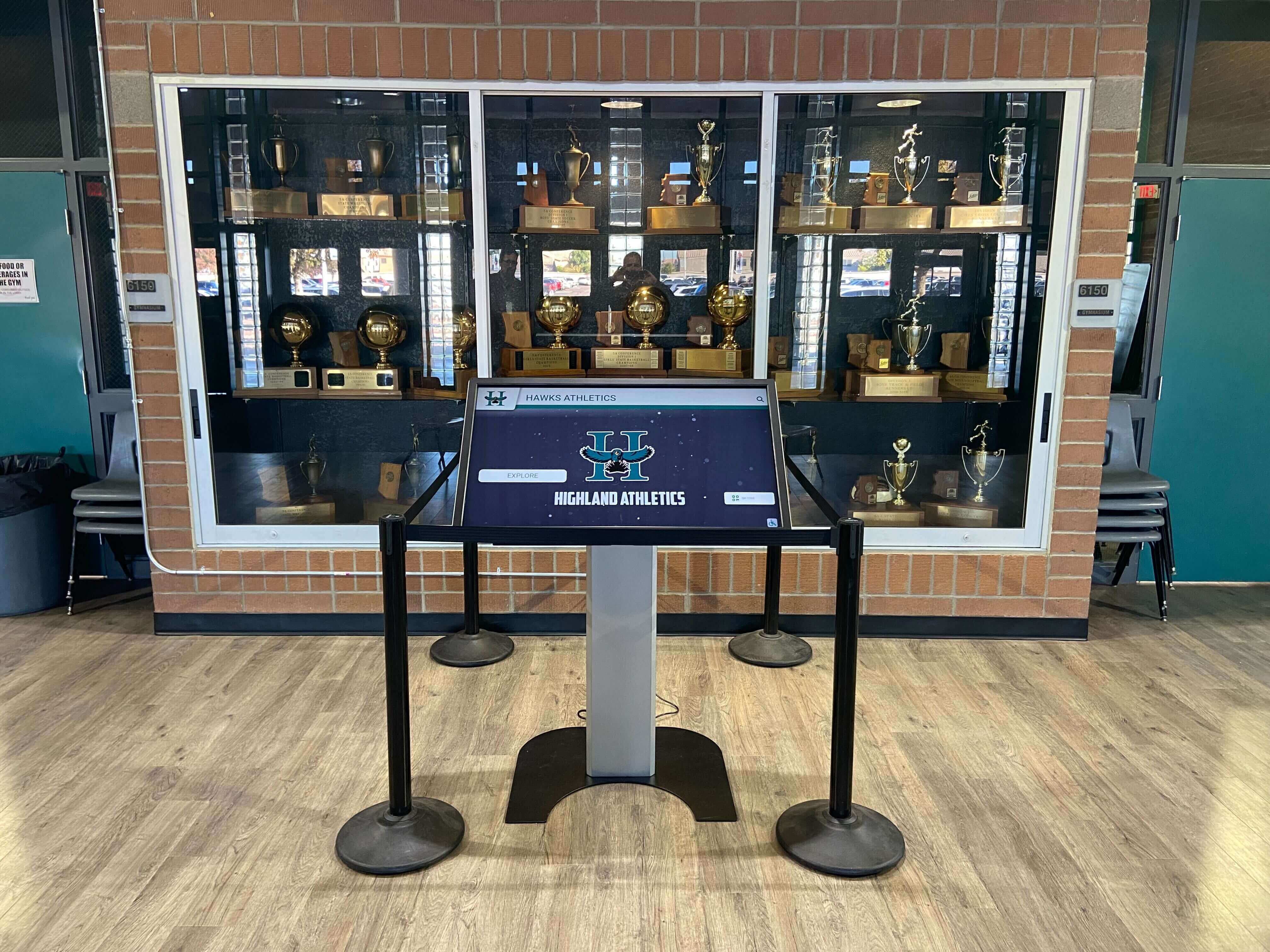
Strategic hallway placement ensures regular visibility among daily school population while accommodating technical infrastructure requirements
Content Migration and Data Management
For schools replacing existing donor walls or consolidating recognition from multiple sources, content migration represents substantial project components demanding careful planning.
Donor Database Integration
Many advancement offices already maintain comprehensive donor information within fundraising databases like Raiser’s Edge, Salesforce, or other constituent relationship management (CRM) systems. Efficient recognition platforms integrate directly with these systems through:
- API connections enabling automated synchronization between fundraising databases and recognition platforms
- Scheduled imports updating recognition content nightly or weekly as new gifts are received and recorded
- Giving tier automation calculating appropriate recognition levels based on cumulative giving totals from CRM systems
- Privacy flag respect honoring donor preferences about public recognition automatically without manual filtering
These integrations eliminate double data entry while ensuring recognition remains current as advancement teams record gifts and updates within existing workflows.
Historical Content Digitization
Schools replacing traditional donor walls often want historical recognition preserved within new digital systems. Digitization projects involve:
- Photography capturing existing plaques for archival records
- Data extraction manually or through optical character recognition transcribing donor names, giving years, and other information
- Information enrichment researching and adding context, photos, or other details not present on original plaques
- Quality assurance verifying accuracy before publication, particularly important for memorial designations or donor name spellings
Professional implementation teams often handle digitization as part of installation services, though schools with comprehensive archival records may complete migration independently before launch.
Staff Training and Change Management
Technology implementation success depends as much on effective staff onboarding as hardware installation or software configuration.
Administrative Training
Advancement staff members who will manage recognition content require thorough training covering:
- Content management workflows for adding donors, updating profiles, uploading photos, and managing recognition tiers
- Search and navigation understanding how visitors will explore content, informing content organization decisions
- Security protocols including password management, role assignment, and access logging
- Troubleshooting basics addressing common issues without requiring vendor support for simple problems
- Analytics access and interpretation using engagement data for stewardship insights and program evaluation
Training should include hands-on practice with test content before launching public displays, building confidence among staff members who may have limited prior technology experience.
Community Communication
Introducing new recognition technology requires explaining changes to various stakeholders:
- Donor communications describing how new systems enhance their recognition with interactive profiles, expanded content, and perpetual acknowledgment
- Volunteer leadership briefing development council or foundation board members about implementation timelines and benefits
- Campus community announcing installations and encouraging exploration through campus media channels
- Prospective donor cultivation incorporating recognition technology into fundraising presentations as enhancement demonstrating institutional sophistication
Thoughtful communication prevents confusion or concern about changes while building enthusiasm for enhanced recognition capabilities that benefit entire institutional community.
Schools implementing senior recognition programs similarly benefit from clear communication ensuring students and families understand how honors will appear and be celebrated.
Calculating Return on Investment for Donor Recognition Technology
Advancement leadership and institutional administrators appropriately scrutinize recognition technology investments, requiring clear ROI frameworks demonstrating value beyond subjective aesthetic improvements.
Quantifying Direct Cost Savings
Touchscreen systems deliver measurable cost reductions compared to traditional recognition approaches across multiple categories.
Update and Maintenance Costs
Traditional bronze plaque donor walls require ongoing expenditures throughout their lifecycle:
- Initial fabrication typically costs $150-300 per engraved name depending on plaque material, size, and fabrication complexity
- Update fabrication for new donors or corrections costs equivalent to initial installation with additional demolition and reinstallation labor
- Shipping and installation adds $2,000-5,000 per update cycle depending on quantity and complexity
- Physical maintenance including cleaning, tarnish removal, and protective finish reapplication costs $1,500-3,000 annually
- Eventual replacement as materials deteriorate or aesthetics become dated, requiring complete donor wall replacement every 15-25 years
A school that adds 50 donors annually across recognition updates faces $10,000-18,000 in annual traditional wall maintenance costs. Over 20 years, cumulative expenses exceed $200,000 before accounting for eventual complete replacement.
Digital systems eliminate per-donor update costs entirely. Schools add unlimited donors through administrative portals without fabrication, shipping, or installation expenses. Annual software maintenance fees typically run $2,000-4,000, saving $150,000-250,000 over 20 years compared to traditional approaches.
Space Renovation Avoidance
Traditional walls inevitably reach capacity during successful fundraising campaigns. Schools face difficult choices: expensive facility renovations adding wall space costing $25,000-75,000, or disappointing donors with news that recognition space isn’t available despite promised acknowledgment.
Digital systems with unlimited capacity eliminate renovation requirements entirely. Schools accommodate 2,000 donors as easily as 200 without facility modifications, avoiding substantial capital expenses while ensuring recognition commitments to all donors regardless of campaign success levels exceeding original projections.
Labor Efficiency Gains
Traditional recognition requires advancement staff time coordinating with vendors, reviewing proofs, managing installations, and addressing donor inquiries about when updates will appear. Digital systems reduce administrative overhead through:
- Self-service content management allowing staff to make updates directly without vendor coordination
- Immediate publication eliminating months-long update timelines and associated donor communication about delays
- Automated giving tier assignment reducing manual calculation and recategorization as giving accumulates
- Centralized profile management where single updates populate across all kiosk locations automatically
A advancement director who previously spent 15-20 hours per recognition update cycle coordinating traditional wall changes might complete equivalent digital updates in 2-3 hours, freeing 50+ hours annually for relationship cultivation and fundraising activity rather than administrative logistics.
Measuring Fundraising Impact
Beyond direct cost savings, effective donor recognition influences giving behavior in ways that generate substantial fundraising returns.
Donor Retention Improvements
National fundraising benchmarks indicate average donor retention rates around 45% for educational institutions—meaning 55% of donors fail to give again the following year. Even modest retention improvements deliver significant revenue impact over time.
Research on donor recognition effectiveness demonstrates that acknowledged donors show 15-25 percentage point higher retention rates compared to unrecognized supporters. For schools with 500 annual donors averaging $1,000 contributions, a 20-point retention improvement generates $100,000 additional annual revenue—$2 million over 20 years from improved retention alone.
Interactive recognition that enables donors to revisit their profiles, share with family members, and connect to impact stories creates ongoing touchpoints strengthening relationships beyond single thank-you communications, contributing to retention improvement.
For schools managing athletic recognition programs alongside donor acknowledgment, visible celebration of multiple community contribution types builds comprehensive culture of recognition.
Upgrade Gift Inspiration
Visible recognition hierarchies create natural motivation for donors to increase giving and qualify for higher acknowledgment tiers. When supporters see peers recognized at leadership giving levels, they often aspire to comparable acknowledgment, particularly in communities where philanthropy carries social significance.
Schools report that 8-12% of donors who initially give at modest levels eventually increase contributions to reach higher recognition tiers after seeing tiered acknowledgment systems. For institutions where 20 of 500 annual donors increase giving from $1,000 to $5,000 to qualify for prominent leadership society recognition, annual incremental revenue reaches $80,000—nearly $1.6 million over 20 years.
Dynamic digital systems that clearly communicate recognition tiers and update immediately when donors reach new levels encourage this upgrade behavior more effectively than static walls where tier distinctions blend together visually and updates appear only during infrequent renovation cycles.
Major Gift Cultivation Assets
Recognition technology serves prospective donor cultivation by demonstrating institutional appreciation, showcasing vibrant philanthropic community, and providing tangible examples of how major gifts receive acknowledgment worthy of extraordinary generosity.
Development officers report that touring prospective major gift donors through recognition displays creates natural conversations about giving opportunities, peer examples of similar giving levels, and acknowledgment approaches for various contribution types. These cultivation conversations don’t directly convert to immediate gifts but influence the philanthropic environment where major gift discussions occur.
While difficult to quantify precisely, advancement teams consistently report that sophisticated recognition enhances cultivation experiences, contributing to successful major gift closures that generate campaign revenue justifying recognition investments many times over.
ROI Calculation Framework
Schools evaluating recognition technology investments might use this framework:
20-Year Cost Comparison
- Traditional donor wall maintenance and updates: $200,000-350,000
- Digital recognition system (hardware + software): $75,000-125,000
- Direct cost savings: $125,000-225,000
Revenue Impact (Conservative Estimates)
- Donor retention improvement (5% increase on 500 donors @ $1,000 average): $1,000,000
- Upgrade gift generation (10 donors increasing $4,000 each annually): $800,000
- Major gift cultivation contribution (0.5 additional gifts @ $100,000): $50,000
- Additional revenue: $1,850,000
Net 20-Year ROI: $1,950,000-2,050,000
This framework demonstrates that even using conservative assumptions about fundraising impact, recognition technology delivers substantial positive returns through combined cost savings and revenue generation, easily justifying initial investment.
Calculating Cost Per Interaction
Unlike traditional donor walls where engagement remains unmeasured, touchscreen analytics enable calculating recognition cost per visitor interaction—providing unique perspective on investment efficiency.
A $50,000 kiosk generating 2,000 interactions monthly (typical for high-traffic school locations) delivers 480,000 interactions over 20-year operational life, equating to $0.10 per engagement. Each interaction represents an opportunity to inspire giving, strengthen donor relationships, or build community pride around philanthropy—outcomes worth far more than 10 cents to advancement mission.
This per-interaction cost compares favorably to other advancement expenditures like direct mail appeals ($2-5 per piece), event costs ($50-200 per attendee), or travel for personal visits ($200-500 per meeting) while reaching far broader audiences including prospective donors who wouldn’t merit personalized outreach until demonstrating giving interest.
Selecting the Right Touchscreen Recognition System
With multiple vendors and varying system capabilities available, schools benefit from structured evaluation frameworks ensuring selected solutions align with institutional needs and advancement strategies.
Essential Selection Criteria
Content Flexibility and Customization
Recognition needs vary dramatically across institutions based on fundraising models, campaign structures, and advancement priorities. Effective systems accommodate diverse requirements through:
- Configurable giving tiers matching institutional recognition societies from comprehensive naming opportunities through annual fund acknowledgment
- Flexible metadata fields capturing information relevant to your donors beyond standard name/amount fields
- Custom design options incorporating institutional branding, colors, and aesthetic preferences
- Multi-campaign management recognizing simultaneous initiatives without requiring separate installations
- Specialized content types supporting scholarship donors, memorial gifts, planned giving society members, or other category-specific recognition
Systems that force standardized recognition structures may work beautifully for some schools while creating frustrating limitations for others—thorough evaluation should confirm alignment with your specific requirements.
Long-Term Vendor Stability
Digital recognition systems represent 20-30 year institutional commitments. Vendor financial stability and long-term support commitments prove as important as current product capabilities:
- Company longevity favoring established organizations over recent startups that may not survive next market downturn
- Installation base indicating market acceptance and ongoing viability rather than experimental products with uncertain futures
- Support infrastructure including responsive customer service, regular software updates, and troubleshooting resources
- Hardware sourcing using standard commercial components with multi-vendor availability rather than proprietary hardware that may become obsolete
- Cloud platform reliability ensuring recognition systems function even if original vendor exits market through acquisition or closure
Schools should request client references specifically asking about long-term vendor relationships, responsiveness to issues, and software evolution over years of partnership—revealing vendor character impossible to assess from sales presentations alone.
Total Cost of Ownership
Initial system purchase prices represent only partial costs schools incur across recognition system lifecycle. Comprehensive evaluation includes:
- Hardware costs for displays, kiosks, computers, and installation
- Software licensing typically annual or monthly fees for content management platforms, security updates, and new feature development
- Installation expenses including site preparation, mounting, electrical work, and network configuration
- Training and implementation covering initial staff onboarding and content migration
- Ongoing support for technical assistance, troubleshooting, and system optimization
- Content development if vendors provide professional photography, videography, or profile writing services
- Future expansion understanding costs to add additional kiosks or locations as recognition grows
Some vendors quote attractive initial prices but impose substantial ongoing fees making total ownership expensive. Others charge higher initial investment but include extensive services and lifetime software access. Only comparing total 5-10 year ownership costs reveals true affordability.
Implementation Timeline Expectations
Schools planning recognition technology should understand realistic implementation timelines, allowing appropriate project scheduling around campaigns, dedications, or other milestone events where recognition unveiling creates meaningful celebration.
Typical Project Phases
- Planning and vendor selection (6-12 weeks): Defining requirements, evaluating vendors, negotiating contracts
- Design and customization (4-8 weeks): Finalizing interface design, branding integration, content frameworks
- Content development (8-16 weeks): Compiling donor information, collecting photos, writing profiles, digitizing historical records
- Hardware procurement and fabrication (8-12 weeks): Manufacturing custom enclosures, assembling components, preparing for shipment
- Site preparation (2-4 weeks): Electrical work, network configuration, mounting preparation
- Installation and configuration (1-2 weeks): Physical installation, software setup, network connectivity testing
- Training and testing (2-4 weeks): Staff onboarding, content refinement, user acceptance validation
- Launch and promotion (2-4 weeks): Public unveiling, community communication, celebration events
Total typical timeline: 6-9 months from initial vendor engagement through public launch
Schools facing compressed timelines might accelerate certain phases—particularly content development which schools can pursue concurrently with design and fabrication—but implementation rarely completes faster than 4 months without compromising quality or thoroughness.
Coordinating implementation with school anniversary celebrations or facility dedications creates natural recognition launch moments generating community excitement and donor celebration.
Best Practices for Long-Term Success
Installing touchscreen recognition represents beginning rather than conclusion of effective donor acknowledgment. Sustained success requires ongoing attention to content quality, system maintenance, and strategic utilization.
Content Freshness and Regular Updates
Digital flexibility proves valuable only when schools actively maintain current, engaging content rather than allowing recognition to become static despite technological capability for updates.
Establishing Update Rhythms
Advancement teams should establish regular content maintenance schedules ensuring recognition reflects current donor community:
- Weekly updates adding new donors as gifts are received and recorded in fundraising databases
- Monthly feature rotations changing highlighted donors, campaign updates, or impact stories maintaining freshness for repeat visitors
- Quarterly content audits reviewing analytics to identify popular and underutilized content, informing development priorities
- Annual comprehensive reviews ensuring all donor information remains accurate, memorial designations current, and historical content appropriately archived
These rhythms prevent recognition from becoming outdated while distributing maintenance work into manageable increments rather than infrequent massive update projects.
Quality Standards
Consistent content quality maintains professional appearance worthy of donor generosity:
- Photo resolution ensuring images remain sharp on large displays rather than appearing pixelated
- Writing consistency maintaining voice and style across donor profiles
- Factual accuracy verifying names, dates, giving amounts, and other details before publication
- Copyright compliance using only properly licensed photos, videos, or other media
- Accessibility standards including alt text, captions, and other accommodations for all new content
Creating editorial guidelines and review processes prevents quality deterioration as different staff members contribute content over years.
Integrating Recognition with Broader Advancement Strategy
Touchscreen systems deliver maximum value when integrated strategically within comprehensive advancement programs rather than functioning as isolated acknowledgment tools.
Stewardship Touchpoint Creation
Recognition technology creates natural stewardship opportunities:
- Profile unveiling communications announcing when donors appear in new recognition displays, driving campus visits
- Engagement notifications alerting development officers when major donors interact with kiosks during campus visits
- Anniversary celebrations highlighting donors on giving anniversary milestones through featured content rotations
- Impact updates connecting donors to outcomes through profile updates showing project completion or program success
- Family sharing encouraging donors to show recognition to relatives visiting campus, extending acknowledgment reach
These touchpoints demonstrate continued institutional gratitude while maintaining relationship warmth between formal solicitation cycles.
Cultivation Asset Development
Recognition systems serve prospective donor cultivation by providing concrete examples of acknowledgment approaches for various giving levels. Development officers should:
- Incorporate recognition tours into cultivation visit agendas, allowing prospects to experience acknowledgment quality
- Share recognition screenshots in proposal materials showing how their names would appear at proposed giving levels
- Demonstrate update responsiveness explaining how quickly recognition reflects new gifts, addressing concerns about delayed acknowledgment
- Highlight peer examples showing similar donors at comparable giving levels, leveraging social proof
Making recognition central to cultivation conversations demonstrates institutional appreciation values while showcasing vibrant philanthropic community prospects might join through their own generosity.
For schools implementing comprehensive recognition programs across multiple domains, coordinated messaging ensures donors understand full scope of acknowledgment they’ll receive.
Measuring and Demonstrating Program Success
Ongoing program evaluation justifies continued investment while identifying improvement opportunities.
Key Performance Indicators
Track meaningful metrics demonstrating recognition effectiveness:
- Engagement metrics: Total interactions, average session duration, most-viewed content
- Donor response rates: Increase in retention, upgrade gifts, or major gift closes correlated with recognition launch
- Community feedback: Qualitative responses from donors, prospective supporters, or campus community
- Cost metrics: Update frequency, administrative time requirements, maintenance expenses
- Competitive positioning: Peer institution recognition approaches and your comparative sophistication
These measurements inform leadership reporting while guiding resource allocation decisions about system expansion or enhancement.
Regular Reporting
Share success metrics with appropriate stakeholders:
- Advancement leadership: Quarterly briefings showing engagement trends and fundraising correlation
- Institutional administration: Annual reports demonstrating ROI justifying technology investment
- Foundation or development board: Recognition program updates celebrating success and identifying opportunities
- Donor community: Occasional communications highlighting recognition program utilization and popularity
Transparent reporting builds support for recognition programs while demonstrating advancement team sophistication in using technology strategically rather than merely installing attractive displays.
Common Implementation Challenges and Solutions
Understanding typical obstacles schools encounter during recognition technology implementation enables proactive mitigation strategies preventing delays or disappointments.
Historical Content Accuracy Issues
Schools replacing decades-old traditional donor walls frequently discover historical information contains errors: misspelled names, incorrect giving amounts, missing donors, or duplicates where individuals appear under multiple name variants.
Solution: Phased Verification Approach
Rather than attempting comprehensive historical verification before launch (which can delay implementation months or years), many schools pursue:
- Current donor priority verification ensuring active supporters appear accurately while historical content migrates with known limitations
- Crowdsourced correction inviting community members to report errors they notice, leveraging hundreds of reviewers
- Systematic historical research gradually verifying and enriching historical records as resources permit
- Transparent communication acknowledging historical limitations and inviting corrections rather than claiming perfect accuracy
This pragmatic approach launches recognition systems benefiting current donors promptly while continuously improving historical accuracy over time.
Donor Privacy and Preference Management
Some donors prefer anonymous giving or limited public recognition despite making substantial contributions, creating challenges for advancement teams balancing celebration with privacy respect.
Solution: Comprehensive Preference Systems
Sophisticated recognition platforms enable granular privacy controls:
- Multiple anonymity levels from complete exclusion through name-only recognition without giving amounts
- Selective visibility appearing in some contexts (like printed honor rolls) while remaining absent from public displays
- Family name consolidation presenting household giving collectively rather than listing individuals separately
- Memorial preference management respecting family wishes about how deceased donors should appear
- Ongoing preference updates allowing donors to modify visibility as comfort levels or circumstances change
Clear privacy policies and systematic preference capture during gift acceptance prevent conflicts between recognition program needs and individual donor requirements.
Technical Challenges and Ongoing Maintenance
Like all technology, recognition systems occasionally experience issues requiring troubleshooting or repair.
Solution: Comprehensive Support Agreements
Vendor support agreements should clearly specify:
- Response times for various issue severity levels from display failures to cosmetic concerns
- Remote diagnostic capabilities enabling vendors to troubleshoot software issues without on-site visits
- Hardware warranty coverage including display, computer, and enclosure components
- Preventive maintenance like regular software updates, security patches, and performance optimization
- Escalation procedures when initial support doesn’t resolve issues quickly
Additionally, training internal IT staff to handle basic troubleshooting reduces dependence on external support for simple issues while ensuring rapid response to problems affecting daily operations.
Schools managing digital athletic displays alongside recognition systems often negotiate combined support agreements covering multiple installations efficiently.
Transforming Donor Recognition Into Strategic Advantage
The most successful school advancement programs view touchscreen recognition technology not merely as digital replacement for traditional bronze plaques, but as strategic platforms fundamentally transforming how institutions celebrate generosity, cultivate relationships, and build philanthropic culture supporting ambitious fundraising goals.
Beyond Static Acknowledgment to Living Celebration
Traditional donor walls function as historical records—accurate snapshots frozen at installation moments but disconnected from ongoing institutional life. Digital recognition systems create living celebration continuously evolving alongside institutional mission and donor relationships.
This transformation occurs when advancement teams embrace recognition not as implementation project with defined completion, but as ongoing stewardship platform requiring continuous attention, content development, and strategic utilization. Schools that update recognition weekly, rotate featured content monthly, integrate displays into cultivation visits, and use analytics for stewardship insights realize dramatically different outcomes than institutions that install systems and subsequently neglect content maintenance.
The technology enables transformation—but institutional commitment to sustained recognition excellence determines whether potential becomes reality.
Inspiring Next-Generation Philanthropy
Perhaps touchscreen recognition’s most profound long-term impact involves inspiring future philanthropic generations by making giving visible, celebrated, and culturally valued within school communities.
When students walk past interactive donor displays daily throughout their educational experiences, they absorb implicit lessons about philanthropy’s importance, generosity’s community respect, and how extraordinary institutional achievements often depend on supporter contributions. These lessons shape lifetime giving patterns as students become alumni, parents, and eventually their own major gift donors.
Creating sophisticated recognition that honors current donors strategically plants seeds for future philanthropy that may not flower for decades—but ultimately determines whether your institution sustains fundraising success across generational transitions or struggles perpetually as leadership transitions disrupt donor cultures.
Touchscreen recognition represents investment in long-term philanthropic sustainability, not merely current campaign acknowledgment.
Getting Started: Your Next Steps
Schools considering touchscreen donor recognition should begin with these practical steps:
- Assess current recognition effectiveness: Evaluate whether existing approaches adequately serve advancement needs or create limitations hindering fundraising
- Define recognition objectives: Clarify what outcomes matter most—comprehensive donor inclusion, multimedia storytelling, instant updates, analytics capabilities, or other priorities
- Establish preliminary budget: Determine realistic investment capacity including initial installation and multi-year operational costs
- Research vendor options: Identify potential partners serving educational institutions with proven implementation experience
- Request demonstrations: See systems firsthand either through vendor presentations or site visits to reference institutions
- Engage stakeholders: Brief advancement leadership, foundation boards, and institutional administration about recognition technology exploration
- Plan for content development: Begin compiling donor information, photos, and other materials systems will eventually display
These foundational steps position schools to make informed decisions aligned with institutional culture, advancement strategy, and financial capacity.
The evolution from traditional bronze plaques to interactive digital recognition represents more than aesthetic upgrade or technological novelty. It reflects fundamental advancement in how educational institutions honor the generous supporters whose philanthropy creates opportunities, launches innovations, constructs facilities, and transforms student experiences for generations. By embracing recognition technology designed specifically for advancement needs, schools create acknowledgment worthy of the extraordinary generosity that funds institutional mission—today and for decades ahead.
Ready to explore how touchscreen donor recognition can transform your school’s advancement program? Schedule a consultation with Rocket Alumni Solutions to discuss your institution’s unique recognition needs, tour interactive demonstrations, and discover implementation approaches that celebrate your donor community while strengthening philanthropic culture supporting ambitious fundraising goals.