Walk into almost any school gymnasium or athletic hallway and you will find sponsor banners. Most of them look the same: a company logo, sometimes a tagline, and very little else. These banners fulfill a basic obligation—acknowledging the business that wrote a check—but they rarely do justice to a sponsorship relationship that may stretch back years or even decades. Schools that treat sponsor banners as afterthoughts miss an opportunity to deepen community ties, attract new sponsors, and give current partners the visibility they actually paid for.
This guide presents real sponsor banner examples from school athletics and walks through everything a banner should communicate beyond a logo. You will also find a quick checklist you can hand to your athletic director or booster club chair before your next banner order—and learn how digital displays are changing what “sponsor recognition” can mean.

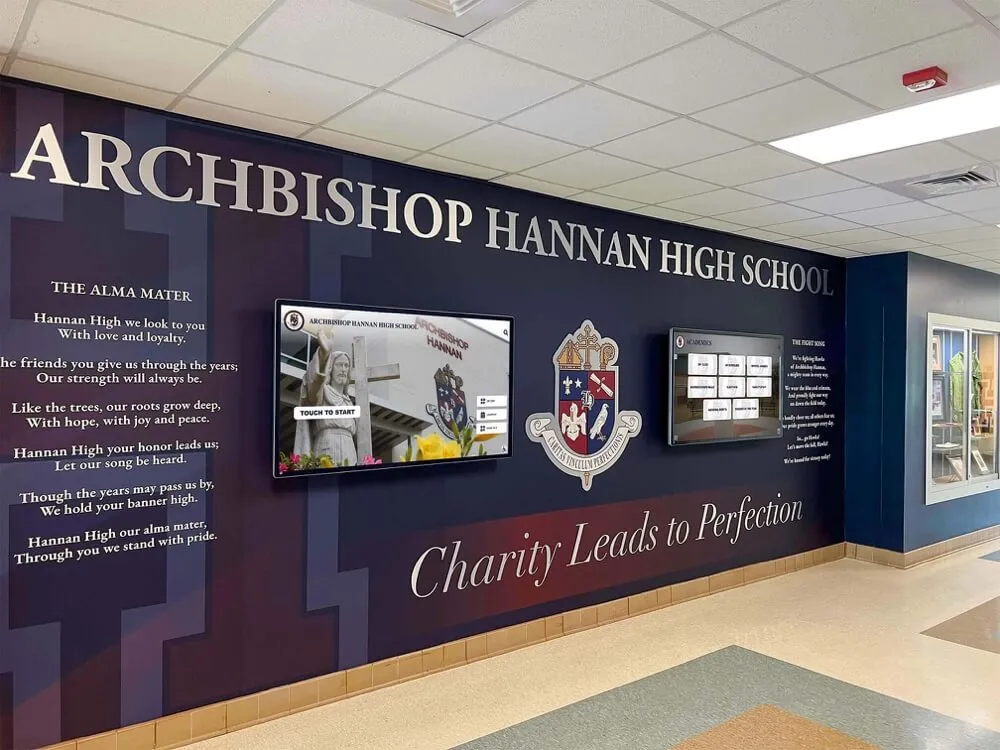
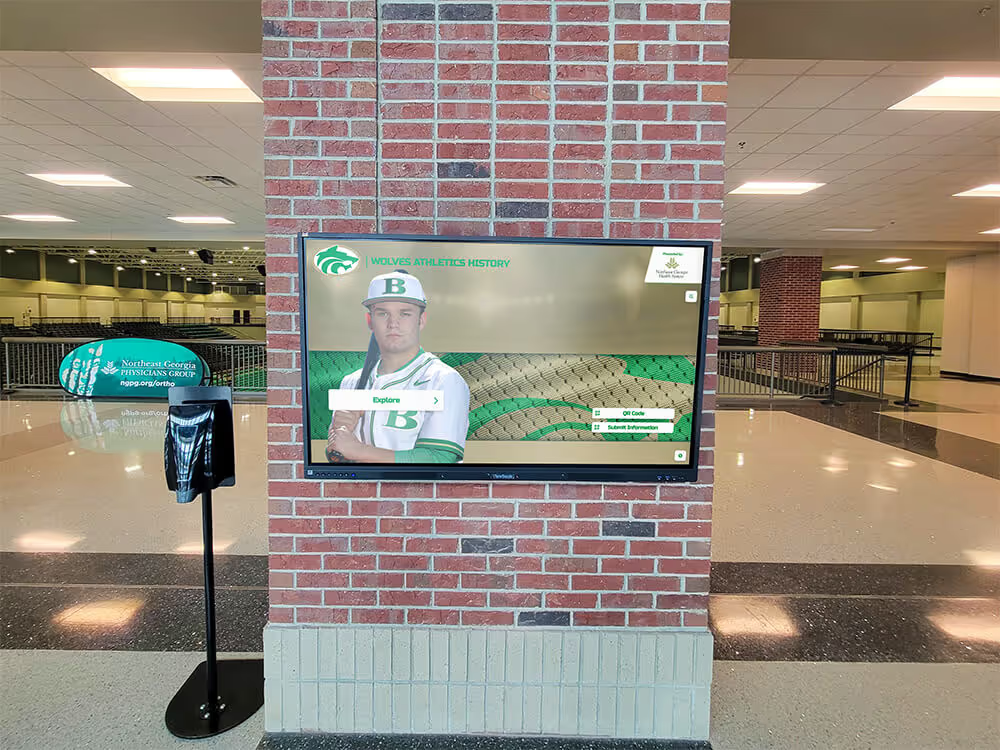
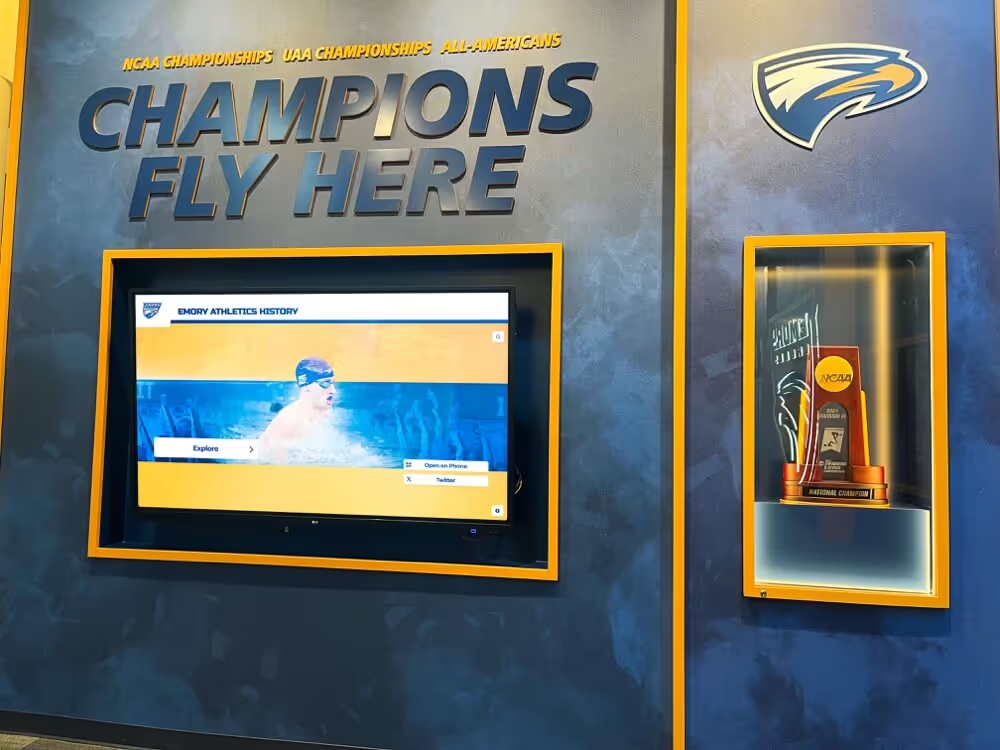
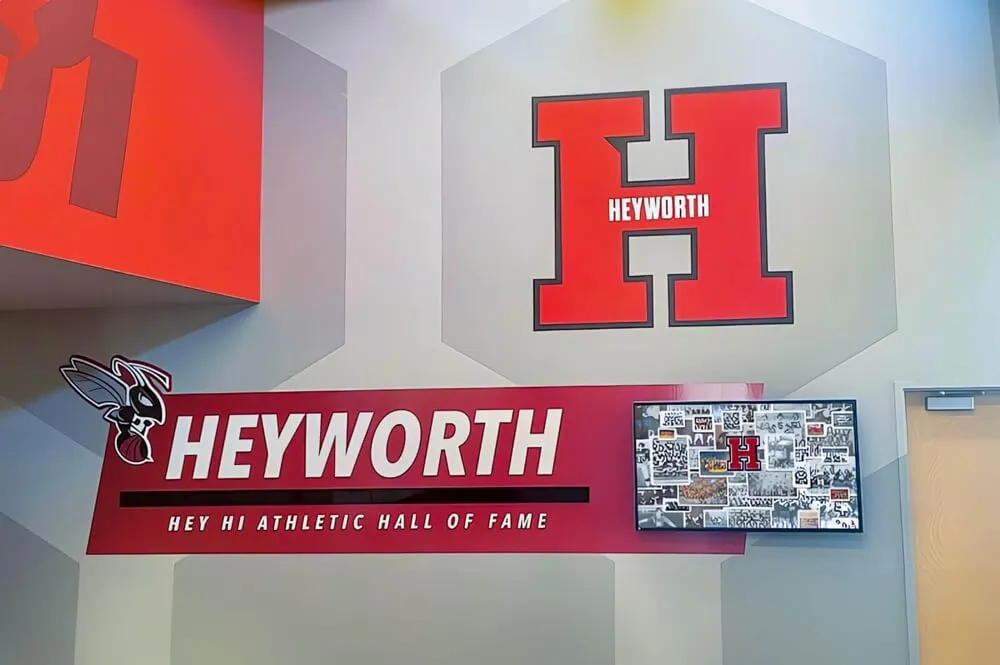
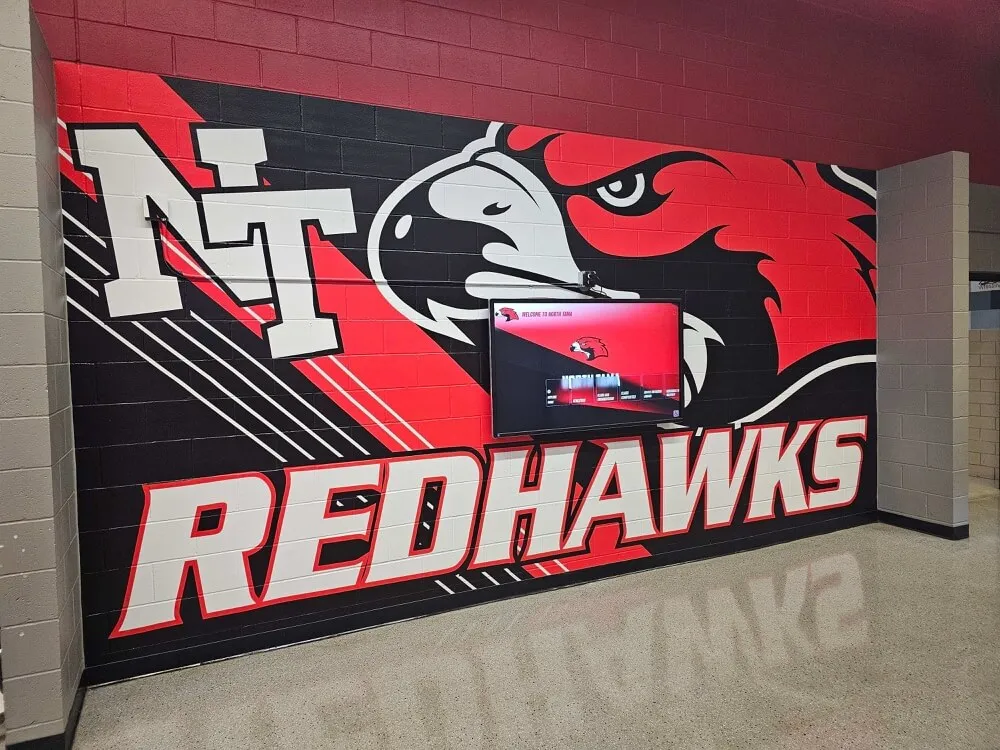
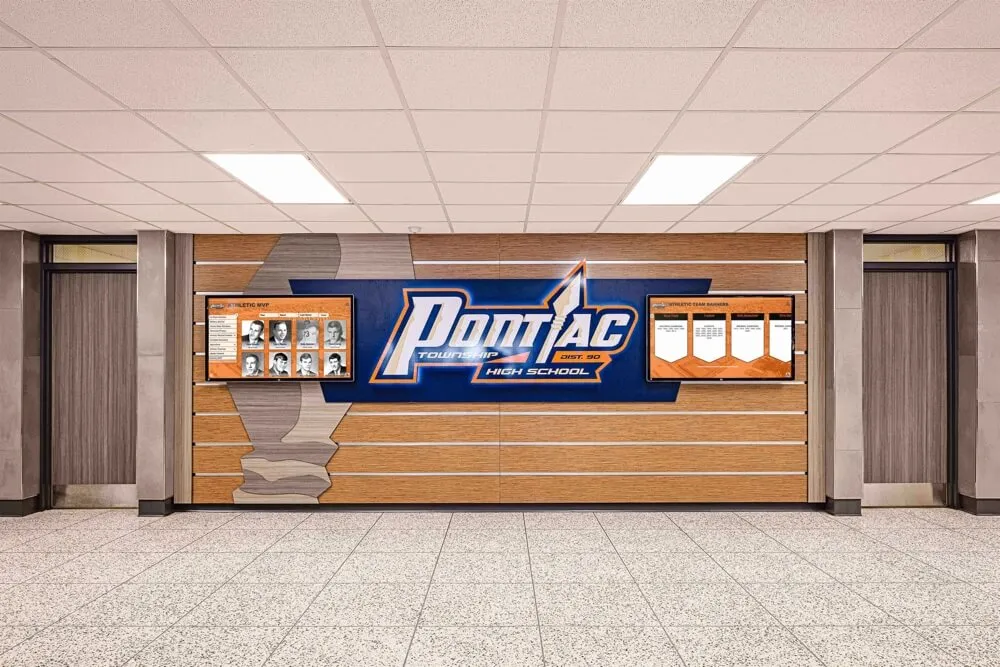
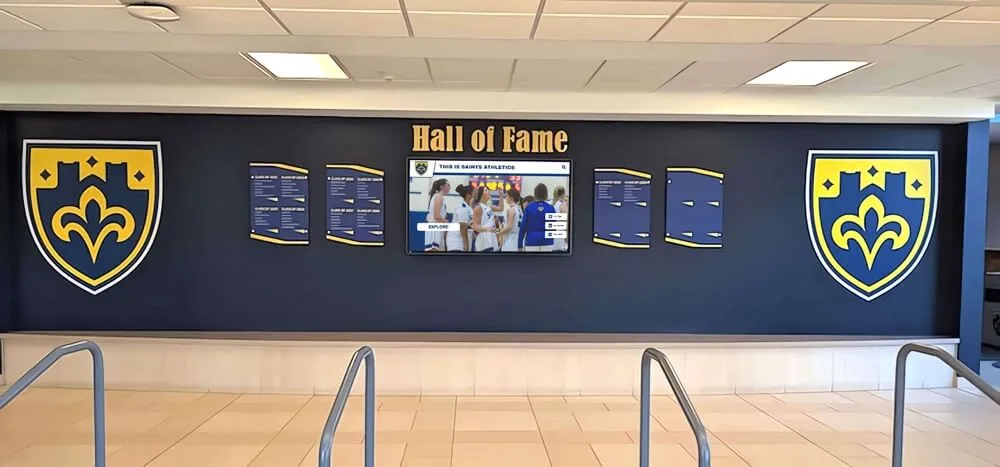
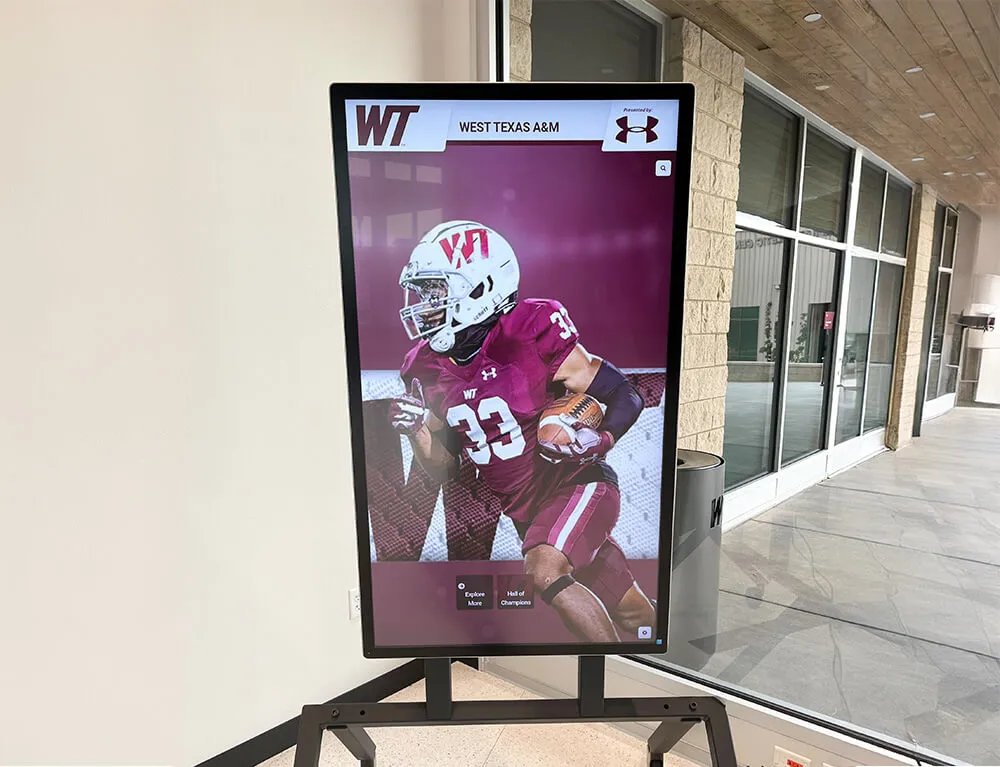
Modern athletic banner displays combine sponsor recognition with community storytelling for lasting impact
Quick Checklist: What Every Sponsor Banner Should Include
Before diving into examples, here is the short answer for readers who need a checklist right now.
Essential elements on any school athletic sponsor banner:
- Company name and logo (primary visual anchor)
- Sponsorship tier or level (Gold, Silver, Bronze, or equivalent)
- Years of partnership (“Proud Partner Since 2018”)
- Sponsor tagline or mission statement (in the sponsor’s own words)
- QR code linking to the sponsor’s website or campaign page
- Contact information or social handles (especially for local businesses)
- School or team co-branding (mascot, colors, season)
- Optional: a brief sentence explaining the sponsor’s community connection
Most school banners include only the first item. The checklist above is the starting point—the sections below explain why each element matters and show what it looks like in practice.
Why Most Sponsor Banner Examples Fall Short
The default school sponsor banner is a vinyl rectangle with a logo and perhaps the words “Thank You” beneath it. There is nothing wrong with this, but it communicates only one thing: a transaction happened. Sponsors see it as routine acknowledgment. Families and students see it as wallpaper.
The problem compounds when a school has ten or twenty sponsors. A wall covered in unrelated logos reads like a parking lot of signage. Visitors cannot quickly identify which sponsors matter most, how long they have been involved, or why they chose to support this particular program.
Good sports team banner ideas for championship recognition show that banners become meaningful when they carry a story. The same principle applies to sponsor recognition—a banner that tells the community who a sponsor is, not just what they sell, transforms a commodity placement into a valued community relationship.
Sponsor Banner Examples by Type
1. Tiered Sponsor Banners
The most common upgrade to a plain logo banner is a tiered display that groups sponsors by contribution level. Tiered sponsor banner examples typically use a naming convention (Platinum, Gold, Silver, Bronze) or a school-themed equivalent (Varsity, JV, Freshman).
What works: Each tier gets a distinct banner size or position. Platinum sponsors receive the largest banner at center-court or above the main entrance. Lower tiers appear on side walls or secondary hallways. The visual hierarchy makes contribution levels legible at a glance.
What to add: Tier name printed prominently on the banner itself (“Varsity Sponsor”) so even a new visitor understands the recognition level without being told.
2. Legacy Sponsor Banners
A local business that has sponsored the wrestling program for fifteen years deserves more than the same banner as a first-year partner. Legacy banners highlight the length of the relationship with language like “Proud Partner Since 2009” or “15 Years Supporting Eagle Athletics.”
This type of sponsor banner example accomplishes two things: it rewards loyalty visibly and signals to prospective sponsors that a long-term relationship with the school is possible and valued.
Design tip: include a small timeline graphic showing milestone years, or the original partnership year in a contrasting color. The visual storytelling takes thirty seconds to design and lasts as long as the banner hangs.
3. Community-Story Banners
Some sponsors have a genuine connection to the school community—an alum who founded a local business, a family that has had three generations attend the school, or a nonprofit whose mission aligns with the athletic program’s values. Community-story banners lead with that connection.
Example language:
“Martinez Family Auto—Serving [Town Name] Families Since 1987. Proud to Support the Wildcats.”
This format pairs naturally with a small photo of the sponsor’s team, their storefront, or a community event where their support was visible. The result is a banner that families stop and read rather than walk past.
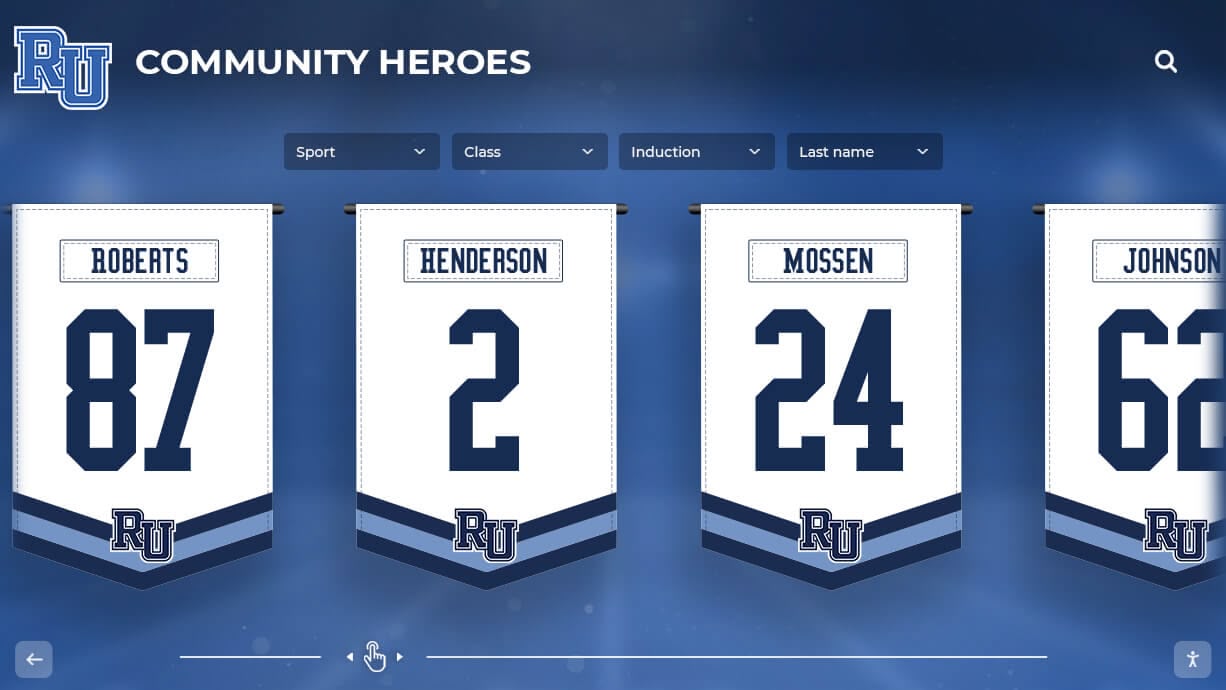
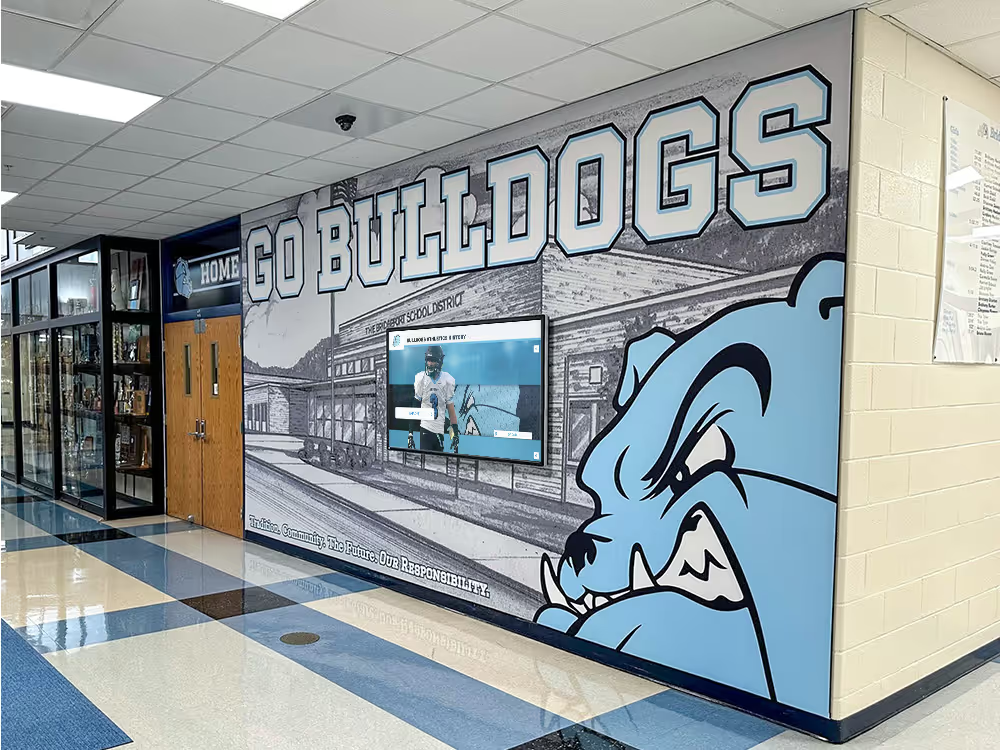
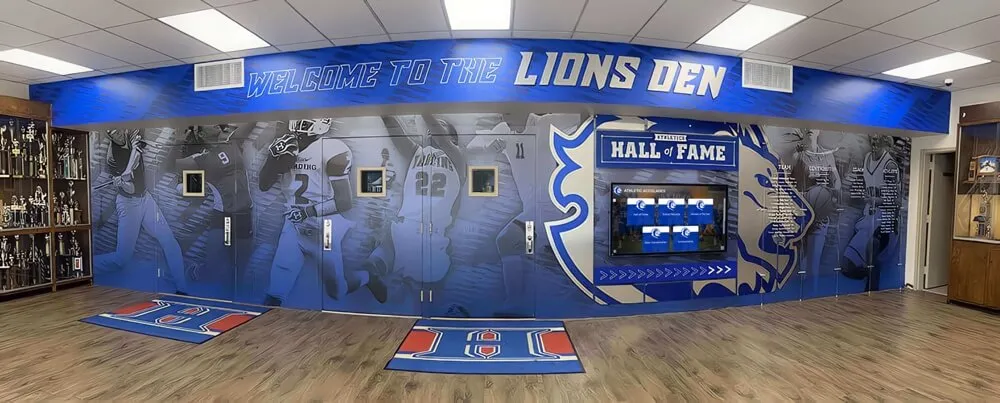
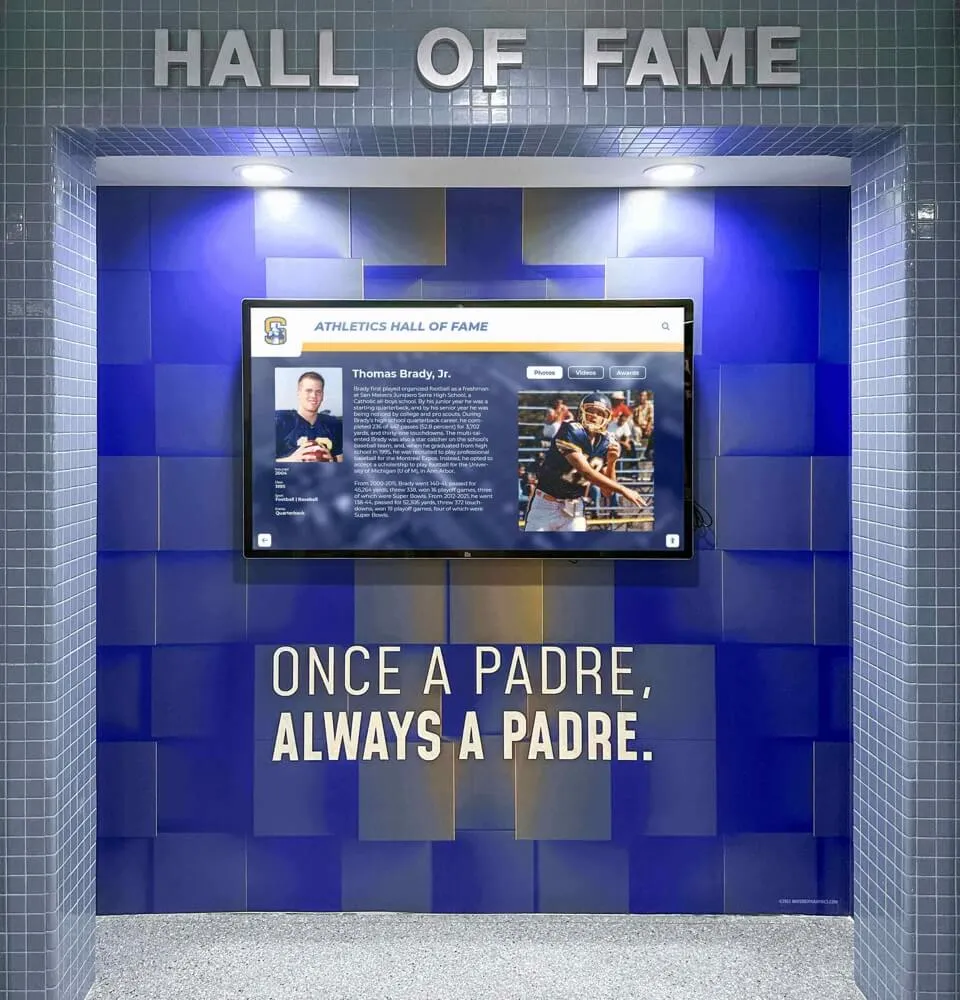
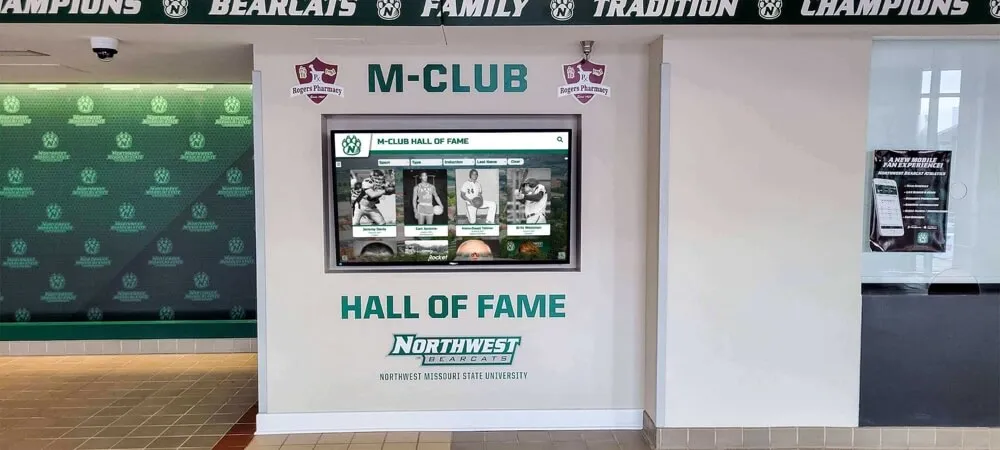
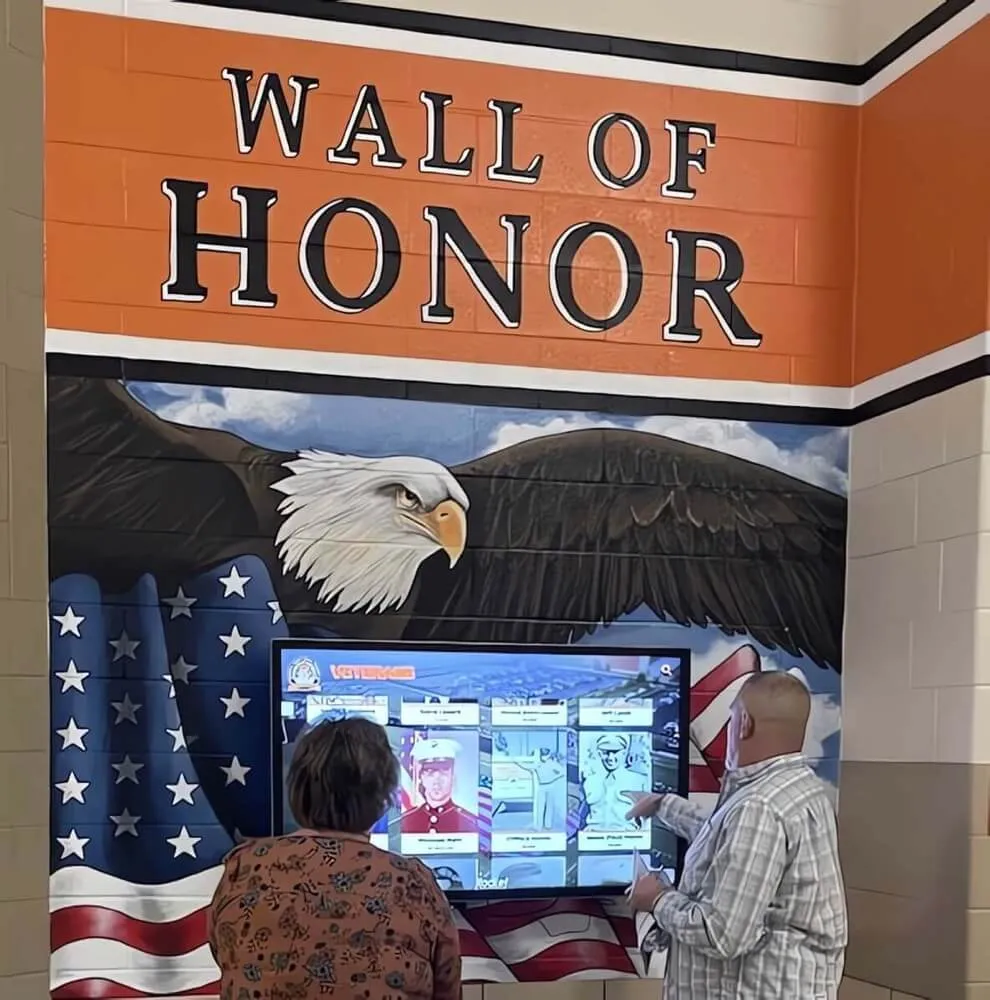
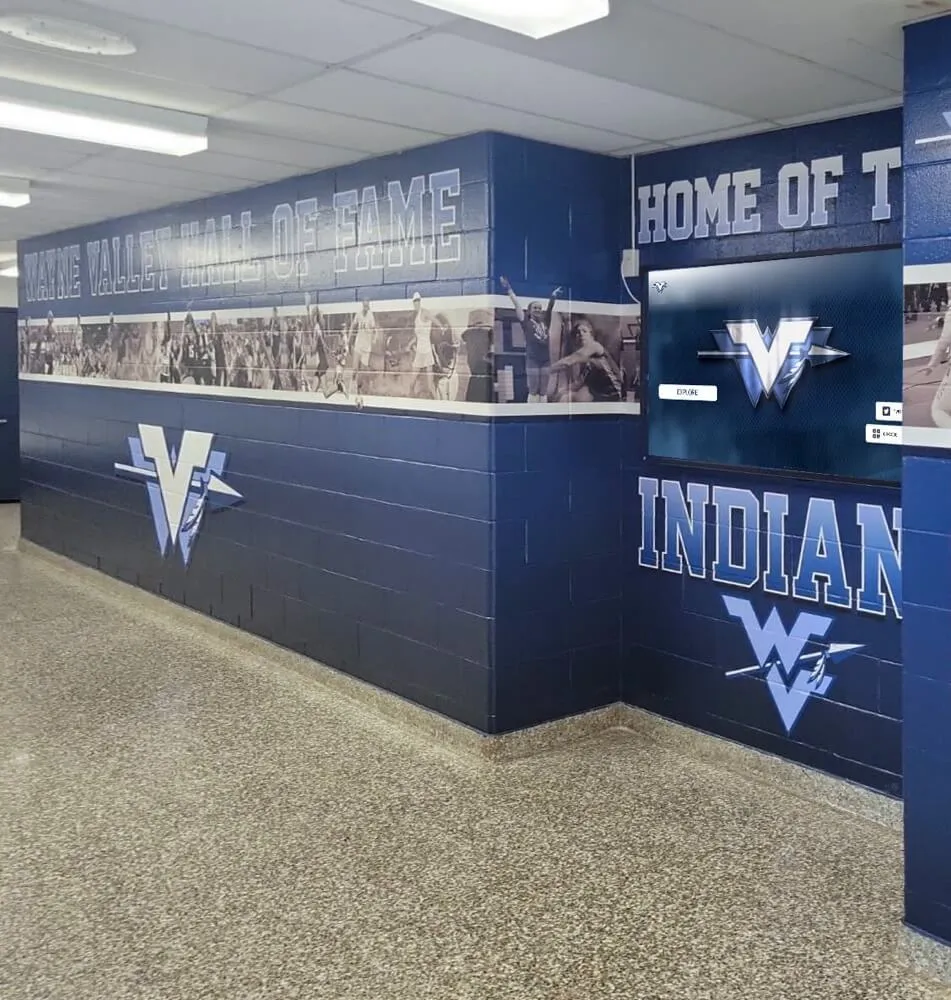
Hanging banners give sponsors prominent hallway placement alongside athletic recognition
4. Event-Specific Sponsor Banners
Tournament programs, playoff runs, and signature events like a Hall of Fame Night create natural opportunities for event-specific sponsor banners that stand apart from permanent hallway recognition.
Event banners typically live on the court or field during the specific event, then move to storage. They should carry the event name, date, and sponsor’s logo, but also a short message connecting the sponsor to that specific moment: “Proud Presenting Sponsor of the 2026 Regional Championship.”
For schools that track athletic records and milestones, aligning sponsor banners with historical moments works especially well. A high school sports banner with design ideas for athletic recognition shows how to blend achievement history with sponsor acknowledgment on a single display.
5. QR-Code Sponsor Banners
A QR code on a sponsor banner turns passive acknowledgment into an active engagement opportunity. Families who scan the code land on the sponsor’s website, a special offer page, or a thank-you video produced by the school—all of which create measurable return for the sponsor.
QR-code banners are increasingly common in higher-education athletics and are now filtering into the high school space. They also give athletic directors concrete data to share with sponsors at renewal time: “Your banner generated 340 scans during home game nights last season.”
6. Digital Sponsor Banners
Static vinyl banners have a fixed capacity—one sponsor, one message, one season. Digital displays eliminate those limits. A single screen can rotate through ten sponsor banners in an evening, display countdown clocks to upcoming events alongside sponsor messages, and swap content between seasons without any printing cost.
Schools that have moved to digital hall of fame and donor wall sponsor recognition displays consistently report higher sponsor satisfaction because digital formats let them offer dynamic, premium placements that static vinyl cannot match.
What to Show Beyond Logos: 8 Elements That Elevate Sponsor Banners
1. Sponsorship Tier or Level
Print the tier clearly on the banner. “Gold Sponsor” or “Presenting Sponsor” tells every parent, athlete, and visitor the value of this partner’s investment. It also creates a visible incentive for sponsors at lower tiers to move up—they can see what premium placement looks like in person.
2. Years of Partnership
“Proud Partner Since [Year]” is one of the highest-impact phrases you can add to a sponsor banner. It signals loyalty, credibility, and community commitment. Sponsors appreciate the recognition; families interpret long tenure as an endorsement of the business.
3. The Sponsor’s Tagline or Core Message
Most businesses have a tagline they have spent money developing. Let it appear on the banner. This respects the sponsor’s brand investment and makes the banner feel like a genuine marketing placement rather than obligatory acknowledgment.
4. A QR Code
As noted above, QR codes create measurable engagement. Place them in the lower corner of the banner with a brief prompt: “Visit us online” or “See our current specials.”
5. Co-Branded School Imagery
A banner that incorporates the school’s mascot, colors, and name alongside the sponsor’s logo feels like a partnership rather than an advertisement. The school’s identity should always be present—this is a school athletic recognition piece, not a billboard.
6. Contact Information
Local businesses benefit enormously from a phone number or website URL on their banner. Families inside the gymnasium are exactly the customer base a local hardware store, restaurant, or orthodontist wants to reach. Make it easy for them to follow through.
7. An Impact Statement
One sentence connecting the sponsor’s support to a specific program outcome carries more weight than any logo: “Your support funded new equipment for 180 student-athletes this season.” Impact statements close the loop between financial contribution and community benefit—something every sponsor wants to see.
8. Social Media Handles
If the sponsor is active on social media, their handle (@YourLocalBusiness) on the banner gives families a low-friction way to connect. Schools can amplify this by tagging sponsors in postgame social posts: “Thanks to @YourLocalBusiness, our team had a great home opener.”
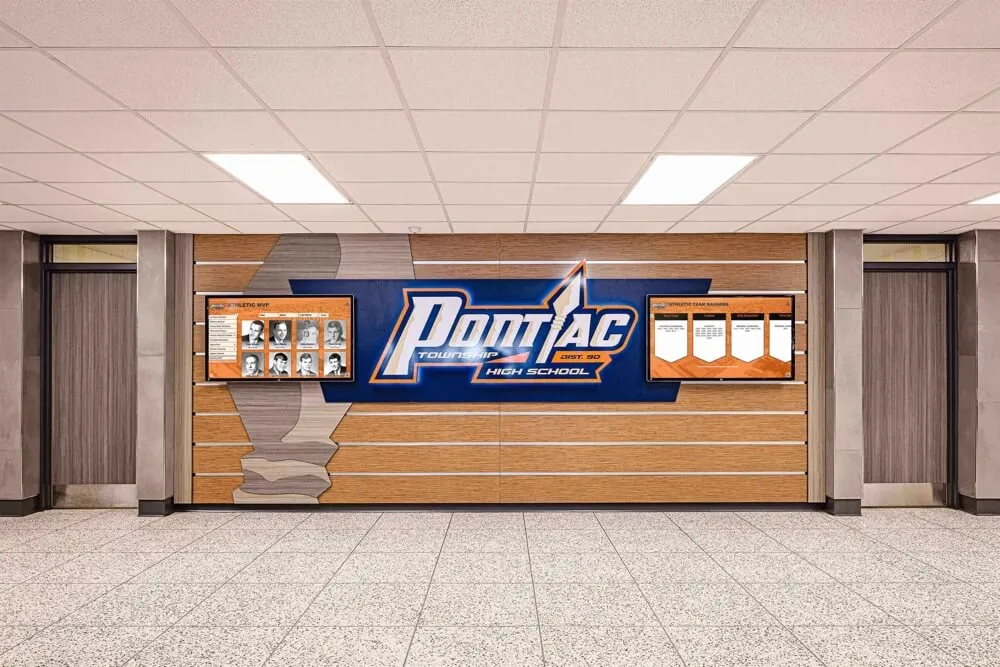
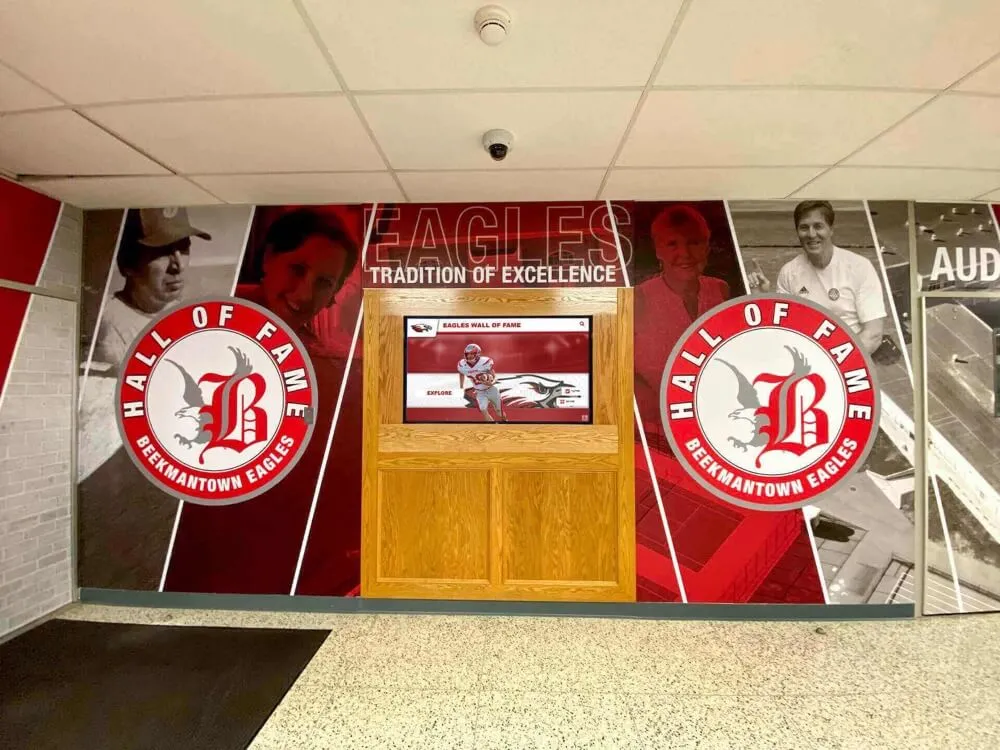
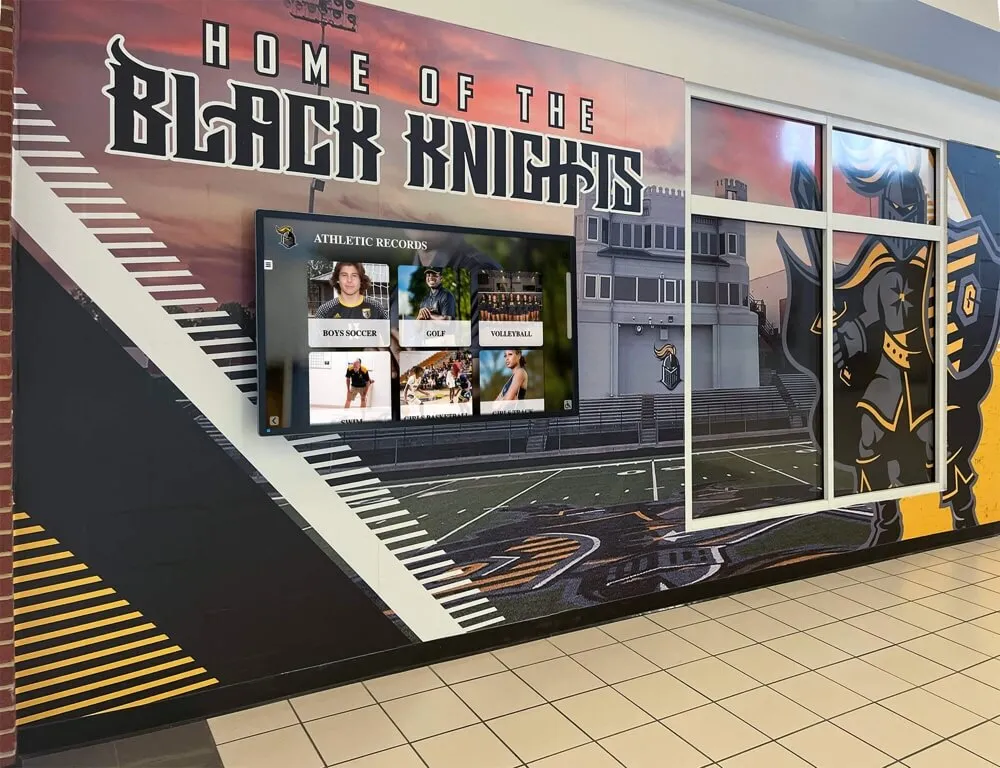
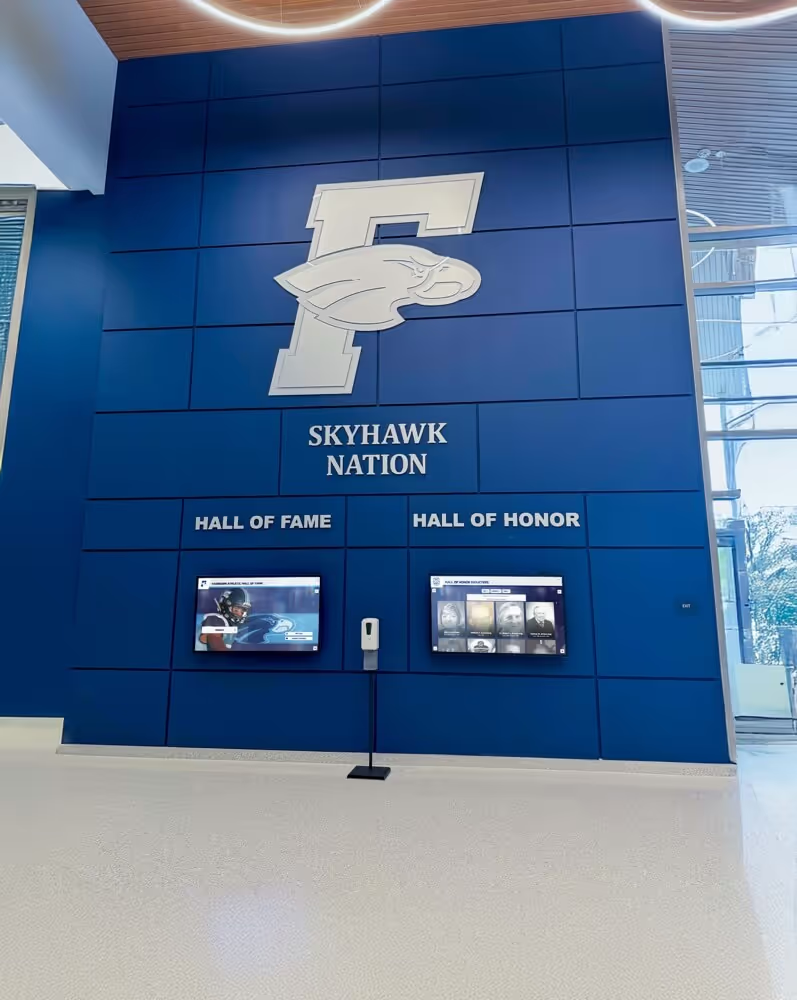
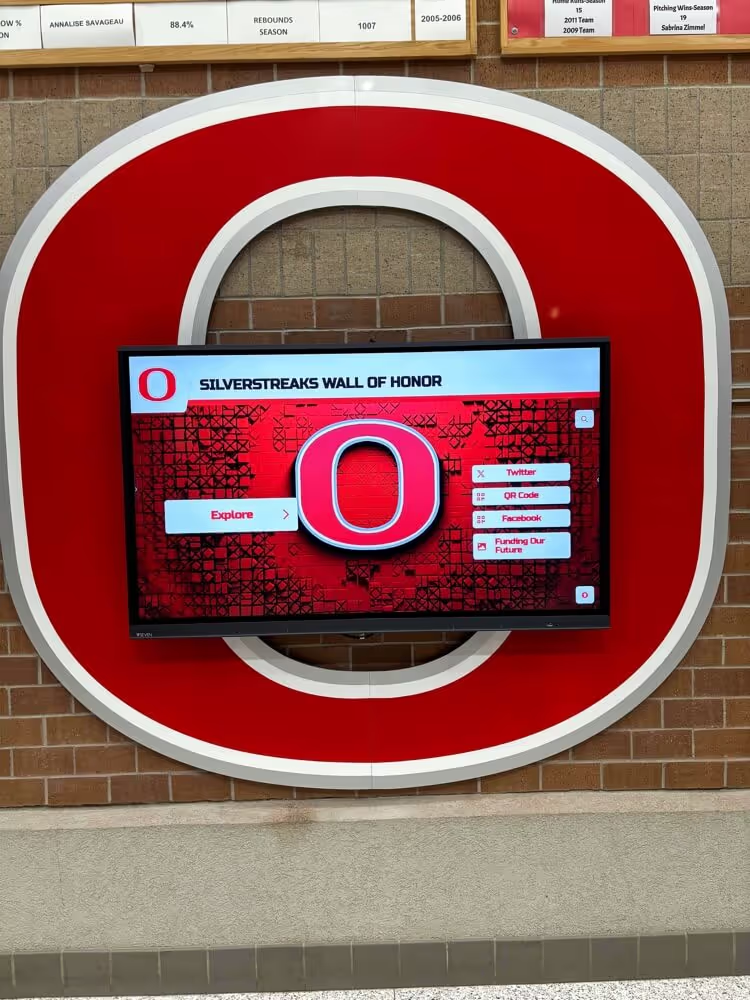
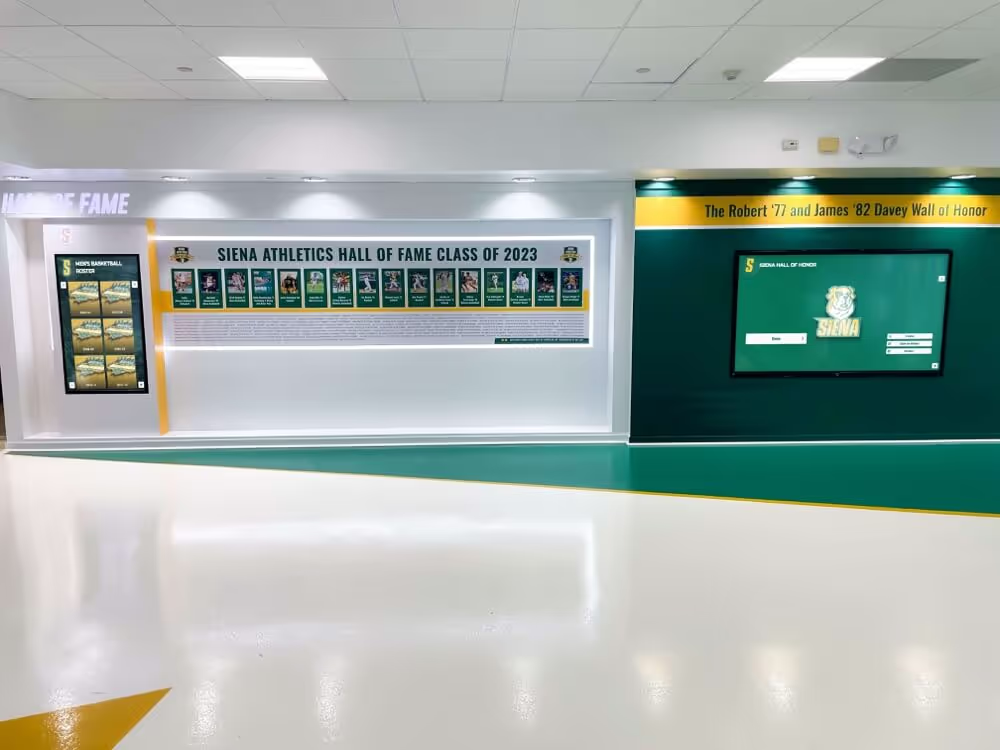
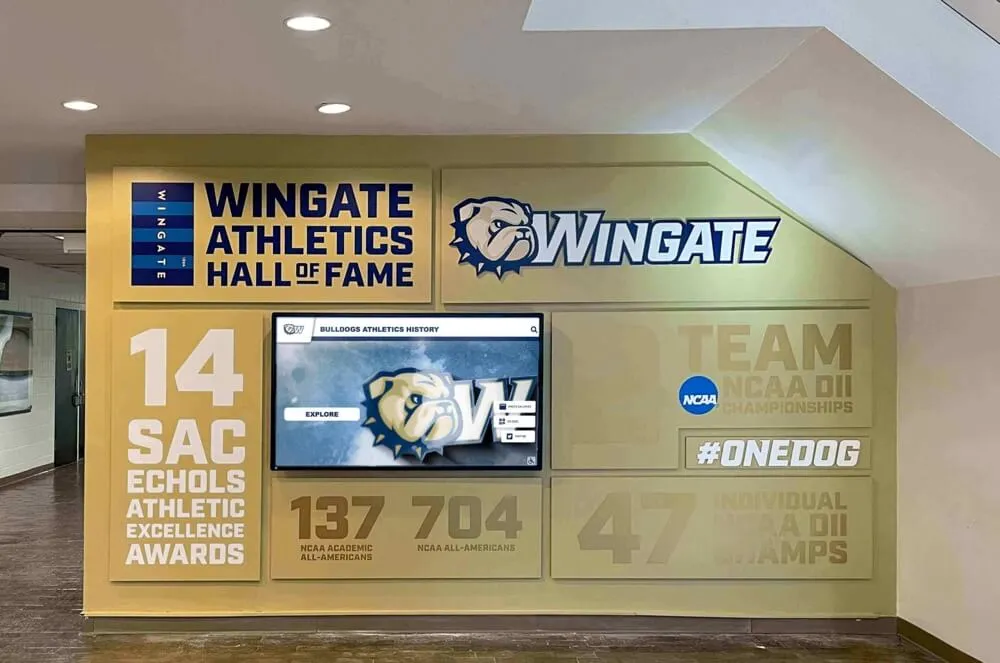
Athletic hallways can integrate sponsor logo boards alongside athlete recognition for a cohesive display environment
Sponsor Banner Ideas for Different Athletic Venues
Gymnasium Banners
The gymnasium is prime sponsor banner real estate. Banners hang above the bleachers or along the upper walls where they are visible from anywhere in the room. Large format (typically 3×8 feet or 4×10 feet) allows for more content—use the space for a tier label, tagline, and QR code alongside the logo.
Center-court ceiling banners are traditionally reserved for championship banners. Avoid confusing sponsor recognition with athletic achievement recognition by keeping sponsor banners on the perimeter walls and athletic records on dedicated championship displays.
Football Field and Track Banners
Field-level banners face a visibility challenge: they are close to the action but hard to read from the stands. Prioritize bold logos and short text. Supplement field-level vinyl with digital signage on scoreboards or press-box screens where longer messages display well.
Athletic Hallway Displays
Hallways leading to gyms and locker rooms are underutilized sponsor recognition spaces. Schools that line these corridors with framed sponsor panels create a “sponsor walk” that visitors experience before every home event. Paired with athlete records and hall of fame content, this approach turns a utility hallway into a recognition corridor that sponsors value and athletes are proud to walk through daily.
Resources on planning school recognition displays that grow over time offer useful frameworks for designing hallway recognition that accommodates both sponsor and athletic content without either competing with the other.
Lobby and Entry Displays
Entry lobbies are where first impressions happen. A well-organized lobby with tiered sponsor recognition—ideally combined with a digital touchscreen featuring athletic records, hall of fame inductees, and team histories—signals to visitors that this is a program that takes recognition seriously.
Sponsors who appear in the lobby get exposure to every visitor: prospective families, opposing teams, officials, community members, and media. For many local sponsors, lobby placement is the most valuable position available.
The Case for Digital Sponsor Banners in School Athletics
Static vinyl does one thing well: it is always on. But it also costs money every time content needs updating, cannot rotate multiple sponsors through the same physical space, and offers no engagement data.
Digital displays solve all three problems. A single screen in the gym entrance can cycle through twelve sponsor banners during a single evening, displaying each for 15 seconds. The school can sell premium time slots (opening ceremony, halftime, post-game) at higher rates than static placement. And the content management system—not the print shop—handles every update.
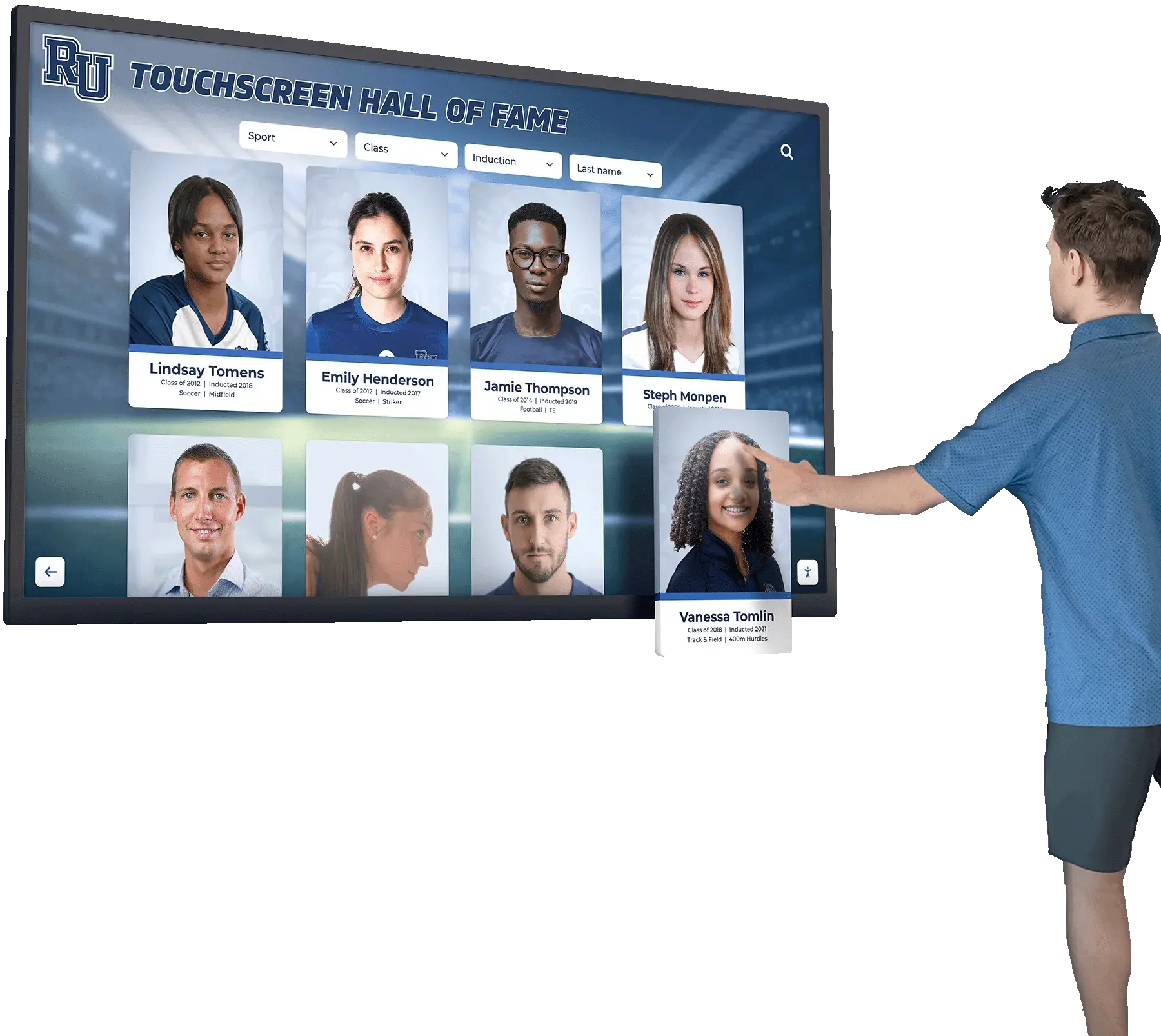
More importantly, digital sponsor recognition can live alongside athletic achievement content. A touchscreen display that shows dual-purpose hall of fame and sponsor recognition lets a visitor browse championship records and all-time leaders in one moment, then see a rotating sponsor message the next. This context makes sponsor recognition feel earned rather than commercial—sponsors appear in the same space as the school’s proudest achievements.
For schools exploring digital donor and sponsor walls together, the complete guide to donor walls and recognition displays for schools and nonprofits explains how to structure tiered recognition across both sponsor and donor audiences in a unified display environment.
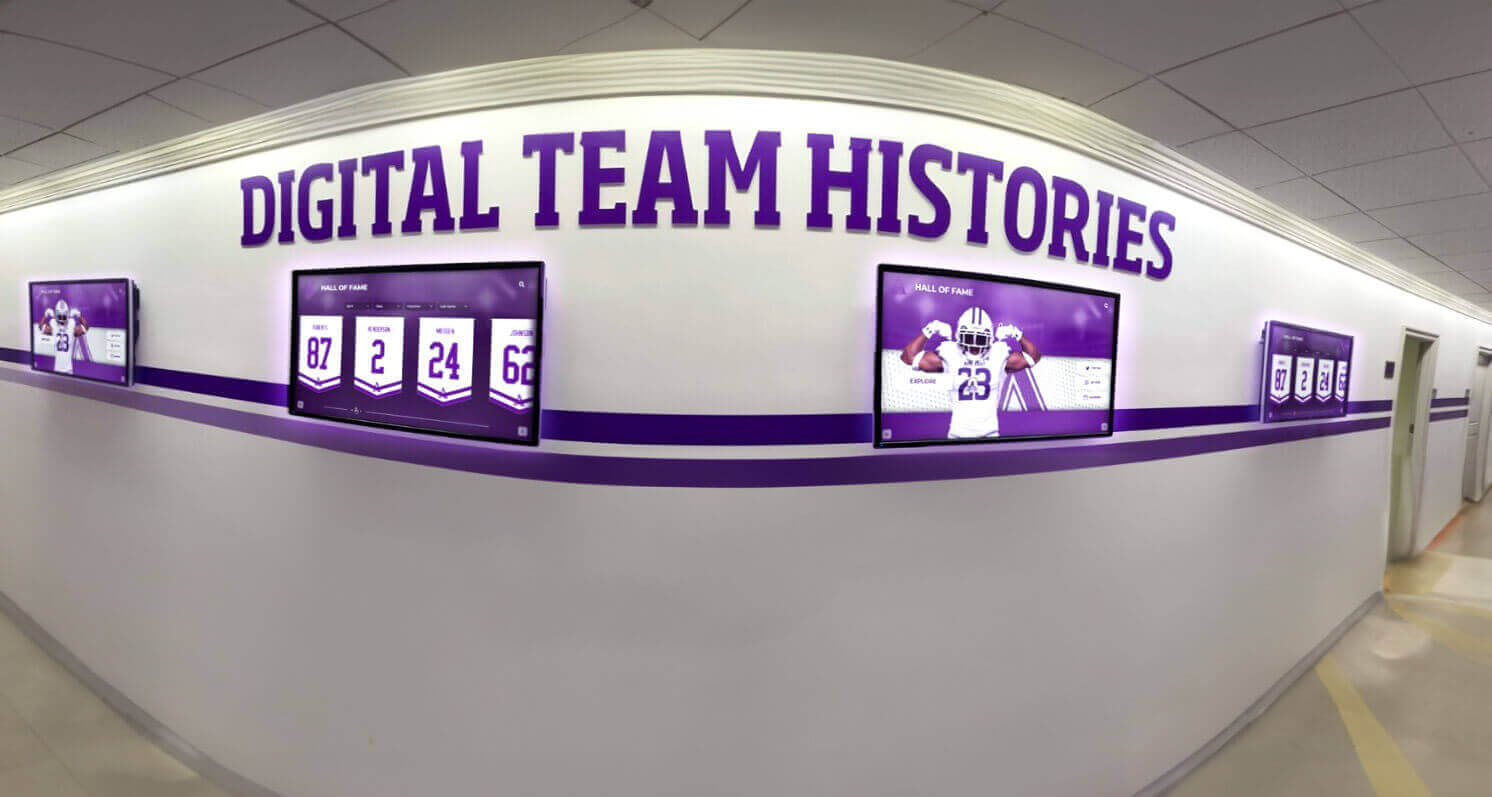
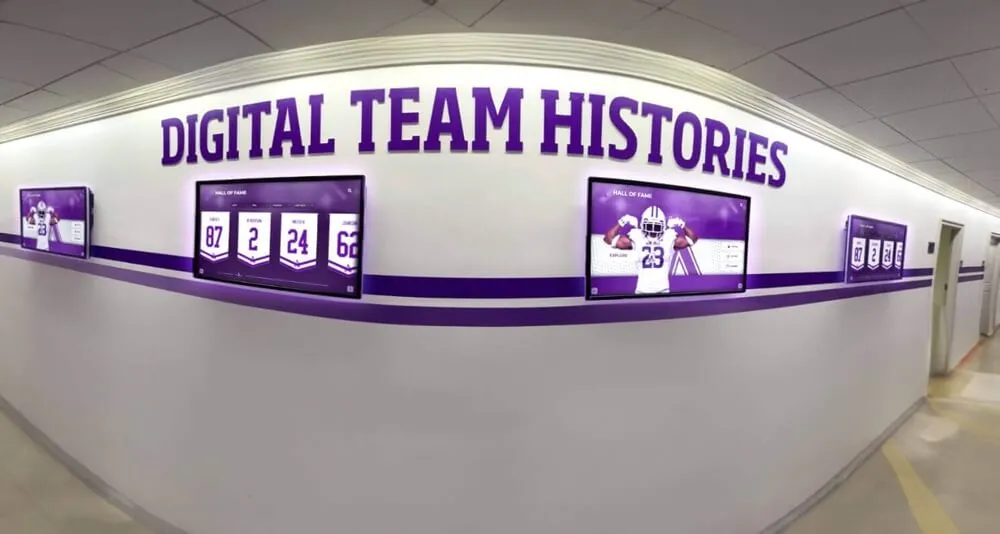
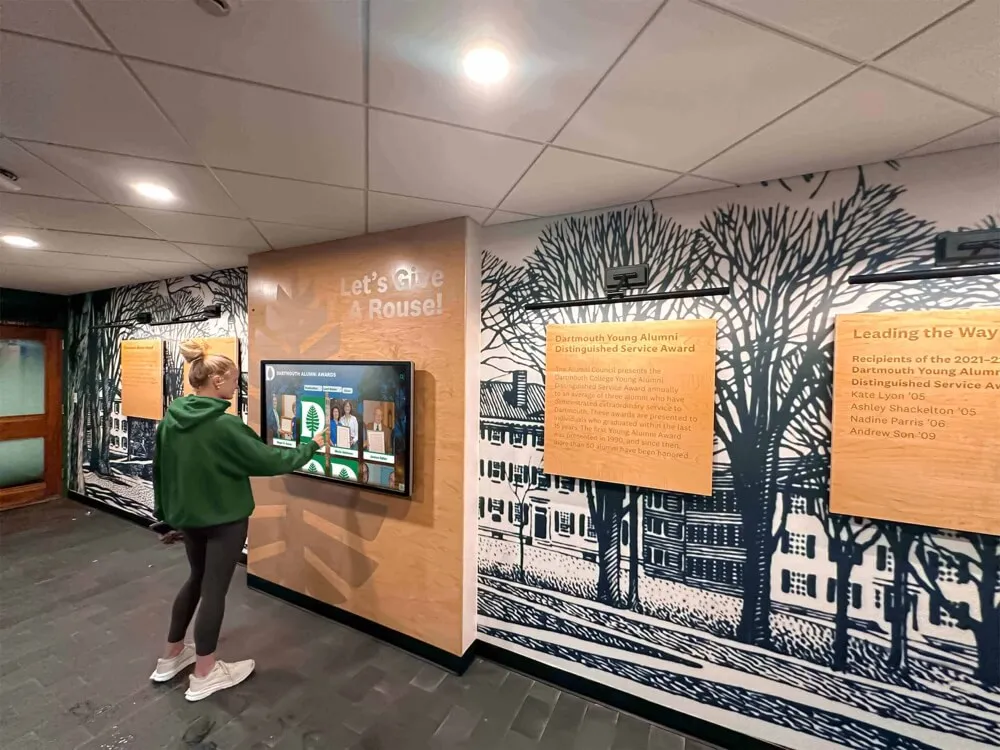
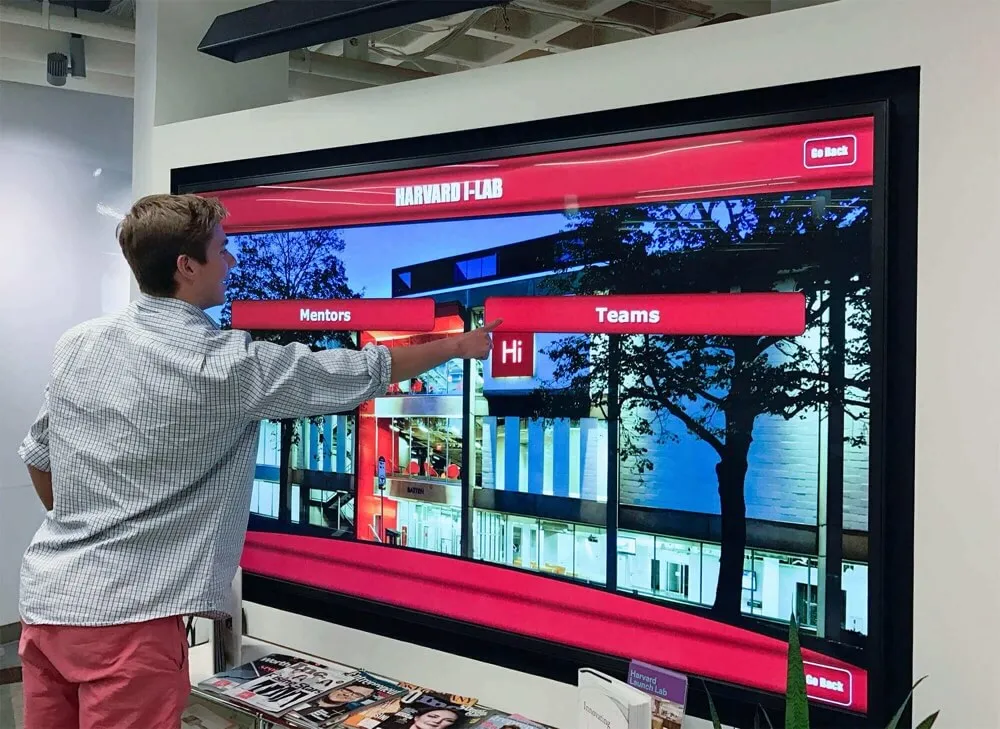
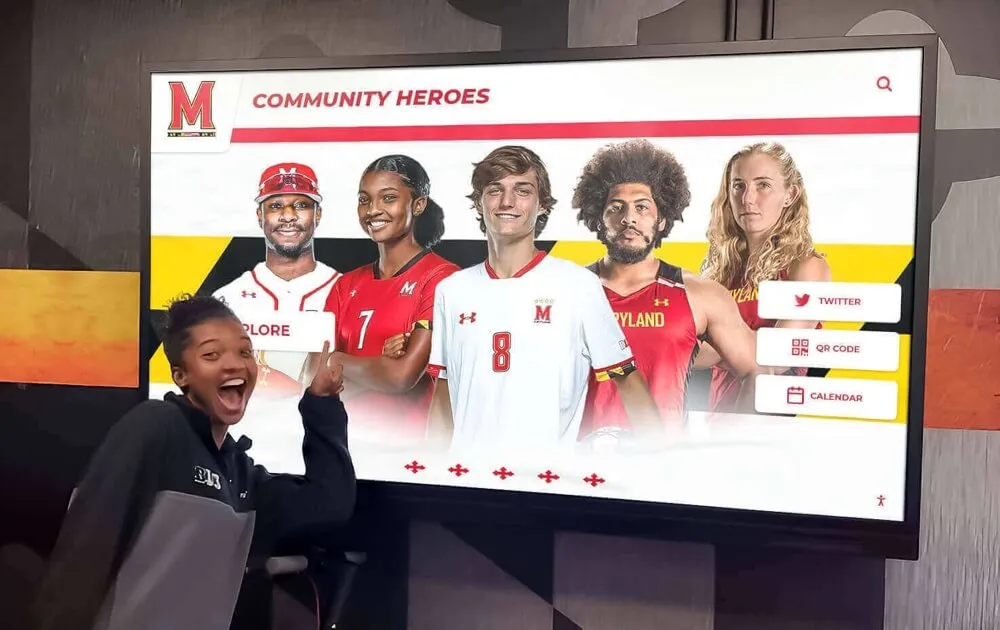
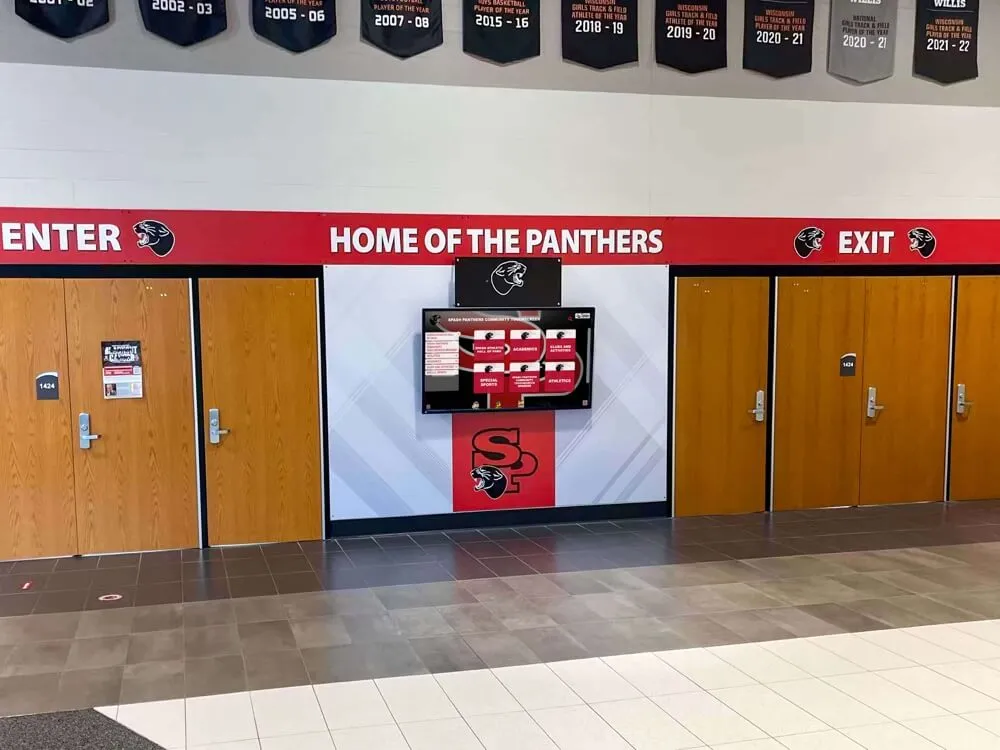
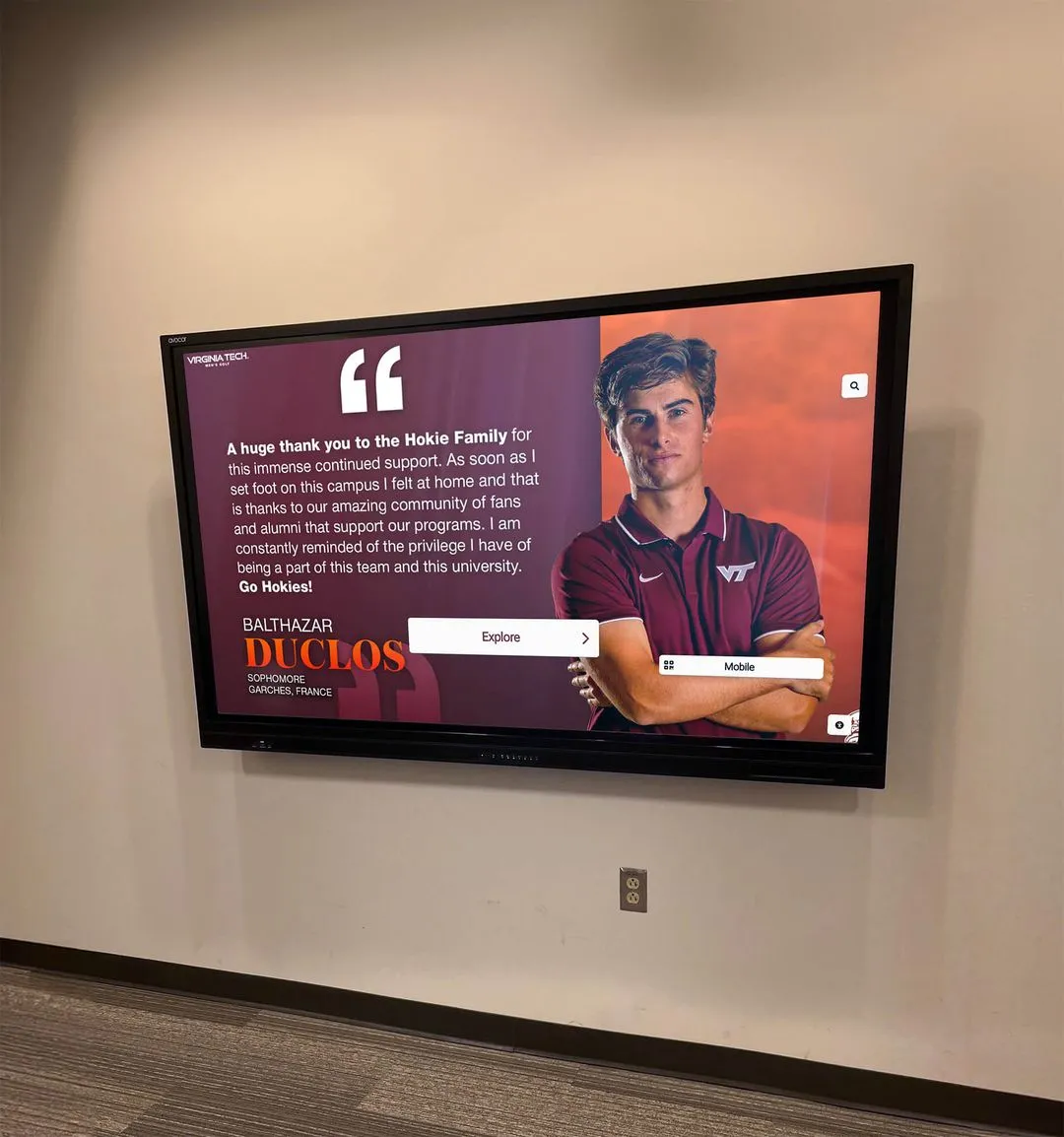
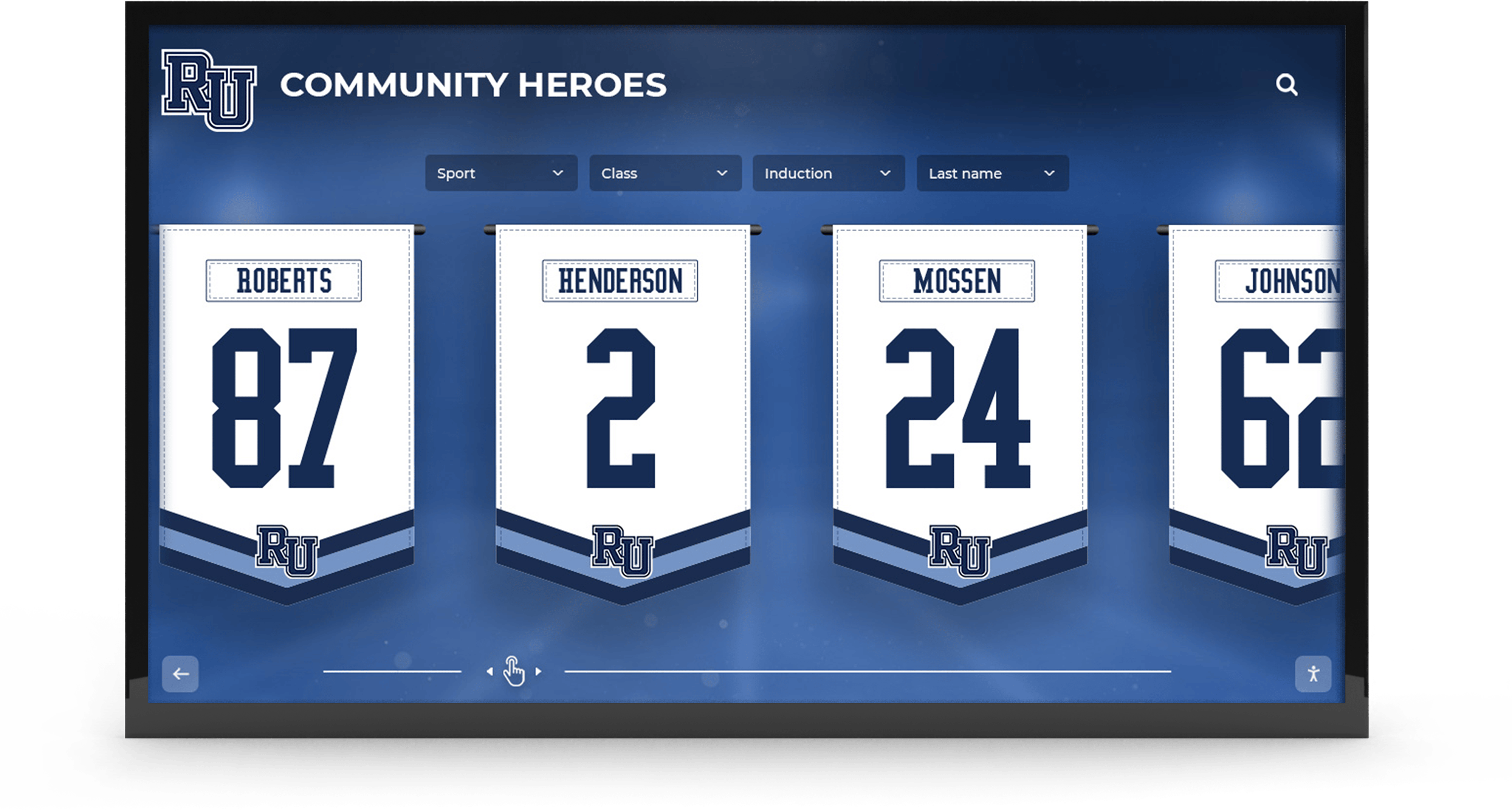
Digital hallway screens can rotate sponsor recognition, team histories, and athletic records throughout the school day
How Schools Are Combining Sponsor Recognition with Athletic History
The most sophisticated athletic recognition programs no longer treat sponsor banners as separate from their hall of fame displays, championship records, or alumni recognition. They integrate all of these into a unified recognition environment.
Consider what this looks like in practice. A family walks into the gymnasium lobby. On the left wall, a touchscreen displays the school’s all-time records by sport. On the right, a framed sponsor recognition panel shows the school’s top five sponsors with tier designations, years of partnership, and QR codes. Overhead, a digital screen cycles through recent game highlights and sponsor messages. In the corner, a traditional trophy case holds hardware from state championships.
Every element reinforces a single narrative: this program takes pride in its people, its history, and its community relationships.
Schools that have moved in this direction—combining digital displays with thoughtfully designed physical recognition—report that sponsors renew at higher rates because they see their recognition as part of something meaningful rather than a transaction.
The school website examples for athletics alumni awards and recognition pages illustrates how this integration extends online, where sponsor acknowledgment can live alongside athletic records accessible to alumni and community members anywhere.
Sponsor Banner Examples: Frequently Asked Questions
What information should be on a sponsor banner for a school athletic program?
At minimum: the sponsor’s logo, sponsorship tier, and the school or team co-brand. For stronger recognition, add the years of partnership, the sponsor’s tagline, a QR code, and a one-sentence impact statement explaining what the sponsorship funded.
How large should school sponsor banners be?
Gymnasium banners typically run 3×8 feet for side-wall placement and up to 4×10 feet for premium positions. Hallway banners are often 2×4 or 2×6 feet. Field banners visible from stands should be at least 4×8 feet with bold, high-contrast graphics. Always verify with your print vendor that the viewing distance matches the text size.
How should schools handle multiple sponsors?
Use tiered recognition to create clear visual hierarchy. Group sponsors by contribution level with distinct banner sizes and positions. Limit the number of sponsors per wall section to avoid the logo-wallpaper effect. For schools with more than ten sponsors, digital displays are the most practical solution because they can cycle content rather than requiring physical space for every partner simultaneously.
Can sponsor banners count toward donor recognition?
Yes, in many cases a business sponsor is also a donor to the school’s athletic foundation or booster club. Where sponsorship and donation overlap, some schools use unified recognition displays that acknowledge both the commercial partnership and the philanthropic contribution. This approach—covered in depth in guides on digital hall of fame and donor wall displays—is increasingly common in programs that manage athletic fundraising and community partnerships together.
What is the difference between a sponsor banner and a donor wall?
Sponsor banners typically recognize businesses that pay for advertising or partnership benefits (logo placement, mentions, event access). Donor walls recognize individuals or organizations that give without expectation of commercial return. In school athletics, the distinction can blur when local businesses give both a cash sponsorship and a charitable gift. Digital displays handle this gracefully by allowing different recognition modules for each relationship type.
Connecting Sponsor Recognition to Long-Term Athletic Legacy
Sponsor banners are most powerful when they exist within a larger recognition ecosystem. An athletics program that carefully documents its national signing day commitments and student-athlete achievements alongside sponsor recognition signals that the program cares about every dimension of athletic success—not just on-field performance.
Similarly, programs that track athletic scholarships and recognition beyond graduation give sponsors a compelling narrative: your investment is not just for game-day visibility, it is part of a recognition culture that follows student-athletes through high school and into their futures.
This broader context—school pride, student achievement, community connection—is what separates a meaningful sponsorship from a transaction, and it should be reflected in every banner you hang.
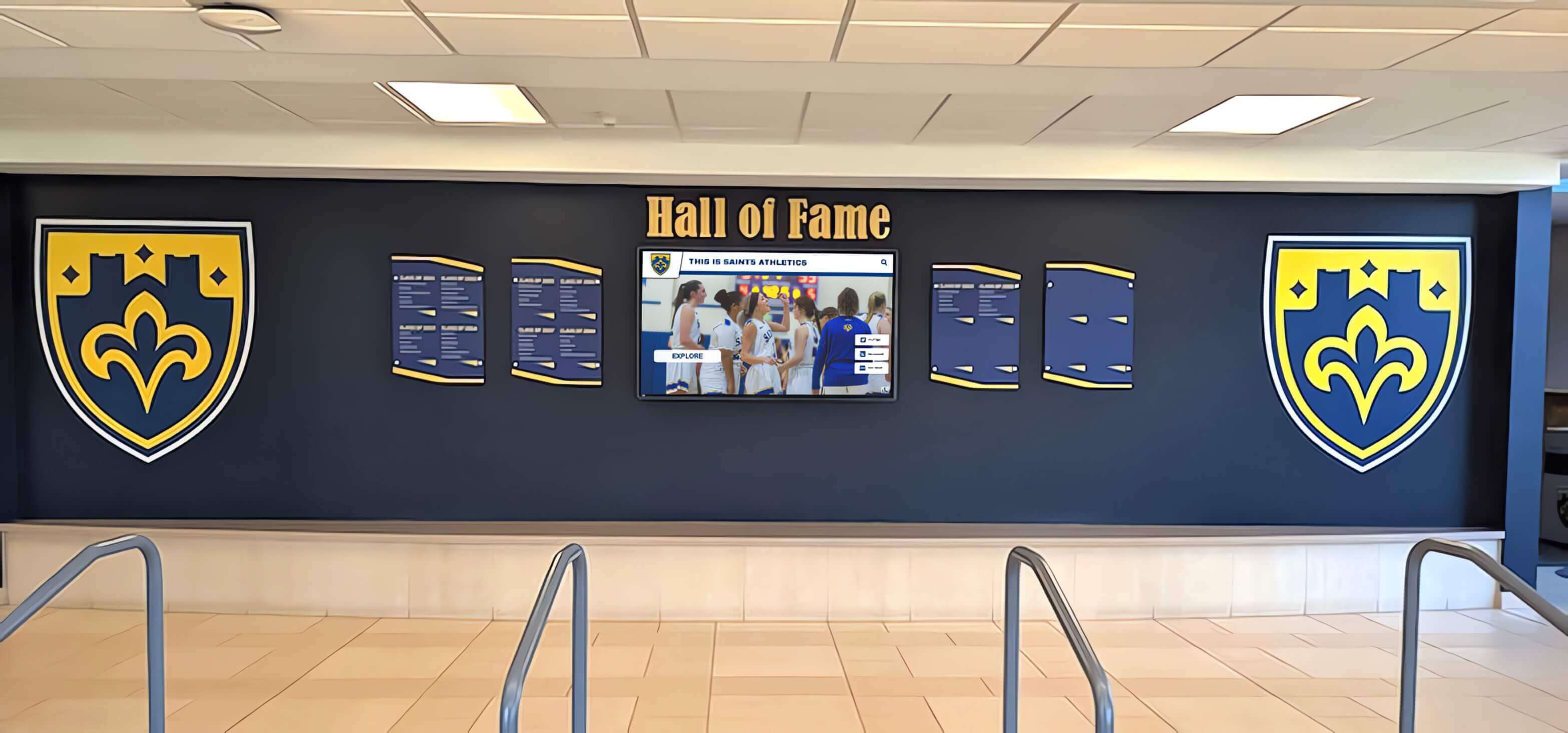
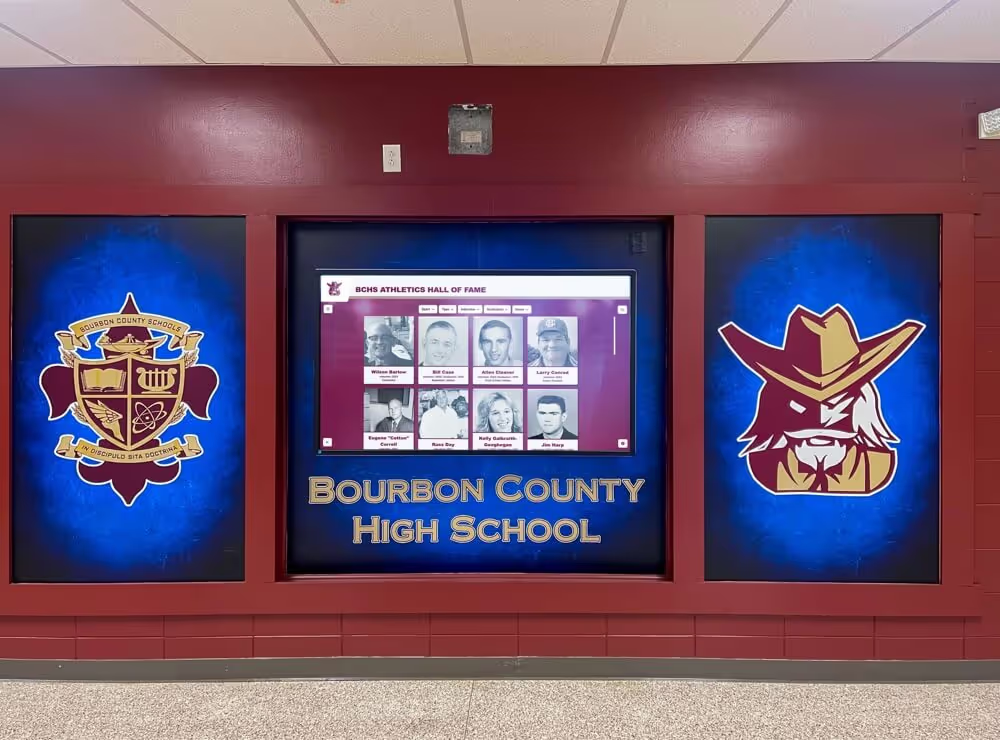
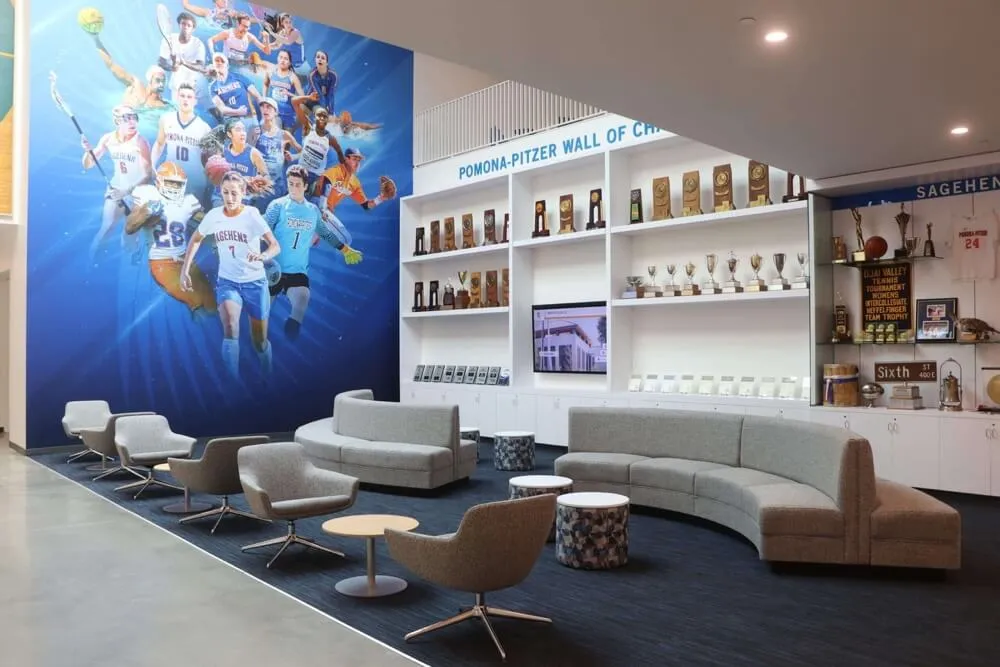
Lobby recognition environments that pair digital screens with physical recognition panels give sponsors premium visibility within a meaningful context
How Rocket Alumni Solutions Approaches Sponsor Recognition
Rocket Alumni Solutions builds interactive touchscreen walls of fame, digital trophy cases, and recognition displays specifically for schools and organizations. Their platform is designed to accommodate sponsor recognition alongside athletic records, hall of fame inductees, team histories, and donor acknowledgment in a single unified display environment.
For athletic directors who want to offer sponsors more than a vinyl banner—rotating digital placements, integrated recognition within a hall of fame context, and remote content management that makes seasonal updates fast—Rocket’s approach addresses all of those needs in a purpose-built system.
The platform also handles donor recognition in the same environment, which matters for booster clubs that manage both corporate sponsors and individual donors. A single display can tier both audiences appropriately without either competing with the other or requiring separate maintenance.
You can see how this looks in your own facility by requesting a walkthrough.
See What Sponsor Recognition Can Look Like
Get a personalized demo of how Rocket Alumni Solutions integrates sponsor recognition, hall of fame displays, and athletic records in a single touchscreen experience built for school athletics.
Request a DemoPutting It All Together: A Sponsor Banner Upgrade Plan
If your school’s current sponsor banners are logo-only vinyl, here is a practical path to stronger recognition without a complete overhaul.
Step 1 — Audit existing placements. List every sponsor banner currently displayed, its location, size, and what information it shows. Note which sponsors have multi-year relationships and which are first-year partners.
Step 2 — Assign tiers. If your program does not already have formal sponsorship tiers, create three or four levels based on contribution amount. Assign each current sponsor to a tier. This becomes the backbone of your recognition upgrade.
Step 3 — Collect content from sponsors. Send each sponsor a short form asking for their preferred tagline, website URL, social handles, and a sentence about their connection to the school community. Most will respond quickly—they want their banner to look good too.
Step 4 — Redesign with the checklist. Use the eight-element checklist above as your template. Add tier label, years of partnership, tagline, and QR code to each banner design before your next print order.
Step 5 — Explore digital for high-traffic spaces. For your gymnasium and main entrance lobby, price out a digital display that can rotate sponsor content alongside athletic records. Compare the annual print cost of updating vinyl banners to the one-time investment in a managed digital display.
Step 6 — Build a renewal presentation. Once your upgraded banners are in place, photograph them and use those images in your next sponsor renewal conversations. Showing sponsors what their premium recognition looks like in your facility—versus a plain logo banner—makes renewal discussions much easier.
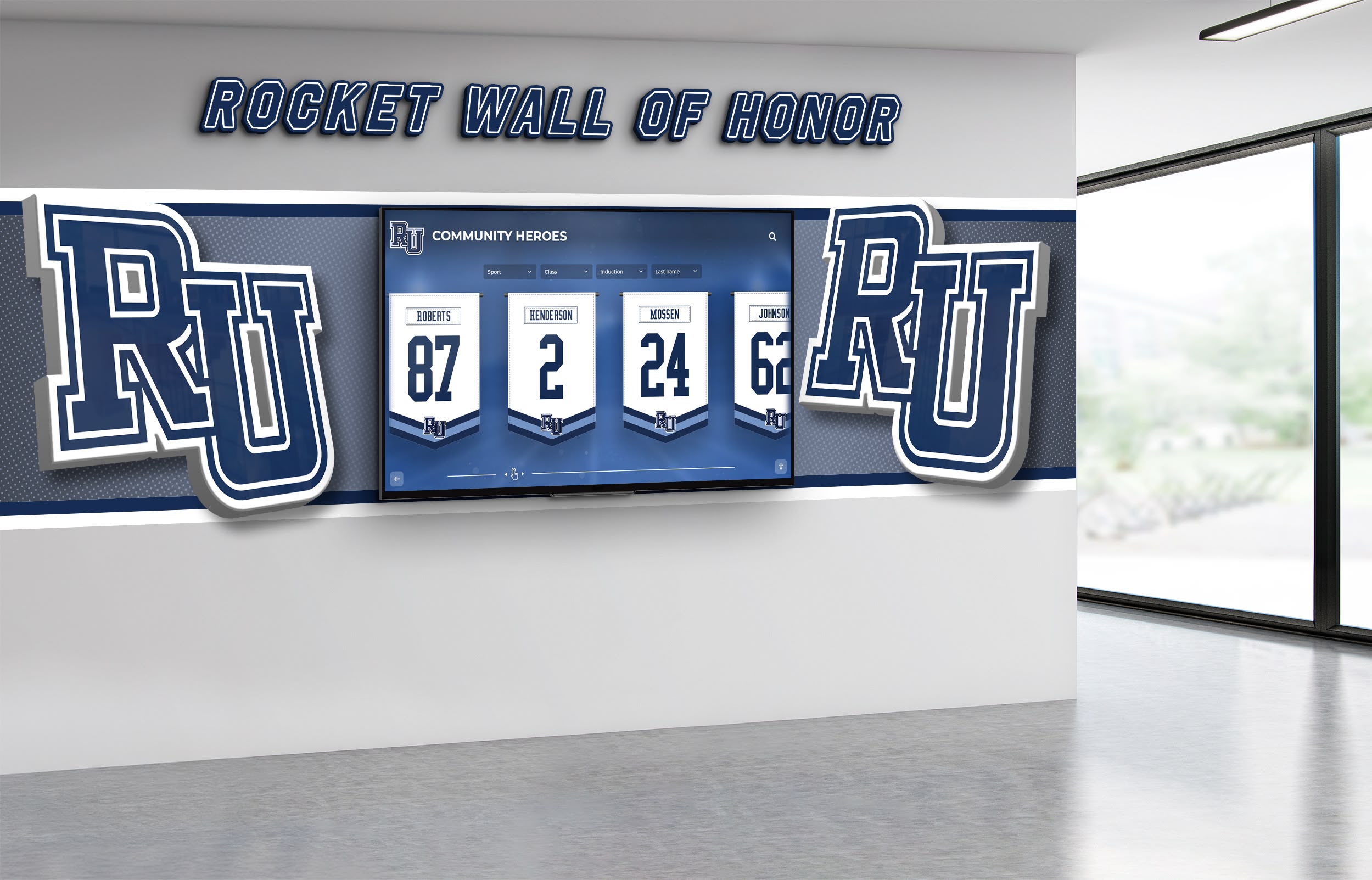
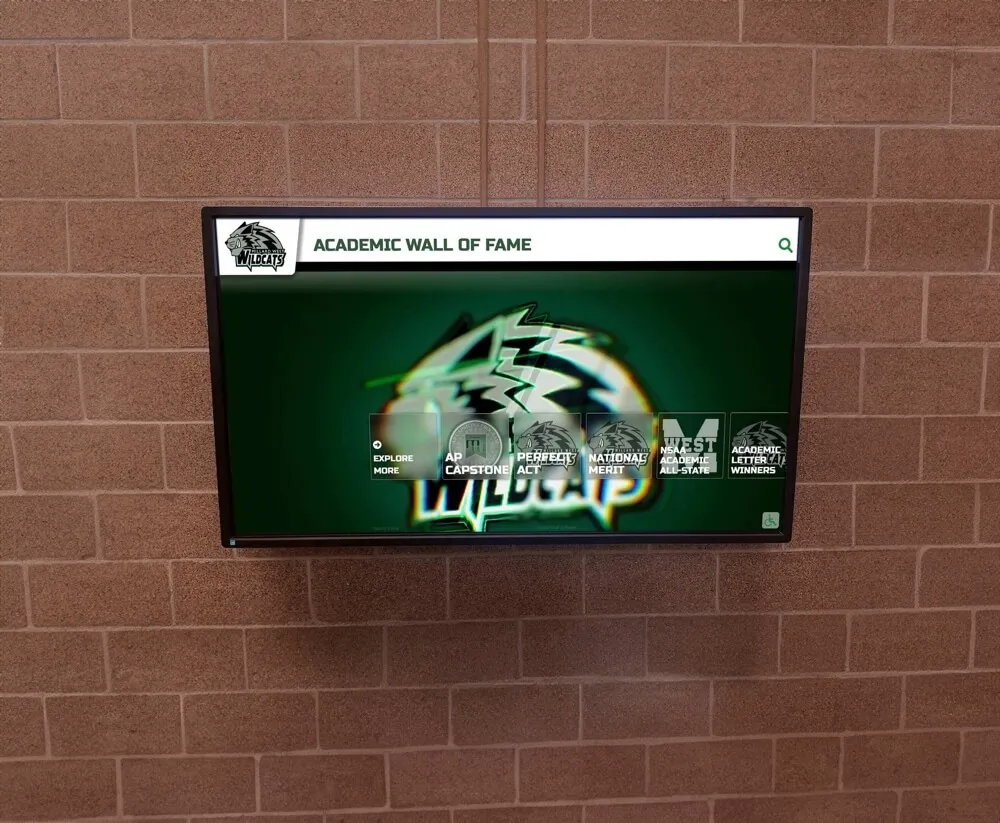
Digital lobby displays give sponsors premium placement within an athletic recognition environment that families and visitors engage with throughout the year
Final Thoughts
Sponsor banner examples from school athletics reveal a wide gap between the minimum (a logo on vinyl) and the possible (a rich recognition experience that tells the sponsor’s story, measures engagement, and lives inside a broader athletic legacy display). Closing that gap does not require a dramatic budget increase—it requires intentional content decisions and, for schools ready to move beyond static vinyl, a shift toward digital displays that can do more with the same wall space.
Sponsors who feel genuinely recognized renew. Sponsors who see their logo lost among thirty others on a gymnasium wall do not. The investment in better sponsor banners pays for itself in partnership renewals, deeper community relationships, and a recognition environment that reflects well on everything the athletic program has built.
Ready to Elevate Your Athletic Sponsor Recognition?
Rocket Alumni Solutions helps schools create recognition environments where sponsors, donors, and athletes are all honored in a unified, professional display. Request a demo to see what's possible for your program.
Schedule a Demo